
Translated material
Non -toxic sticks
Biochemists from Kazan Federal University under the leadership of the senior teacher of the Department of Microbiology, Dokt. Biol. Sciences Ravil Fahrullin took another step in the development of “cell therapy” - treatment by introducing ordinary or stem cells into the human body. They developed a method of applying magnetic tags to the introduced cells, which then allowed to move them to the human body. The work was published in the Langmuir journal of the American Chemical Society [1].
For large -scale use of cell therapy, doctors need to be able to directionly deliver new cells to a affected organ or tissue. Scientists have already learned to deliver nanoparticles to the “destination” and even combine medical, diagnostic and transport functions in them. However, applying a magnetic mark on the cage is even more difficult - the marker should be harmless to its living system and deliver “at address” intact and safety. Kazan biochemists have developed a method for marking cells with super -paramagnetic nanoparticles of iron oxide.
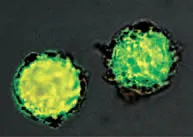
“Previously, work was published, during which potentially toxic magnetic nanoparticles were used to remove cancer cells from the tumor,” said the head of the work of Ra-Vil Fakhrullin, whose words are quoted by the university’s press service [2]. - Of course, in this case, the preservation of cell viability was not required. We tried to make the living “magnetic” cells could, without extracting from the body, to deliver somewhere. We hope that in the future, using a magnetic field, it will be possible to move, for example, stem cells to those organs and tissues where their presence is necessary. This method is very simple, takes 10-20 minutes and does not require expensive processing of nanoparticles. ”
The ultra -paradise superparamagnetic iron oxide is used as a contrasting agent in an MRI and is considered a promising agent for marking cells, but in itself is toxic, and its nanoparticles are unstable in water. In order to neutralize these deficiencies in the magnetic mark, the authors of the work “packed” nanoparticles in the polymer - (Poly) Alllamin hydrochloride. It is non-toxic for cells, stabilizes the nano-part in water and creates a positive charge on its surface. Experiments on the model cell culture HELA (these “immortal” cells are used to study cancer diseases) showed that magnetic nanoparticles are placed on cell membranes without entering the cytoplasm, and are harmless to the carrier cell.
“This is fundamentally a different approach in solving standard problems. I covered the cells with biomedic magnetic nanoparticles and then grown them in the presence of constant magnets. Ordered clusters of living cells were formed that grew directly in the places where the magnets were located, and the cells continued to share, despite the fact that they were modified by nanoparticles, ”says Maria Dzamukova, the first author of the article, second-year student of the biological and domestic faculty.
The editors of the magazine highly appreciated the work: it was included in the list of “hot articles” of the press service of the American Chemical Society (The American Chemical Society, ACS) as one of the most interesting and “breakthrough” works [3].
Kazan University has a glorious scientific and educational history, the Kazan Chemical School is especially fame. Now the Volga Federal University is a historically oldest classic university in Russia after Moscow (it was founded in 1804). In different years, a mathematician Nikolai Lobachevsky, chemists Karl Klaus and Mikhail Butlerov, surgeon Alexander Vishnevsky worked in it; The writer Sergei Aksakov, playwright Evgeny Schwartz studied.
Alexandra Borisov
1. Mr dzamukova, AI Zamaleeva, DG ISHMUCHAMETOVA, YU.N. Osin, AP Kiyasov, DK NURGALIEV, On ILINSKAYA, RF FAKHRULIN, LANGMUIR, 2011, 27 (23), PP 1438614393, http://pubs.acs.org/stocken/prespac/pressSpac/ Full/10.1021/La203839V
2. Http://tggpu.ru/podrobnee.php?id=11334
3. Http://portal.acs.org , press package of December 21, 2011