
Translated material
Books of my childhood
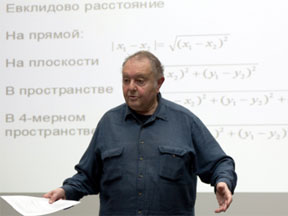
Another interview from the cycle "Book. Knowledge" about the favorite books of childhood and problems of popularizing science - with a mathematician, linguist, doct. physical. Sciences, professor of mechanical-mathematical and philological faculties of Moscow State University, laureate of the Enlightener Award Vladimir Andreevich Uspensky . Talked by Natalia Demina .
What books in childhood had the greatest effect on you? What did you like to read in childhood?
It seems that those books that he read first, in early childhood, have the greatest effect on a person. This is similar to the fact that the main teacher remains the main thing for life. Lydia Fedorovna, a teacher of my zero - and in those days there were such - and the first three classes, I remember with gratitude. Therefore, I will begin with what I read at the age of four to five years. First of all, the wonderful children's magazine "Chizh". After his actual death in 1937, there was nothing like this in our literature. The texts of the Oberiuts and drawings of Bronislav Malakhovsky were printed in it. Both the Soviet government arrested and killed. Malakhovsky’s comics about smart Masha, whose prototype was his daughter Katya, were published from number to room; When later, from the beginning of the 1950s, Katya became my friend, I could see one dwell on how accurately she was depicted as a smart machine. By the way, Malakhovsky illustrated the first edition of the Golden Key that I read.
Relating with full respect to the wonderful text, I must admit that Buratino, Karabas Barabas and other characters forever remained with me not so much as Alexey Tolstoy described them as the same as Malakhovsky painted; Therefore, in the illustrations of other artists, they seem to me unlike themselves.
The “three fat men” of Yuri Olesha could not have been preserved in my memory, if not for the fantastic color illustrations of Dobuzhinsky (and even the network of the same shops, which, alas, have to use). The impact of illustrations and, in general, the whole visual design of the book on the still not strong consciousness is huge. It still seems to me that my choice of profession was influenced by the fat signs of square roots in the 29th edition of Algebra A.P. Kiseleva , published in 1917 and got into me at the end of 1941 in Novosibirsk during the evacuation. But this already applies not to childhood, but to adolescence: the beginning of the Great Patriotic War turned out to be a line between these two periods of my life.
But I will return to early childhood. I recall the micropoem “ how to get sick from honey from the bear,” published by a separate brochure; In the post -war years, I searched for her and could not find her for a long time, soon discovering the reason for her disappearance: the author of the poems Boris Kornilov was arrested and shot, and the artist Konstantin Rotov was in custody (from which, fortunately, he left); Now the brochure can be found on the Internet, making a search on the name of the author and illustrator.
I remember the extreme impression of Marshak's poems about the fireman Kuzma, this was perhaps my first reading. By reading, I wanted to, when I grow up, become a firefighter. (And only then - on duty on the platform of the newly built subway, a slender young man in uniform, highly raising a disk on a stick and pronouncing loudly: “Ready!”). In Konashevich’s drawings for verses about Kuzma - Kalancha, drawn in the text Konashevich, and on the cover Kustodiev; racing horses of fire carts preceded by Verkhov; Firefighters themselves in brilliant copper helmets. There is no Kalanchi in the new version, the helmets decreased and faded, the horses were replaced by cars, and the charm was lost. Yes, and his poems, modernized, ruined Marshak.
No need to modernize children's literature. Firstly, it always gets worse. Secondly, historical memory is lost: it would only be good if modern children learned how firefighters looked in the 1920s and early 1930s. Thank God, the Marshakovskaya “mail”, which I have known by heart from those five years, remained as it was - without jet aircraft. Marshak (“baggage”, “Mr. Twizer”) was then remembered better than Chukovsky. Only in adulthood did I realize that Chukovsky is deeper; Perhaps because he is closer to the Oberiuts.
The next “fire” was Marshakovskaya “The Tale of the Stupid Mouse”. The fairy tale is very unpleasant, scary. Let me remind you the plot. The mouse cannot fall asleep, lulling his mother does not suit him, he asks her to look for a nanny; As such, Mom-smoke invites a duck, toad, horse, chicken and pike; They reject all their mouse. Finally, the mouse invites a cat whose mouse lulling the song likes. Its cat, of course, eats how you can guess from the final stanza: "The mouse-mother came running, / looked at the bed, / looking for a stupid mouse, / and you can’t see the mouse." In my opinion, a fairy tale for small ones with such an end is unacceptable. And the name is wrong, it would be correct: "The fairy tale about the capricious mouse and the stupid mouse." Presumably, the name was given by the author to the edification: be pleased with what the mother does.
The edification may be fair, but the method of conviction, consisting in eating a hero of a fairy tale, is unacceptable for younger children.
It is time, however, go to later, although still childhood. What books had the greatest effect on me at this age? The question of the impact is always difficult and can hardly have a clear answer . According to today's sensations, I answer as follows : fairy tales (Russian folk, Andersen and brothers Grimm , Aksakov's Scarlet Flower, Harris's Tales with a mysterious mother Midouz and her daughters ), “Myths of Ancient Greece” Kuna, “Mowgli” Kipling, “Little Dikari” Seton-Tom. “Legend of Tila Ulenspiegel” de Coster and “Don Quixote” Cervantes; In childhood, I read Don Quixote in an adapted edition, and in full and delightedly in adolescence. And also, perhaps, the “notes of the student” de Amichis (this book has another, somewhat sweet name “Heart”, to which it is sometimes published); In these "notes" there are separate stories about heroic children.
From there, for example, I learned the famous legend of the Dutch boy who saved the country from the flood, plugging a hole in the dam with a finger. But to begin a list of books that had the greatest impact should be from two names: this is Valter Scott's “Aivengo” and “outcasts” of Viktor Hugo. I think that I did not differ from many boys who mentally identified themselves with their beloved hero - the noble knight Wilfred Ivengo (then his name was written with a soft sign). Other works of Scott did not make such an impression on me.
For the first time I met the text of Gyugo on Kozetta, published in the wonderful series of Detgiz’s brochures, Book behind the Book. The fact that the text of the Kozette book is just a meager exposure from the “outcasts” remained hidden for me; Therefore, the end, at which the unfamiliar benefactor took Kozette with him to start a new life, created an entailing feeling of secret and the desire to "look beyond the horizon." The desire came true when I got the volume of the “outcast”. I still remember my feelings that have been who had learned me when I was sitting on a bench in the pre -war Moscow court, I read about how Jean Valzhan stole silver from the bishop who had sheltered him and how the bishop declared the police caught to him with stolen silver that he gave him silver to Jean. After that, he tried to read other Hugo novels, but could not defeat them. The same strong feelings, but with another sign, caused me that episode from the story “without a family” of Hector, there was little, where the cauldron cover was locked so that the owner’s nephew could not cast a soup.
Your second question ("What did you like?") Is more simple. It seems that I remember what books I read with pleasure (of course, I must keep in mind that the words “I remember” uttered by an 81-year-old sclerotic should be treated with suspicion). One of the birthdays, for nine or ten years, they gave me a rather thick book; It was called "Children of Captain Grant"; It seems that this was Jules Verne's first book in my life (the second was the “mysterious island”). I began to read it in bed in the evening, and then put it under the pillow. It was such a special pleasure, almost happiness: waking up, take a book from under the pillow and read it for at least ten minutes to school . This is acute pleasure from morning reading cannot be forgotten ...
Among the childhood’s favorite books are “Hyperboloid engineer Garin” by Alexei Tolstoy, “Treasure Island” of Stevenson and three great books by Mark Twain: “The Adventures of Tom Sawyer ”, “The Adventures of Geklberry Finn” and “Prince and the Beggar”. The story of how Tom Soyer paints a fence should have long been in psychology textbooks. I don’t remember the illustrations for Toy Soyer, but I remember one of the illustrations for the “Geklberry Finn” from the pre -war Detgiz publication from childhood. The illustration was called the “sick Hannah” and portrayed a certain Hannah, about which heklberry was packed that she had a pig. The patient was depicted with cheeks tied with a scarf, the ends of which were tied on the top of the head, forming a semblance of hare ears. It is noteworthy that my friend Natalya Leonidovna Traubberg remembered the same illustration from her childhood. And the phrase " In the Tower of the main keeper of the royal stockings!" From the "Prince and the Beggar" still sounds in my ears. It is necessary to name two more completely lovely books that adorned my childhood - this is the “adventures of Penrod” by Tarkington about the twelve -year -old American boy at the beginning of the 20th century and the “foreman of the Vilbay school” Reed about the English school for the late 19th century.
I remember several books visually, but I do not remember their name. Many books were in pre -revolutionary publications, for example, books of small format in the red bindings of the Golden Library series; The name of the series was written on the rim of the circle, inside the circle the golden girl and the boy read the book. It seems that it was in this series that I read the terrible story about the Chinese boy who met on the street of his beloved teacher, subjected to punishment: he had to wear a planed square with a hole around his neck on his shoulders.
With great enthusiasm I read the Yankees at the court of King Arthur and only then - a presentation of the legends about the knights of the round table. I remember the pre -revolutionary book, which told these legends with beautiful color illustrations on separate gluing. It seems that the first in this book was the legend and an illustration of the appearance of the Sword Escalibur from the lake. I don’t remember the names of the book, but I remember that I read without stopping. After the war, already in a completely adulthood, I searched for a long time, with great difficulty (because I didn’t remember the name then) found it in the central children's library and, to my disappointment, almost despair, it seemed boring to me. Then, it seems, this translation from English was reprinted in Soviet times.
I read and re -read the collection of ancient Japanese legends with Japanese illustrations and the mysterious name “Nihon Mukashi Banashi” on a beautiful red bind. I read a lot of Bussenar, the benefit of the house was a collection of his works (remember, with Gumilyov: “And in“ Around the World ”about everything / told the boys later / his beloved Bussenar” ); Probably, even then I understood that this literature was not the very first grade, but the Bussenar “blue man” was read in one breath. As a first -rate literature, Rabelais was slipped to me, convincing that I should be funny and interesting; I did not experience any of these feelings, but with pleasure I examined the illustrations of Dore to the Dilogy Rabelais.
I remember how I began to read Eugene Xuen, who accidentally fell into my hands, read with exciting interest, but my father dissuaded me from continuing reading. It was not forbidden, but dissuaded. I find this story instructive. I respected my father extremely and unconditionally believed his every word. He said to me: “Now you enjoy reading Agasfer, but if you don’t read it now, and first read it when you grow up, then your pleasure will be incomparably big.” I immediately stopped reading, but when I revealed Agasfer in adulthood, I felt bored after a few pages. So I didn’t read it.
Of course, I read and re -read the “trips of Gulliver” in a retelling for children. Such a retelling is usually limited to the first two travels, to the lilliputs and to the giants - and sometimes even the first, to the Liliputs. Complete Gulliver with enthusiasm read in adolescence. I heard with chagrin from modern students that - with unit exceptions - almost all of them were satisfied with children's publications and that the words “Lapo” and “Guingma” were unfamiliar to them. From Russian -speaking literature I loved very much and gratefully recall “Lonely Sailing” Kataeva. This book was read after the “Children of Captain Grant”, so the mention of Kataev’s text “A master, similar to the Lord Glenarvan,” did not cause me questions when reading.
But I noticed that it painfully systematically telling all this, creating a false impression that I remember everything well. In fact, my memories of the reading in childhood are fragmented and incoherent. Here is one of them. Several times I have been comprehended by inflammation of the lungs, and they made me a rather painful thing - mustard wrapping. These are not mustard, this is when the sheet is smeared with mustard, and a person is wrapped in this sheet. The procedure is quite painful, and my mother, in order to console me, said: “But when you get out, you will receive “ Seton-Tompson-Domino ” .” What is Seton-Tompson-Domino I absolutely did not understand. “Little savages” were later, and I did not even understand that Seton-Thompson was a man. And now they know who Seton Tompsson is?
It seems to me that this is such a writer who wrote about animals, but did not hear anything about his Domino.
Ernest Seton-Tompson is a wonderful Canadian writer. He really wrote mainly about animals, as well as about the wise life of the Indians, about how children played the Indians and the like. And the “domino” is the name of the black-brown fox, whose life he described with sympathy in the novel of the same name, which gave the name to the whole collection. This book of Seton-Thompson in green binding was meant and meant mother. As a child, I liked to read about animals, and maybe it had some beneficial effect on me. I did not have my own animals, except for guinea pigs in early childhood. It does not seem right to keep animals at home, the animal should live at large. I do not like cut flowers. Flowers should live in the ground, at least in a pot, and animals, except for cats and special breeds of dogs and fish, should not be at home. It is completely not obvious that a person is better than an animal. In animals, there is still less vile. I read quite a lot about animals, all sorts of stories, mostly Seton-Tompson. And the lovely documentary story “threw” Vera Chaplin - about the lioness, which the author raised at home, and in a communal apartment.
Finally, I read the complete collected works of Konan Doyle (English arthur ignatius Conan Doyle). This was the publication of the beginning of the 20th century; When the need for money came, his father sold him to the Lenin Library. It was complete at the time of the publication. There and about Sherlock Holmes, but not only about him. Conan Doyle called himself the author of historical novels. I well remember his two novels about the life of the knights of England from the time of Richard the Lion's heart: “Sir Nigel” (in the named edition - “Sir Naygel”) and “White detachment” ; The second novel is a continuation of the first. I read household stories from this meeting. But I basically read Konan Doyle not in childhood, but in adolescence.
My childhood ended with the outbreak of war, and I was then ten and a half years old. A month later, my mother, my younger brother Borya, I and our wonderful nanny Masha, who baked the pies at the wedding of my grandmother, were sent to Novosibirsk; The complete meeting of Conan Doyle as one of the largest values that had in the house went there. There, on the bench of the Novosibirsk court, I read a book that, perhaps, most answers your question about the greatest influence. It was Jack London's story “Interstitseal Skitale”, which produced an impact on me, incomparable. Then, with enthusiasm, he began to read the “sea wolf” of the same author, but, as before, in the case of Agasfer, my father convinced me not to read - with the same argument and with the same result a few years later.
But it was in childhood, and not in adolescence, one thing made such a strong impression on me that from horror I stopped reading it - it was the “war of the worlds” of Herbert Wells. I was alone in the room, there was blackness outside the window, I read to the place when terrible Martians and tentacles flew in and began to kill everyone, then I felt scared, and I called my father ... I’m afraid that now no one reads it.
I also read the “War of the Worlds”, and the “Time Machine”, even, in my opinion, in English.
The wonderful story “Time Machine” is its very first book. First, it was published in some kind of periodical, in a newspaper or in a magazine. Here, his glory began with this, and he became a writer. Since childhood, I remember this episode that frightened me from the “War of the Worlds”. Martian ships were like very large cannon shells. Everyone was delighted, a solemn delegation with flags and the local mayor at the head went to a welcome meeting. And the Martians began to crawl out of their shells with these terrible tentacles and who meet everyone, sending some ray to people. Such terrible so -like Martians ...
At what age was it?
Nine years old, before the war. For eleven years I turned in November 1941.
Among their favorite books were there some popular science, except for Seton-Topson?
You asked me correctly, although Seton-Topson still wrote artistic, although cognitive, works. Like Jules Verne. I was read out by Perelman - not to Grigory Yakovlevich, our great mathematician, but to others - Yakov Isidorovich (in order to avoid misunderstandings - he is not the father of Gregory).
Did you like his books in mathematics or physics more?
And those and others. “Entertaining geometry”, “Entertaining mathematics”, “Entertaining physics”, “Entertaining astronomy” - I read these and other books of Perelman with great pleasure. I also had a small book released even before the revolution on the entertaining physics of another author. However, why “it” was, she is now, I hold her in my hands: miracles without miracles: little physics in application for fun / comp. A.P. Nechaev. SPb., 1911.
Anyway, I was going to be a physicist! But then, when I was still a schoolboy and went to the mathematical circle at the Moscow University, the head of the circle Yevgeny Borisovich Dyunkin reasonably dissuaded me, explaining on a visual example that I could not withstand the methods of reasoning used by physicists. When I met Dinkin, he was still a student of Mehmat, and I am a student of the 7th grade; Now he is in the United States, a professor at the University of Cornell, a member of the US National Academy of Sciences, a man is quite famous.
More recently, in September 2010, speaking in the conference hall of the Physical Institute of the Academy of Sciences, in the presence of authoritative physicists, I reproduced the story of Pyunkin and asked: do physicists really reason and think so? To which the hall answered me with a laugh: "Yes, this is how we reason."
Can you give this reasoning now?
Can. Dyunkin said so. There are two formulas, and B, which express something there. Suppose physicists need to prove that the values A and B are equal, that is, to prove that A = B. But outwardly A and B are completely different, so their equality is not obvious. Physicists begin to produce over A and in various transformations in order to make sure of the required equality, and as a result they come to the equality of A = B+C. And then they say this: “Since it can be seen that it is equal to infinity, and there is no infinity of physical meaning, then let us equate it to zero, that is, simply put, we will discard, and then it will turn out a = B.”
I thought you would say that with zero or close to him.
No, if with was equal to zero, then this would be a normal mathematical reasoning. The whole charm is that with equal infinity and therefore, physicists say, we equate it to zero, as having no physical meaning. At the Physics Institute, I completely reproduced this story and heard that physicists were arguing that way, and I heard from physicists very authoritative ones - it was an expanded meeting of the Academic Council, dedicated to the eightieth anniversary of one of the academicians working in this Institute.
However, let me return to your question about your childhood’s favorite popular science books. Among them is not only physics and mathematics. I enjoyed leafing through Tom Bram, carefully read the "life of insects" Fabra. The book of Fabra is serious, not quite childish, but it is not even that carried me away, but literally entrusted me. I collected butterflies, walked with a net, and a cylindrical suitcase hung over my shoulder; The strap was attached to its flat bases, and on the side, on the cylindrical surface, there was a door. Such a suitcase with a lid on his side was an indispensable attribute of a young naturalist, as follows from the drawings in the journal Pioneer. In the suitcase there were cotton wool and ether - a means for killing a caught butterfly. Next, the butterfly was dried on the doll, pricking on a pin and placed in a box with a glass top. One of these boxes has been preserved and stands on my shelf now, in January 2012.
But most of all I was interested in ants. In the ants I was shocked by their ability to breed aphids as a dairy breed of livestock, ant wars and a complex structure of an anthill. Sometimes they talk about the sociology of the anthill, but, in my opinion, an anthill is rather not society, but an organism. Providence saved me from becoming a biologist, otherwise I would have plunged into Lysenkovschina over time: the sadly famous session of the 1948 vasculin session was right for the summer between my first and second courses of the MSUMT MSU.
Since you have started talking about popular science literature, you would like to say this. It seems to me that in childhood and adolescence no less, but, perhaps, even she does not play a greater role, but literature artistic, but cognitive. She belongs to many works by Jules Verne and even the mentioned “Hyperboloid engineer Garin”.
At one time, “extraordinary adventures of Karik and Vali” were successful; In this book, children decrease to the size of the midges and in this form make a trip to the micromir of plants and animals. There was still some kind of book of similar content, where reduced heroes penetrate the anthill. Unfortunately, I do not remember either its name or the name of another book, which, I remember, I loved very much. It consisted of a traveler's stories; One of these stories described the populated floating islands on Lake Titikak. And from the adventure book “The Struggle for Fire” by Joseph Roni, I learned about the life of ancient people.
Do I understand correctly that heroic Soviet literature has no influence on you? For example, the books of Arkady Gaidar or someone else?
Someone probably still provided. At some stage, for me, as for all my peers, the red ones were good and the white are bad. But then, even before the war, a strange event occurred. Without any visible reasons-and if they were, then I don’t remember them-I suddenly realized with complete clarity and with some surprise that I do not like Soviet power. This awareness made such a great impression on me that I made an appropriate statement to my parents. When they were nearby, I told them so, with a shade of surprise:
"I realized that I do not like Soviet power."
They asked if I understand that this cannot be told to anyone; I answered that I understand. I think they were frightened - but they did not show the species. I was nine years old, or even less. As for Gaidar, he, of course, was a good writer, and his story “Chuk and Huck”, which I knew almost by heart, belongs to the Soviet children's classics. And what else was there good literature for children in the Soviet Union? I don't even remember ...
Zhitkov?
Well, of course, Zhitkov! How could I forget him? The hero of the Marshakovskaya "Post" Boris Zhitkov. Well, what had the impact on me was his book “What I saw” . This is a completely wonderful, almost brilliant book! Thank you, Natasha, for a reminder!
By the way, the “Heroic Soviet Literature” you mentioned belongs to the story “Lonely Sailing”, about which I spoke and read and re -read. Its author, Valentin Kataev, morally, apparently stood very low. This was noted by Bunin and confirm knowledgeable people. But he was a very talented writer. Even now I remember individual episodes from his wonderful story - how Petya Bache kept entrance exams to the gymnasium and how Kvass was ceremoniously sold in a kvassnika booth.
I only now realized that this is the same Kataev. I somehow did not compare that the person who is now said that he was so bad, and the author “lonely sail” is one and the same person.
He is a very talented writer, and
Genius and villainy are two things, of course, joint - contrary to the words of the Pushkin Mozart,
claiming that "genius and villainy are two things inconvenient." Here Stalin, for example, was a brilliant person, but by villainy no lower than Hitler.
What do you think about the state of popularization of mathematics in Russia now?
The condition is not bad, if we talk about our two capitals. However, Russia is not exhausted by them. In the province, the situation is much worse.
After all, what is popularization? To date, it consists mainly in the publication of printed materials. Well, we can talk about public lectures, but how many people will come to public lectures? Of course, sometimes the lecture is then posted on the Internet, but again I do not know at all the influence of the Internet on popularization, I am not familiar with the statistics of sites attendance. Speaking about the role of printed products, I said "today." This is an important reservation. Because
The proportion of various sectors of the information space changes with dramatic speed, and the role of the Internet and, possibly, other means will increase.
In February 2011, the annual awarding of the President of Russia for young scientists took place. One of them was awarded to Nikolai Andreev for the popularization of mathematics. I do not remember that a bonus of this level has ever been awarded for the popularization of science. Andreev and his employees created a series of short cartoons, united by the name "Mathematical Studies." Each of the cartoons in an accessible form explains any interesting and non-obvious mathematical fact. This, of course, is a fairly new technology in popularization. It is significant that all these cartoons can be watched on the Internet in free access mode.
I will return to the topic of books. In Moscow, there is a wonderful institution - the Moscow Center for Continuous Mathematical Education (MNCMO). He, in particular, publishes popular brochures in mathematics, a thousand copies. But where to buy them? They are sold in a bookstore at the center and in large bookstores in Moscow and St. Petersburg. And that's it. Fortunately, most of them are laid out on the Internet.
In Soviet times, popular science publications were produced by tens of thousands. Already at the end of this time, in 1987, my book “What is a non -standard analysis?”, Available to the understanding of schoolchildren of mathematical classes, was published in 27 and a half thousand copies. Then it was normal.
Of course, now the circulations are much less than they were before.
But now there is the Internet. However, writing and edition of the book is only the first and second stages. The third stage is its appearance on the shelves of bookstores. The distribution of books is a completely different matter, and far from always it is brilliantly delivered. Let me give me an example close to me.
In the fall of 2010, the Dynasty Foundation D. B. Zimin awarded me the Enlightener Award for the book “Apology of Mathematics”. According to the regulation on the award, the publisher who published the book of the laureate is allocated 130 thousand to promote this book. My book was published by the Petersburg publishing house "Amphora". With the "amphora" I have a very warm relationship; Suffice it to say that the publishing house believed to my honest “merchant” word and paid an advance, without recording the manuscript submission in the contract.
They trusted you very much.
Yes, and I told them: “There would be a written contract, I could violate it, and you would sue me. But I will not violate the words and write. When - I will not say, because I myself do not know, but I will definitely do it. "
So, I am very good about this publishing house, and what I will tell you about now is not a complaint, but a visual, in the example, demonstration of a strange, but often encountered image of thought. After the award, they wrote to me from the publisher: “We are going to advertise your book. To this end, we are going to arrange competitions and quizzes, they will be held in three rounds, and in the final the winner will be awarded a casket with books, including yours. We want to conduct such an advertising campaign. What are your proposals about this? " . I answered them: “I have no suggestions. You came up with everything very witty, I am completely delighted. ”
But then I remembered the “Moscow Book House”, which unites forty stores in Moscow. This is the main book network of Moscow. On the new Arbat they have a head store. I called their reference service and asked if they have a “apology of mathematics” on sale. “There is,” they answer, “one copy in the store“ Book House in Bibirev ”.” - “What is this? One copy for all of Moscow? " - “Yes, one copy in Bibirev. Therefore, if you want to purchase it, we advise you to call there first, because while you go there, they can buy it. ” Then I wrote to my publishers: what advertising? What tours? You first ensure her admission to the capital's stores, I'm not talking about Khabarovsk. After some time, I received a message from them that another circulation is issued.
So the popularization of book products, the popularization of mathematics and anything rests on book distribution. We have it - except for Moscow and Petersburg - very bad. Book -trade is a commercial thing, it used to be book trading people who could receive instructions from above. Now no one can do anything. I well remember the Shvydky lecture when he was the Minister of Culture. He said: “We support small district libraries, we transfer money to them to buy literature. But unlike the Soviet era, we cannot indicate to them what to acquire. And for the allocated money, they acquire the AIDS-info newspaper and the magazine “Intim”. And we can’t do anything, they have freedom. ” So that's it.
You once talked about the importance of scientific popularization for the very existence of the country ....
There is such a point of view, and it looks believable that the authorities deliberately stupid the population, because it is easier for the stupid population to manage. It may be true, I don't know. But stunning of the population in Russia occurs. On the other hand, a stupid population cannot successfully defend, and indeed it is normal to live. Even militarily should be a mathematically competent population. There will be no such war as they were before, there will be a war in a different format. Each state, all the more so large as ours, has an army, and the army lives in the assumption that something can happen that it will have to fight. (After all, if the army is sure that he will never go to fight, then why is it needed at all?) But here we are not only about the military. All civilization is becoming more technogenic, and since it is technogenic, then still a smart population needs.
Remember the Song of Vizbor : “But we make missiles / and blocked the Yenisei, / and also in the ballet area, / We are ahead of the planet!” ? We really make rockets and even launched in November 2011 the expensive Fobos-Grunct apparatus in order to study the satellite of Mars. As you know, at the initial stage of flight, some missile engines did not work, the device could not leave the low near-Earth orbit and in January 2012 fell into the ocean. One version that the human factor was to blame was the insufficient level of responsibility, education and imagination.
And before that we were comprehended by loud failures in the space industry. Here we blocked the Yenisei, and in August 2009, a terrible accident occurred in the Sayano-Shushenskaya hydroelectric power station, which is sometimes considered comparable to Chernobyl. Why? Because, as I read, they placed an uncertained turbine there, something was fixed not on five piles, as it should be, but only on three and so on. I don’t remember the exact details and numbers, but they, like most of my fellow citizens, were most likely hidden from me.
But, as I understand it, this disaster (like Chernobyl) came to a large extent from the inadequate level of education of those who worked at the station.
In order for the country to live normally in the conditions of technogenic civilization, the entire population should have a sufficient level of education, including - perhaps, first of all, in the field of mathematics.
Because the mathematical culture would prompted, for example, that an uncertained turbine will sooner or later go into a variety. Still, perhaps more important: mathematics accustoms to justice. Mathematical reasoning is transparent, they are open to public control. Unlike missile engines and hydrochloric power plants.