Translated material
Valentinov Color
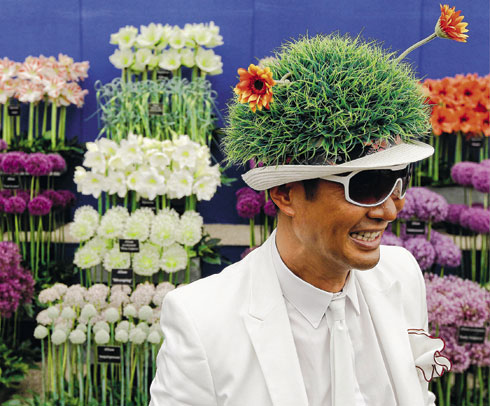
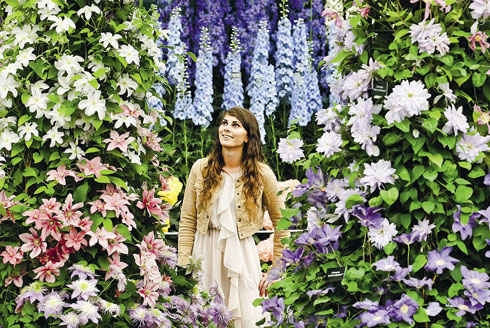
The annual international exhibition of floral design in Chelsea is held in May Valentinov Color. Statistics claim that February 14 - all lovers - celebrate more than eighty percent of the population in our country. And the number of colors sold on this day is no less than on March 8. What flowers and how to give it correctly - the New Times found out
In front of the gate of Eden
Two roses have flossed magnificently,
But the rose is the passion of the emblem,
And passion is the brainchild of the earth ...Nikolai Gumilyov
Recently, an incredible robbery occurred in St. Petersburg. Two men broke into a flower pavilion. While the saleswoman was shaking at the box office, they took eighteen armfuls of roses, they didn’t even look into the cashier. Blinks of the saleswoman met unexpected guests hospitably - wagged her tail, even licked one. So far, robbers have not been found, but some citizens, following Bologna, see a romantic trace in this story.
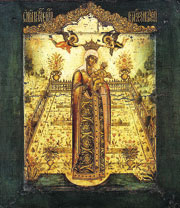 |
| Icon of the XVII century. Nikita Pavlovts "Helicopter Prisoner" |
The heavenly garden all began with Eden - the Paradise of the Garden, the place of pleasure, full of flowers. In the Song of the Songs of Solomon, Paisa is described as follows: “The helicopter is concluded, my bride’s sister, a sealed source: your seedlings are a garden with grenade apples, excellent fruits, backsets with backgammon, backgammon (musk) and saffron (Crocus), ciliated and cinnamon, with all the Livanny trifles ...” Pushkin Veritograd - “Safe” ... Sental.
The helicopters in Rus' first appeared at monasteries and princely estates. There was even a name - a red garden, that is, a beautiful one, which not only fruit, but also bloomed. They could admire them, show the guests. In the Tretyakov Gallery, you can see the icon of the 17th century Nikita Pavlovts - "Veritograd Prisoner". Believers consider her miraculous and worship on March 14. The Virgin is depicted here against the background of the Garden of Paradise. In the stalls - many flowers, in vases - carnations and tulips. In the hand of the Virgin Mary - red carnation. The garden was written off from Tsaritsyn Luga in Zamoskvorechye, the Bolshoi Tsarist Garden opposite the Kremlin, which was defeated during the time of Ivan III. It was the venture of his second wife Sophia Fominichna Paleologist. It was she, the niece of the Byzantine emperor Greek, Sofya, who introduced in Muscovy fashion for regular gardens with a clear layout and overseas flowers.
From that fashion in Moscow there were only a few names. Gardeners - from the Palace Sadovaya Sloboda, Sadovnicheskaya Embankment and Sadovnican Lane. Anenhof grove is also a memory. During the reign of Anna Ioannovna, on the shores of Yauza, Rastrelli created a summer garden, which was called Annenhof. In the Kremlin, he made the same winter that was later transferred to the summer. There was a terrace with a descent into a flower stall with five pools surrounded by statues and vases with flowers. The name of the garden ring also arose thanks to the colors. When they removed the earthen rampart to fill the space, they erected at home with the front gardens. In many Russian cities you can find a garden street, but more often only as a memory of the former.
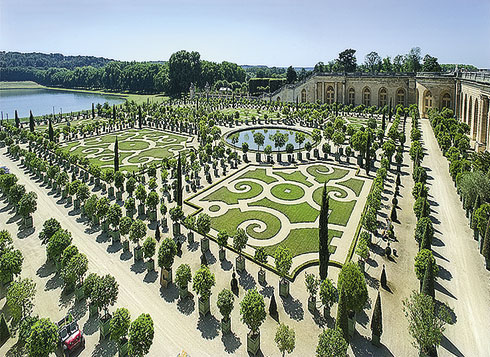
Versailles gardens - the great creation of Andre Lenotra Gardener was born a cry "Everything is in the garden!" Naturally, Peter I belongs to us. He introduced in Russia fashion to meet guests in the garden, in nature, throwing them with splashes of water from fountains and fireworks. Gardens and parks became the reception halls of the palaces. Summer garden, Peterhof - the whims of the emperor. Oranienbaum - whim of Aleksashka Menshikov. Then - Tsarskoye Selo, Pavlovsk. All of them are built under the influence of the gardener of the kings and the king of the gardeners - the Frenchman Andre Lenotra. His gardens form a "precious crown" around Paris. His greatest creation was Versailles, an object of admiration and imitation.
For a long time, the Russian nobility invited only foreigners to her garden masters. Fedor Vasilievich Fintelman, a Sadovian scientist, is known as a designer of the Petrovsky Park in Moscow. His Peru owns “complete Russian gardening, floriculture and gardening, or the guidance and construction of plants in rooms, greenhouses, greenhouses, gardens, and gardens based on 45-year experiments”. Finnelman is considered a teacher of most gardeners in Russia of the 50s of the XIX century. The gardener Karl Kebah, the creator of the park in the Yusupov Palace in Misheror, remained in history. Here, among the flowers, Felix was engaged in the native of Nicholas II Grand Duchess Irina Alexandrovna. Here, during the Yalta conference, the Soviet delegation led by Stalin lived.
In St. Petersburg, the exhibition "History of the House of Gardener Buka" is now open. Peter (Peter Petrovich) Book has been engaged only in flowers all his life. He was a gardener in the estate of Count Grigory Orlov on Elagin Island. When Emperor Alexander I bought the island for his mother Maria Fedorovna, says Svetlana Schmidt, curator of the exhibition, he granted Buka the title of garden master of the court of his imperial majesty. The island was invited to re -plan Karl Rossi, the future creator of the ceremonial face of St. Petersburg. On Elagin, the Great Russians, along with Peter Buka and the garden master of Peterhof, Pavlovsk and Tsarskoye Selo Joseph Bush, changed the layout of the regular part of the park, paved the air line and created a unique ensemble. Bouring was in the jurisdiction of a large greenhouse farm, summer, pink garden. Together with ten students and six workers, Peter Petrovich worked without bowing his hands. He left a lot of plant catalogs, colors of flowers. Most of all, of course, roses. Then - levkoi, razhed, heliotrops, famous for aromas. Different varieties of cloves, dahlias, verbenes are new flowers at that time, like Petuni. The sheet of 1834 compiled by him was preserved for the purchase of flowers in London. In the list of more than two dozen plants, one Camellia Japanese - ten varieties. But this document dates back to the time after the death of Maria Fedorovna, when Empress Alexandra Fedorovna often visited here, who was called the White Rose all her life.
In the tower, I left them from them
And with a blue -blue violet
I fell asleep, I slept
I was bright in a dream
I was waiting for something
And he woke up - with you ...Konstantin Balmont
You are Rosa Charlotte, the future Russian Empress, was the only daughter of the Prussian royal couple. The thin, delicate Lotthyen received a nickname in honor of the heroine of the novel de la Mott Fouck “The Magic Ring”. Alexandra Fedorovna remained the most romantic of all the Russian empresses. The roses surrounded her all her life. When Nicholas I built Alexandria in Peterhof for his wife, the poet Zhukovsky offered a coat of arms for her - a wreath of white roses pierced by a sword. For the new residence, the empress, along with other plants from Hamburg, brought 640 bushes of pennies of 247 varieties.
Royal persons have always loved roses, thousands of books were written about this. The now resilients of the crowned persons are no exception. Everyone knows about the addiction of the Prince of Wales Charles to the queen of flowers. Especially for the future monarch, a new rose variety with the smell of citrus fruits was brought out. The presentation was held at the world famous flower exhibition in Chelsea. Then Queen Elizabeth II handed her son the highest floristic reward - Victoria’s medal for “passionate enthusiasm for plants, gardening and contribution to the preservation of the environment”. This is the second such reward in the family of English monarchs, the first was received by Queen Mother in 1951.
In Valentinov, the day , unlike our country, where today gardeners are not in demand, in Europe a landscape designer, florist - a prestigious and honorary profession. When in the fall Elizabeth II was looking through the Internet to the gardener in the Balmoral castle in Scotland, where the queen traditionally spends summer, she had someone to choose from. In England, the garden master is not rare. There are many celebrities among them. In many countries, Jackie Makvikar, a multiple winner of the exhibition in Chelsea, know. The gardener David Domoni, the author of the fascinating film about gardening at the BBC, is a regular participant in many international exhibitions, gives master classes around the world, he was in Moscow. And the gardener Steve Vin became famous for planting flowers on the roads on the roads, creating an oasis in miniature. Our landscape designers and gardeners are famous people in very narrow circles. Therefore, for now, as in the song, red clove is our flower. In a solemn case - roses or bouquets selected according to the principle: the larger the bouquet, the more love.
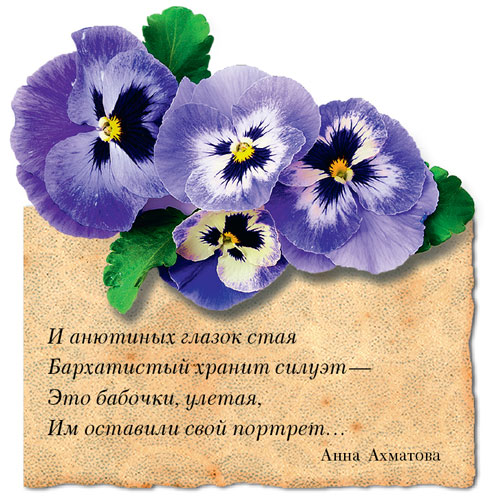
In England, where the tradition came to us to celebrate the day of lovers, loved ones send Pansy- pansies, and not only because they begin to bloom in this time
I, they are also called Hearts Ease - hearty reassurance, hearty joy. The British are reverent to this flower. The story is known, as in the 19th century, Lady Mary Benet, the daughter of Count Tankerville in Walton, in England, planted the entire garden with pans and the entire terrace of her castle. Her gardener Richard took up selection, leaving the largest and most beautiful specimens. Later, the pans were crossed with a violet. Now they are Viola Lutea and Viola Tricolor. There are several hundred varieties. The British made the industry out of this. Not so long ago, completely black pans were brought out-Faust, light blue-Margarita and wine red-Mephistopheles. The experiment continues, now gardeners are trying to get terry and very smelling flowers, since they clearly lack the fragrance.
In Russia, although pansies begin to bloom from the end of April and many varieties bloom until late autumn, they are not so popular. In Rus', they were generally considered the flowers of the dead, not suitable for the garden. They were also called Ivan-da-Maria. The legend talks about two lovers who got married, then learned that they were a brother and sister, and decided to die, turning into a flower. The topic of guilt, sin can be traced in the Latin name. In the Greeks, the eyes spied on the bathing of Venus turned into a pans. Viola in English is also “purple”-the color of the prohibition violation, homosexual. But this does not prevent people in many countries from loving pansies. Moreover, Ingermanland made them its floral symbol.
If you are afraid to get confused in all these signs, take your beloved to Holland, there will be a annual, already 79th flowers festival from 23 to 26 on February 26, but the most fascinating spectacle can be seen in the verbaverof.
Moscow flower exhibitions are held in late summer - in the fall. The largest - at the VVC, last year 500 companies from 22 countries participated in it. "Flowers of the EXPO", "Expo-Flora of Russia"-this is so far.
You can visit the famous Botanical Garden of Padua. Fans of exquisite flowers go to the ice cream in the Czech Republic. Here is the largest castle park in Europe - the cultural heritage of UNESCO. Since 1848, rare plants have been grown in the castle greenhouse. Now there are 250 of them. Anturia has already bloomed, or Royal Strelitzia.
And, of course, an unforgettable sight is the annual (since 1862) international exhibition of floral and landscape design in Chelsea, which will open traditionally at the end of May. Will it surprise it this time? Last year, one of the hits was a key garden - a composition created by prisoners and homeless of 10 thousand plants.