
Translated material
Musical intellectual
It is known about tastes, as you know, it is difficult to argue. They, in particular, are not amenable to classification by social groups. The audience of readers of the TRV-hobby is also characteristic of pluralism. But still, no one has yet denied the rule “like this”. Say, if you are not indifferent to music, then, being an acting scientist, you are unlikely to give preference to poppes before ... yes to anything. In my personal observation, intellectuals and music prefer the corresponding, regardless of the genre.
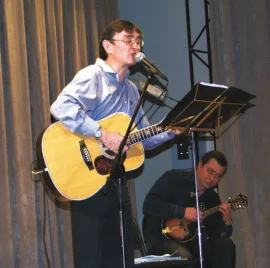
The author-performer Timur Shaov is a bright representative of the intellectual direction. Which, however, does not cancel its other virtues. To whom, in an amazing zigzag of fate, did not hear Timur, I recommend that you look at least on the Internet. There, his songs are by no means a deficit. I know Shaov’s repertoire almost completely, but his concert was lucky to visit for the first time. In Troitsk, where this happened, the full hall is going with a great creak, but then - the apple had nowhere to fall. And the audience clearly did not remain in the way: intelligence intellect, but it is also necessary to be able to be able to be able to be able to be able to possess a repertoire.
Formulating scientifically, a good song (in any absolutely genre) is a harmonious synthesis of the source material and quality performance. The first ingredient includes melody and text, the second - vocals and instrumental arrangement. So, I will risk speaking almost peremptorily. In Russia, there are few equal Timur Shaov according to the integral component of creativity.
Shaov composes melodies from pleasant to beautiful and writes to them invariably magnificent poems. He is perfectly recognizable, one might even say, inimitably in his performance, and thanks to cooperation with virtuoso musicians, his songs are professionally “made” and served. Timur also owns a guitar at the level, as they say, "so that I myself play." In addition, he has good songs for a hundred, and among them there are practically no those that you do not want to listen to the second time.
Undoubtedly, there are strict critics of Shaov's work. Fu, a bard, will say alone, putting into this definition the dislike of the stones by the stake past the notes by three thieves' chords through the secondary in the text “works of amateur song”. Well, yes, some Shaov’s things are quite traditional on the melody. The guitar in the hands is again acoustic, the arrangements are clearly not orchestral, the music is generally not loud ... despite the fact that true zealots of the purity of the genre often refuse Timur in the right to be considered a “purebred bard”, about which he himself repeatedly reported creatively with irony.
But Shaov is not at all the accident when the artist gets stuck between the genres in the “neither ours nor yours” pose, but just the opposite - personifies a wonderful thesis: all genres are good except boring. Already something, but Shaov’s songs cannot be called boring in any case. In them you can catch any styles and directions of modern music: rock and roll, and blues, chanson, and reghey, and fragments of the classics. Particularly advanced experts will notice that this, they say, has already been played, and then it has been said more than once. I will mind: no matter-notes of only seven, thirty-three letters, repetitions are inevitable, but the scale of musical and poetic culture allows Shaov to gracefully avoid stupid plagiats, and if something is heard somewhere, then exclusively as “quotes to the place”.
And finally, the main thing. It somehow happened that in the Russian song tradition, the writers who own the word occupy a special, I am not afraid of pathos, a cult position. Moreover, this applies to almost all musical poetry-from hard rock to chanson, from rap to the KSP. To say that Shaov knows how to write poetry - in fact, to say nothing. Such a fertile-muddy fabulist still to look for such a prolific and fluent. But with all the impressive sizes of his song texts, I almost never want to say: "Better less - better." The poetic canvases detonated by Shaov are fascinating in their imagination, various topics and accurate in terminology. Non-trivial reflections on eternal truths are replaced by recognizable household sketches and continue not boring lectures on the current political and economic situation. The intellectuality and nationality in Shaov’s texts are mixed in bizarre, but almost always in perfect relationships.
The vivid feature of Timur is that he is one of the few authors who confidently call a spade a spade, and this is perceived completely without tension. With full understanding. Well, he doesn’t happen to him as in a joke - "there is an ass, but there is no word." Shaov, for example, is not at all shy in the songs to call himself Chuchmek/Basurmanin, and therefore we can safely say: there would be more such real Russians. It remains only to be surprised and admiring how free and rich (when it is necessary sophisticated, when necessary-exaggeratedly modernized), a poetic language in a person who was born and a significant part of his life spent in the far from the most Russian-speaking area of our country. However, it is enough to read Shaov’s brief autobiography in order to understand that the family is “to blame”. In such a family, a “folk poet” was simply obliged.
On the stage of Shaov and his comrades (Mikhail Makhovich with Mandolina and multi -instrumental, Andrei Kudryavtsev - just wizards) held two departments, more than an hour each. At the exit, I heard an opinion under which he was ready to subscribe: "This is anything, but not an" amateur song. " Timur actively and wittily communicated with the audience, sang from the audience from the audience and paid tribute to the software “Mumuumu” “What Gerasim was silent about.” And there was also an autograph session at 50 people, and shooting TV before the concert, and a conversation with the writing press after ... Well, we did not strongly torment the comrade so professionally and kindly. Literally a few questions with an underlying possibility of an exclusive interview. And then - no matter how you talk heart to heart with the author from the song: "You know, Petya, I respected science ..."
But the most remarkable thing is that, listening to the works “first -hand”, you can highly understand a person’s life attitudes: his attitude to family, loved ones, friends, ill -wishers, homeland, creativity, good and, conversely, risky habits, football, sex, politics and even (a rare case!) To science ... and realize that these attitudes are very close to your own own. Then, already good songs, he will become even more pleasant to listen.
Ilya Mirmov