
Translated material
The parrot takes the stick
Can an animal use an object that is not used in natural conditions as a tool and to which it is very inconvenient for it to manipulate? It turns out, maybe. Specialists of the Department of Cognitive Biology of the University of Vienna (Department of Cognitive Biology, University of Vienna) and the Institute of Etho -Lorenza (Konrad Lorenz Institute for Ethology) (Nestor Notabilis), and the bird took up the stick to get a treat.
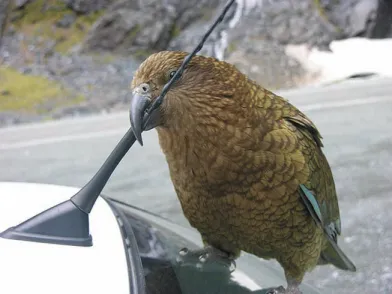
The stick is perhaps the most common tool for primates, but other animals use it extremely rarely. Among the birds, only two species regularly use sticks: woodpeckers and Novochaledled crow. Grabbing the leaf petiole, a twig or a long spine with a beak, they are pulled out of insects and larvae from cracks. However, in laboratory conditions, tools often begin to use those who have never done this in the wild. For example, the rooks under the leadership of the University of Cambridge (University of Cambridge and London University of Queen Mary University of London) learned to insert a thin branch into a vertical tube and press it on a moving platform to get a treat. The rooks have no physical obstacles to the use of a wand, like the Vyurks and Novo -Kaledonsky ravens, their beaks are straight, so the birds easily take the twig for the tip, so that it becomes a continuation of the beak, and act aimed at it. And Kea's Crusy Parrots, and they can grab the wand only on the side. Under natural conditions, they do not need twigs at all: they are not picking insects not from wood cracks, but from under the pebbles and nests they are not curled-Nestors are arranged in small caves. That is, neither physical nor environmental prerequisites for the use of a stick as a tool of work in N. notabilis do not. But Austrian researchers tried to force several parrots caught in nature.
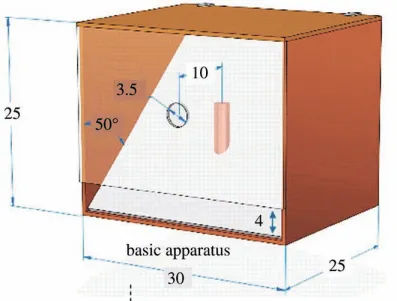
Before the parrot, a wooden box with a transparent plastic front wall was put, which did not reach the bottom, forming a slot of 4 cm high. A hole with a diameter of 3.5 cm was made in the center of the wall. Inside the box, there was an inclined aluminum plane with a column-platform, and the experimenters placed an open box on this platform, and in it-peanuts! It is impossible to resist, but how to get it? To do this, you need to stick into the hole one of the attached sticks with a diameter of 2 or 1 cm and a length of 20 cm and push the box from the platform. She overturned, and the treat on an inclined plane rolled into the gap, to the feet of a skilled bird.
The parrots realized how to act, they grabbed the sticks and poked them into a transparent wall, sometimes even pushed their gun into the hole, but did not hit the box because they could not grab the stick so that it was convenient to manipulate, the curvature of the beak interfered.
Finally, a particularly talented parrot nicknamed Kermit developed a complex technology of shitting boxes. He took the wand with a beak on the side, at the closest to the transparent wall of the end, and attached this end in front of the hole. Then he intercepted the wand with one foot around the middle, inserted into the hole and “sent” inside, grabbing his beak at the other end of the stick. These manipulations require good coordination of movements, since both paw and beak are involved in them. But Cermit coped.
Researchers scored five more adult males Nestors and invited them to learn from Kermite. From a distance of one meter, the birds were observed as Kermite over and over again affects the box with peanuts, and then they were offered to try it themselves. The parrots comprehended this wisdom with various success. Two, Tammy and Bruce, did not learn how to get peanuts and dropped out at the first stage of the study. Two more, peak and Frovin, mastered the technique of Kermite, and Luke, although he was busy for the longest, but developed his own method. Grasping the wand near the end, he put it on the edge of the hole and pushed it inside, intercepting it with its beak, and did not help his paws.
But why do parrots show miracles of dexterity and ingenuity? Do they definitely want to get a nut, or do they just like to drop boxes? To clarify the motivation of Kea, they were put on the platform alternately boxes of two colors, green and red, and the bait was placed in only one of them: Kermite and Frovin - in red, hatch and peak - in green. At first, all the Nests knocked out all the boxes in a row, but then they learned to choose and pushed only a drawer of the desired color, with a bait, and in other cases they did not even take up a wand. By the way, in this test, not Kermit, but Frovin, turned out to be the most smart.
So, the parrots are alien to the thirst for destruction, they are interested in peanuts, and they learned to get it using a technique that they did not know during a free life. But, perhaps, scientists overestimated the capabilities of the parrots, and they do not aim with a wand in the box, but simply insert it into the hole and shut it up until they touch the bait on the platform? Can a bird enter a tool, and not just swing it?
To find out the answer to this question, the researchers put a ker with two holes and two platforms, on which they simultaneously placed green and red boxes. The box with the bait was located on the right, then to the left of the empty wall, closer or further from the front wall, or both boxes were placed at the same level. The task of the parrots was to pushing with a stick that box in which the nut was hidden. During testing, the birds made the right choice on average in 70 % of cases: they drove a wand in a hole located opposite the platform with a nut, and its location did not affect the choice of bird. This means that Kea understood the task and brought a wand for the desired goal, but at the same time came across certain difficulties. It is possible that the parrots simply missed due to the fact that it is inconvenient for them to hold a stick in a curved beak, and even intercept with a foot. So they rushed into one box, but fell into another, so they did not always manage to get peanuts.
So, kea, which do not use sticks and twigs for the equipment of the dwelling and the production of feed, i.e. They have neither physical nor environmental prerequisites for the use of a stick as a tool, however, they can learn this. And in the laboratory, they are able to solve problems that they never had to face in nature.
Natalia Reznik
Alice Mi Auersperg, Ludwig Huber and Gyula K. Gajdon. Navigating a Tool End CK-Tool Use in Kea (Nestor Notabilis), Biology Letters, DOI: 10.1098/RSBL 2011.0388