
Translated material
Kortchevatel
One of the brightest trends in recent times is the emergence of a large number of the so-called “open access magazines”, in which articles are available through the Internet, without any subscriptions, and authors of adopted articles pay for publication. Many traditional, paper magazines are also switched to such a scheme, and some offer a mixed model: articles of paid authors are laid out in open access, and the rest remain in access by subscription and in paper form. Among the biological magazines on the open -access model, magazines of PLOS (Public Library of Science) and BMC (Biomedcentral) are published. Most of these magazines are indexed in the main databases, having quite decent (3-4), and sometimes high impact factors (for example, 12.47 in PLOS BILOGY, 6.89 of the Genome Biology of the Navy). The open access model allows you to experiment with various editorial schemes. For example, in the journal Biology Direct (BMC, Impact Factor 3.74), the author himself chooses three reviewers from among the members of the editorial board (which may agree, refuse or offer an external reviewer) and even decides to publish the article after receiving the article, but the signed reviews are published together with the article itself. Sometimes discussions between authors and reviewers are no less interesting than the articles themselves.
But at the same time, an open access model, requiring small initial investments to open a magazine, is very vulnerable. Many scientists receive a lot of spam messages from publishers with proposals to publish an article, and often become a member of the editorial board. The fact that this is spam, and not an targeted newsletter, is clear from the fact that invitations come from magazines that have nothing to do with the addressee’s specialty.
One of the most (sad) famous publishers is Bentham Science Publishing. The recent history of this publishing house is replete with scandals. For example, at one time the publishing house used advertising leaflets sketched from BMC leaflets, and instructions for the authors were rewritten by whole pieces [1].
In 2009, Philip Davis, a student of the University of Cornell, and Kent Anderson, Deputy Director for International Development in the prestigious New England Journal of Medicine, presented the publication in the Bentam- Open Information Journal for a meaningless article [2], Generated by the Scigen computer program-the same one that we used to use for the root (TRV-hunger No. 13, 09/30/2008, http://www.scientific.ru/trv/2008/013/ostap_bender.html ). Frota was submitted on behalf of the Center for Research of Applied Frenology (knowledgeable English slang will appreciate the reduction - CRAP). The article was accepted for printing, the authors received an invoice for $ 800 and sent a letter to the editor stating that they were responding an article due to errors discovered in it. The editor -in -chief of the magazine Bambang Partanto at the University of Pittsburgh resigned, and the director of the publications of Bentham Science Publicing Mahmud Alam said that the publishing house had noticed a provocation and pretended to take an article to bring its authors to clean water [3]. However, the version of Alam is replete with minor inconsistencies and, apparently, is an attempt to justify himself retroactively. However, in fairness it should be noted that in another journal of the publisher, Open Software Engineering Journal, the article was not adopted.
In the same year, Open Chemical Physics Journal has published an article that indicated traces of a termite mixture in the ruins of New York Twin Bashenes, allegedly discovered after the September 11, 2001 terrorist attack. Since this article was published without the knowledge of the editor -in -chief, Marie Paula Piles from the University of Pierre and Maria Curie, the result was another resignation [4].
Another publishing house with muddy roots leading an aggressive marketing policy is Omics Publing Group. In 2011, a number of members of the Journal of Earth Science and Climatic Change magazine resigned after the publication of the Stonehenge article, which discussed the Earth’s immune system, and global warming was interpreted as an infection. After the scandal, the article was deleted from the magazine website, but a formal refutation - which is the norm in such cases - did not follow [5].
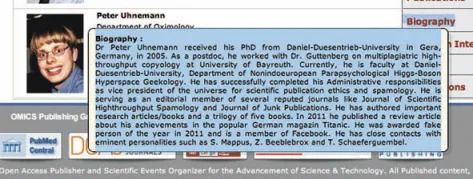
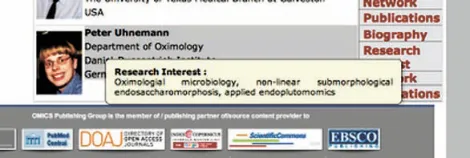
And the next wonderful joke was just told in his blog by Jonathan Aizen, a bright adherent of a free access model, one of the founders of Public Library of Science and the Chief Editor of Plos Biology [6]. In the editorial board of Molecular Bioology magazine (not to be confused with the translated version of the Russian magazine Molecular Biology, published by Springer), Peter Uhnemann (so!) Daniel-DuesentRieb (this is the German name of one of the Disneuman characters). In the biography of UNEMANN , the magazine website says that after graduating from the university, he worked in the field of multiplagiaric high-performance copying (so! Multiplagiatric Highput Copyology) and spamology, is a member Highthroughhout Spamology and Journal of Junk Publications, as well as the laureate of the Picture Personnel Prize in 2011.
In fact, this character is the creation of the German satirical magazine Titanic. Journalists brought him an Ak-box in Facebook, and he soon became a friend of many German politicians. As he ended up in the editorial board of the scientific journal, it is not yet known: either this is the amateur performances of the technical personnel of the publisher (in the past, the publishing house has already used data from Facebook to promote their magazines), or someone’s joke.
Morality. Deeply liable colleagues, when you are invited to publish articles in the previously unknown magazine and even more to become a member of the editorial board - see what you get involved in. Even a simple “thank you” can be interpreted as your consent, and then it will not be easy for you to ensure that your last name is removed from the list.
Mikhail Gelfand
1. J. Dunckley, M. Hodgkinson. A Short Post About Bentham Open. Journalology (08/27/2008) http://journalology.blogspot.com/2008/08/short-post-bout-bentham-open.html
2. P. Davis. Open Access Publisher Accepts Nonsense Manuscript for Dollars. The Scholarly Kitchen (10.06.2009) http://scholar-lykitchen.Sspnet.org/2009/06/10/nonsense-for-dollars/
3. N. Gilbert. Editor Will Quit Over Hoax Paper. Nature 459: 901 (06/17/2009). www.nature.com/news/2009/090615/full/news.2009.571.html
4. Bentham Editor Resigns Over Steven Jones' Paper. Screw Loose Change (04/28/2009) http://screwloosechange.blogspot.com/2009/04/bentham-editor-resigns-over-stven.html.html.html.html.html.html.html.html.html.htm
5. Richard Poinder. The Open Access Interviews: Omics Publing Group's Srinu Babu Gedela. Open and Shut? (12/19/2011) http://poynder.blogspot.com/2011/12/open-c-cess-interters-mics-publing.html
6. J. Eisen. Scary and Funny: Functional Researcher Peter Uhnemann on Omics Group Editorial Board. The Tree of Life (01.30.2012) http://phylogenomics.blogspot.com/2012/01/scary-and-funny-functional-researcher.html