
Translated material
TEK without Sechin?
After the "present." As a result of permutations in the government, which will inevitably follow the presidential election, Igor Sechin, who oversees the fuel and energy complex, may well lose their deputy prime minister. What will change in the oil and gas industry with its departure - the New Times sorted out 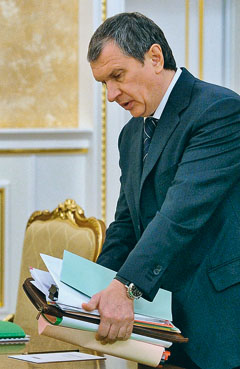
Two approaches
According to experts interviewed by The New Times, the need for changes in the Russian TEK objectively rushed for a long time. If nothing in the industry is changed, says Nikita Maslennikov, an adviser to the Institute of Modern Development (Incor) , over the next 10-15 years, oil and gas production in the country will be reduced by 1.5 times. Which, given the raw material dependence of the domestic economy, will have catastrophic consequences for the federal budget. To prevent this from happening, a serious and stable influx of investment is required. And so far they stubbornly do not go to the industry. The investment attractiveness of the Russian "Neftyanka" will be the higher, the less the degree of state participation in it is. But the state is in no hurry to privatize its companies due to low market prices.
A strong -willed solution can change the situation - let's say, if Dmitry Medvedev, having turned out to be the head of the government, will still achieve his initiative to sell part of the state -owned shares of large companies as soon as possible. And even if the current prices in the market do not have any special benefits for the budget, the sight for the future is important - that the institutional changes will eventually turn into an influx of investment.
Igor Sechin has a different approach: wait until the market rises - and then sell assets at higher rates. He is not embarrassed by the warnings of a number of experts that this is fraught with tightening the privatization process for many years. Moreover, the Deputy Prime Minister in every possible way ensures that the dominant state participation in the Russian oil and gas sector remains, grows and grows stronger. For example, in a recent letter sent to Vladimir Putin, Sechin proposed to sell a blocking stake in the Novorossiysk Sea Port of Rosneft *** Today, the portions of the Russian Railways own shares of the port, and according to the privatization plan, they must be put up for competitive sale ..
Another “fresh” idea of Sechin from the same area (with which he again turned to the prime minister) is the creation of a state oil and gas service holding, which implies the withdrawal of relevant services from state-owned companies (and thus “salvation” of their privatization).
Less "Gazprom" *
Experts blame Sichin that with him the fuel and energy complex was practically closed for innovation. “We have missed many advanced technological solutions that the world is already using: liquefied gas technology, shale gas production, and production on the shelf. The industry is, to put it mildly, in the catch -up development mode, ”said Nikita Maslennikov, recalling that in Russia - 25% of the proven world gas reserves and 14% - oil. According to the expert, the old, easily accessible, remaining from the Soviet era of the deposit (Urengoy, Samotlor and others) are almost exhausted. But for the development of new, more capital -intensive, with difficult conditions of production, new technological solutions will be required. “And the industry should be rebuilt so that these innovations come,” the expert believes. "
Politics in the oil and gas sector - closed, monopolized, it is controlled by a narrow group of persons
”According to Igor Jurgens, the chairman of the Board of Incor (the head of the supervisory board of this institute is Dmitry Medvedev), the question of creating no less“ parallel Gazprom ”is already being worked out:“ If you look at the gas assets of the companies controlled by Gennady Timchenko, such as Sibur and Novate, then this is actually parallel “Gazprom” - In total, they belong to the third part of the entire gas market of Russia, while they have producing power, and the system of delivery of raw materials to the West. ” The gas industry, they came to the electric power industry after the reform of Chubais and brought $ 40 billion. “It does not matter that Putin’s friends own these companies, the main thing is that a certain model of the state’s struggle with“ natural ”monopolism can be implemented on their example,” adds Igor Jurgens.
The law of conservation
No matter what rumors are dissolved about the further personnel fate of Sechin, do not forget: Igor Ivanovich - by no means an independent figure on the chessboard of a large Russian business. “Sechin may well leave the government due to bad relations with Medvedev. But I do not believe that this will lead to any positive changes in the industry, ”says Mikhail Krutikhin, partner of the Rusenergy consulting agency . “In his place they will take some other“ their own ”, equally“ effective ”manager, for example, Alexei Miller.” Nikita Maslennikov shares this point of view: “The oil and gas industry is a ridge of the entire Russian government. This is money that can go to the implementation of any political projects. Therefore, if Vladimir Putin again becomes the president, then he will continue to prefer to control this segment “manually”.
Vladimir Feigin, the President of the Institute of Energy and Finance , has no reason to believe that Sechin will be removed from the chief of the fuel and energy complex: “He is actively involved in all the processes of managing the industry. A new person may need many months, if not years, to figure out all the nuances. ” The experts considered the evidence of Sechin’s strong positions in January-February, on the direct assignment of Putin, the loud anti-corruption campaign in the electric power industry-numerous frauds with the withdrawal of the top managers of the funds to offshore were identified in the industry. As for rumors about the allegedly uncomplicated personal relations with Medvedev, Sechin may well return to a high position to the Presidential Administration, and the “headquarters” of the leadership of the industry will move there with him-as it was already in the first half of the 2000s.
“Politics in the oil and gas sector is closed, monopolized, it is controlled by a narrow group of persons, and the leadership does not allow any competition or privatization by it,” Igor Jurgens summarizes. “So, while Putin is in power in the country, nothing in this area can change.”
How Igor Sechin led the fuel and energy complex:
In 2003, as deputy head of the President of Russia, the deputy head of the administration of Russia actively opposed the discussion in the Government of the Gazprom reform plan, which was the curator of which was Dmitry Medvedev.
In 2003–2008 He stood behind the criminal prosecution of the former head of Yukos Mikhail Khodorkovsky and directly led the process of the collapse of Yukos.
In 2005, the Gazprom and Rosneft confined to Vladimir Putin stated by Vladimir Putin. As a result, Rosneft remained an independent player on the oil field.
In the spring of 2011, while being at the posts of Deputy Prime Minister and the chairman of the board of directors of Rosneft, he made a scandalous breakdown of the project with the British BP to master the Arctic shelf.
At the end of 2011-early 2012, he expressed a public disagreement with the plan for privatizing part of the assets of large state-owned companies of the fuel and energy complex, which is insisted by Dmitry Medvedev.