
Translated material
The limits of the falsehood
The limits of the falsehood. The presidential elections will be held in one or two rounds - it largely depends on the real ranking of candidates, but on how much it will be finished by the main one and taken away from everyone else. The New Times assessed the power of power in falsification of voting results
To assess the scope of falsifications in Russia, different methods are used: comparing data from neighboring sections of the same type of voters, mathematical modeling in order to identify the share of an “abnormal” distribution of votes, post -sophisticated hundreds of polls ... Moreover, even studying the official data of the centrisbirromium, you can calculate the share of the votes obtained by “specific”, most prone to freetings of methods Voting.
"Pulling" of lists
The turnout based on the results of the State Duma on December 4, 2011 amounted to 60.21% of voters. These are 65.8 million people out of 109.2 million, who were on December 4 on the lists of the Central Election Commission * * Of these, almost 337 thousand live outside Russia .. However, in the summer of 2011, the CEC resolution indicated that on July 1, only 108.1 million voters were registered in the Russian Federation. Where did the additional 800 thousand people come from in the country in five months? And in reality, even more, given the vote on absenteeism: 1 million 797 thousand people received them in the plots, and only 1 million 258 thousand voted on them. That is, more than half a million people were deleted from the voter lists in their sites, receiving absenteeisms, and no additional lists were included.
Total: the real volume of “pagan” of lists, behind which the multiple voting of the same persons may be hidden - about 1 million 376 thousand people. If we add to this those who voted in absentee, prematurely or at home * * at home on December 4, 4.3 million voters voted., Then we will receive 7.15 million, or 11% of “specific” votes in total. And this is without taking into account direct stuffing, bribery, rewriting protocols.
The post-online survey of Levada Center December 8–16, 2011: the distribution of votes from the number of voters 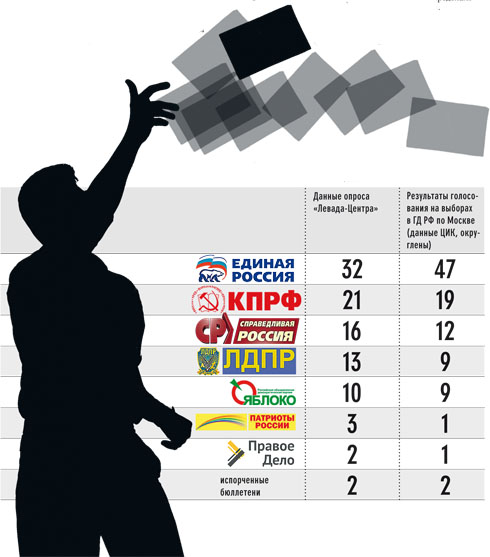
Spilkin's method
The most sensational method for assessing the scale of falsification in recent years is mathematical modeling. He has different options, the most famous bears the name of one of the electoral statistics of Sergey Spilkin. It is based on the voting distribution graphs in the areas. With normal distribution, the curves of all parties should have an approximately comparable form, and this pattern is noted in most “normal” elections. However, in Russia a feature is noted - a schedule of one of the parties (“United Russia”) is “anomalous”. By comparing the curves of all parties and the United Russia curve, using the coefficient, you can roughly determine the volume of the “abnormal” part of the votes for it in specific elections.
So, according to Spilkin’s calculations, the real turnout in the December 4 elections amounted to about 46.1%, 50.4 million voters voted. United Russia, according to its calculations, in reality received 33.9%of the vote instead of 49.32%, the Communist Party - 25%, “Fair Russia” - 17.3%, the LDPR - 15.2%, and Yabloko - 4.5% ** in life of the CEC counted the communists 19.2%, Socialist -Revolutionaries - 13.2%, Zhirinovsky parties - 11.7%, and the “Yabloko” - and the “Yabloko” - and the “apple” - and the “apple” - and the “apple” - 3.43%..
Sociologists of the Levada Center received similar numbers, a week after the day of voting, the question that asked Muscovites: “Have you voted in the election of deputies of the State Duma and if so, for which batch?” 4
Thus, in the capital, United Russia was supposed to get 15% less than it was eventually counted. If you apply the Spilkin method to Moscow, then the result of the party in power would be lower by all 17.5%.
Total: Assessment of distortions of voting results on the country's scale can range from 7.13 million (the share of “specific” votes, according to official figures) to 15.3 million (according to the method of spilkin).
Regional differences *
The traditions of falsifications in each region are different. Somewhere, as in some republics of the North Caucasus, in the final protocol, just any desired result is written, somewhere they prefer stuffing, cruise votes or rewriting protocols.
A number of regions "traditionally" shows anomalous shares of voting at home.
In recent years, voting on absenteeism has become more popular: loud scandals occurred because of this in the Sverdlovsk, Chelyabinsk, Voronezh, Ryazan regions, St. Petersburg.
Falsification directly during the voting is also caught with great difficulty: it is impossible for the observer to sit behind each member of the commission and check whether the voter signed up for himself, how it is impossible to also monitor the additional lists of voters in different areas and find out if repeated voting of the same person has occurred. "
The result of the election on March 4 largely depends on the turnout in the regions of the "protest" group: mainly the Russian North, Siberia, the Urals, the Far East
“But the frauds during the vote count, if the observation is organized correctly, can be effectively suppressed. In this case, the share of distortions due to violations during voting is directly proportional to the number of“ living votes ”. In other words, the more real voters came to the sites, the less you can throw the ballots for those who really did not vote.
Leaders of Voting at home in the elections of the State Duma of the Russian Federation on December 4, 2011 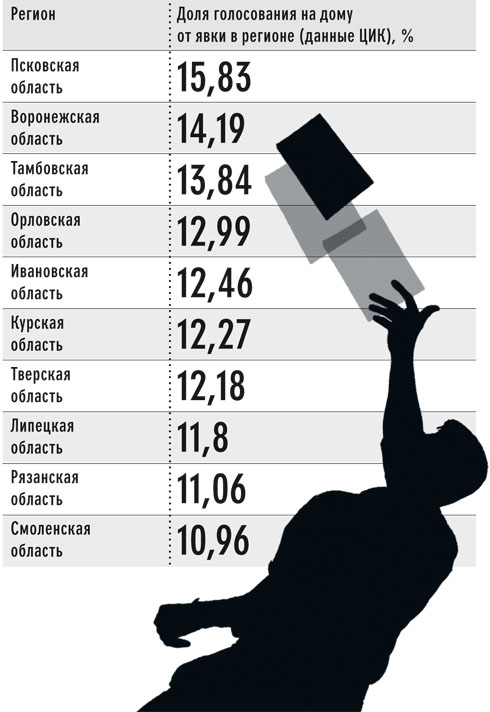
It is not surprising, therefore, in the elections in recent years, consciously inspired campaigns can be observed on an artificial breakdown of the turnout of the protest electorate and thereby increasing the results of “from power” candidates. Often, the campaigns themselves are carried out precisely where the highest share of the protest electorate and higher electoral control is the highest - as a rule, these are large cities. Among the methods of reducing the turnout are defiantly scandalous campaigns, black PR, nomination of candidates with high antires.
From December to March
According to the results of the voting on December 4, all Russian regions can be divided into three groups. Thus, the national republics of the North Caucasus and the Volga region remained with the zone of the traditional “electoral anomaly” (both in the turnout and the percentage of the “necessary” candidates). For many years, Tuva, Chukotka, Kuzbass, Yamalo-Nenets district, since the beginning of the 2000s and the Tyumen region have been included in the same group. Often, the “abnormality” of the territory voting is associated with the features of the “electoral machine” built in the same or another governor, which is based on the initially high rating of the head of the region.
In the December 4 elections, 20 regions of the country gave United Russia more than 60%, and almost three more regions reached them - from 56–60% for the party in power. In addition to the above-mentioned “abnormal” regions, two areas of central Russia (Tambov and Tula, the last “merit” of the new governor Vladimir Gruzdev), one region of the North-West (the Komi Republic, where the extremely scandalous elections), as well as the Saratov, Astrakhan regions and the Krasnodar Territory, were clearly closed into this group. In total, these 23 regions include 25.1 million voters. It can be assumed that on March 4, these regions will provide a “correct” result.
Another 32 regions, even taking into account the violations, gave “United Russia” less than 40% of the vote. You can add seven more regions with 40–42% of the vote to them - mainly the regions of the Russian North, Siberia, the Urals, the Far East. 52.2 million voters live in the regions of this “protest group”. However, they also noted the reduced polls in comparison with the all -Russian turnout. It is unlikely that the regional and local authorities have resources to radically change the features of voting in these territories.
Finally, 21 regions can be recorded in the "middle peasant". Here is Moscow, and a little jumped out of the "abnormal zone" Rostov region, as well as Voronezh, Stavropol, etc. This is about 30.8 million voters. The electoral evolution of these regions raises the greatest questions, and, perhaps, it is on the behavior of this group that it depends: the presidential election will be held in one round or two. In the same Moscow, the repetition of the "elections in Damaging" is fraught with risks of all-Russian political destabilization. So you should not wait for hard falsifications in the regions of this group.
Thus, the final result of the presidential election largely depends on the turnout in the regions of the “protest” group and the ratio of the rigidity of the administrative resource and the struggle for electoral control in the “middle” group.
At the same time, control in the presidential election is usually more complicated than on parliamentary ones. Firstly, the last more winners, players personally interested in the maximum result and fighting for its receipt. By the way, in 2007-2008, the Pilkin method showed that the distortion in the presidential election was stronger than on parliamentary ones. Secondly, in December 2011, along with the State Duma elections in 27 regions, regional parliaments were elected and candidates for the Legislative Assembly were also interested in control. In March 2012, along with the presidential election, only some regions will be held in elections, and even then to local, not regional authorities. It is not surprising that if many real controllers are not formal observers from the candidates, but by social activists who have the status of media correspondents.
True, this trend can be broken by the hazardous fashion to sign up for observers and the overall growth of protest activity. But how effective the "angry townspeople", who have already learned to go to street protests, will be at polling stations, we will only understand the results of March 4.