
Translated material
The creator of the world
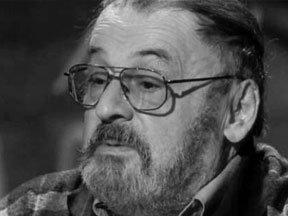
Asar Isaevich Eppel died. Good Russian writer. These words cost a little, for there are writers, but there are writers. Some create a name for themselves, weaving an entertaining narrative, in the network of which a bored reader comes across. Others-lure him, touching the casual of topical public ulcers or, on the contrary, something eternal, incomprehensibly wizard ... others simply amuse us to tears.
Eppel belonged to those that are extremely rare in our gray time prose writers, who believe that all of the listed copyright valor are nothing if the language of written is not absolute. That is - is not impeccable, does not recede from very stringent requirements, but they are inconspicuous in himself. Requirements regarding several almost independent matters at once - usage, syntax, prosodies, and in general - sound ...
Such, writing in Russian, now will not be scrapping for two dozen-good would be, at least half a dozen found! ..
But, for some reason, I want not about that now.
Asar Isaevich had a rather strange fate for the writer. Moreover, even that he lived his whole life with a typical Moscow writer-he did not drive ships, did not heal, did not fought, as a good half of the Russian classics, did not suffer from the dogs of the regime, did not sit, did not emigrate, etc., but only creaked with a feather: he wrote or edited and received fees for this.
After the successful graduation of the Moscow Engineering Institute. V.V. Kuibysheva in 1957 quickly switched to freelance bread of a newspaper journalist, columnist and generally a wide profile writer: he wrote everything that was touched - up to the children's drama or lyrics for the musical according to the stories of Babel. I must say that in those epic-Soviet times, it was more difficult to stand on such rails than today, however, on the other hand, a person, still standing on them, usually gained much greater material stability than today's fellow. With one good article, one could feed a month. But I'm not talking about that again ...
In 1970, Eppel joined the Union of Writers - this was also a rather complicated business then, but the members of the Union fell into a certain Wednesday defered by the state: it was a rather high social status, which could well be converted into all sorts of, in the Soviet sense, vital benefits. That most of the 10,000 members of the SP of the USSR did, not having the slightest moral or any other informal grounds. Asar Eppel was just the minority, which, of course, had these reasons. For, among other things, he was also a translator - from several languages: Yiddish, who was actually his second language, German, English, Italian, but the main thing was Polish. In those days, there were few translators, and they were usually good. In order to have boldness to translate an artistic text, it was necessary to know the language - more precisely, at least two languages: translated original and Russian (this is now in many cases only in the process of work they get acquainted with the first and are very poorly owned by the second). Translators were respected and appreciated. And they paid well - which undoubtedly contributed to maintaining the level (although not only the reason for its height).
Especially appreciated those who belonged to, so to speak, the highest caste - to translators of foreign poetry from the original language (and not in the interference). It was to this category that Asar Isaevich belonged - and in this capacity he enjoyed the highest authority.
His most famous translation ... let’s say, the most significant of it, as a translator, the contribution to the Russian literature was, however, the translation of the prosaic-a small meeting of the stories of Bruno Schulz-the strange-fan-sprinkled and complex Jewish writer and artist who wrote in Polish and lived almost unholys in the Carpathian Drogobych: first in the first time Austria-Hungary, then in Poland, then, not for long, in the USSR and in the final-in the zone of the German occupation ... Then he was translated-but, since Eppel, alas ... everything coincided here-and a certain worldview proximity of the author with the translator, and that both Yiddish were the second native language-such hits are so infrequent that they deserve it that they deserve it Reading only for this. Even if the reader does not have a separate interest in prose of this kind.
So Asar Isaevich lived until the end of the 70s: he enjoyed good fame in not too wide circles, actively participated in the Consid-free everyday life, with her rather strange, in the opinion from today's far away, morals encouraging the speed of reaction, the notorious CDL restaurant, always-willed intrigues, etc. He lived, and suddenly ...
And suddenly, at the very end of that decade, approaching the middle of his fifth ten, Apple begins to write stories. By 1982, nineteen were created, which made up his two own collections: "Herbal Street" and "Champignon of my life." These texts tightly adjacent to each other became the result of processing childhood memories. The material served as a spatio-temporal continuum: the action takes place mainly in the northwestern region of Moscow (somewhere in the triangle between the current metro “Shcherbakovskaya”, the Yauza platform and the Sheremetevsky Palace in Ostankin) in the 1940s and 1950s in one-story private houses and the hastily knocked out huts.
Later, in 2002, a third collection of ten such stories was added to them - “The crushed Satan”. A certain amount has been written in recent years-all about the same time and place (several attempts by Eppel to go beyond these same herbal streets were just unsuccessful-it was felt that the author writes about what he did not know, did not understand and did not love.), In fact, his whole heritage.
Is it a lot or little? Will it be forgotten soon or will it remain for a long time in Russian literature? I would venture to assume the second, and that's why.
There is a special writer's valor, given not to everyone even a significant prose writer. This is the merit of creating a world out of nothing-in some way akin to a divine creation, but in the immeasurably smaller, of course, a scale-the invention of a new, previously absent space-time. Asar Isaevich precisely created such a special space in his stories - special, nowhere before the previously not seen Moscow of Eppel. How is this valuable? In fact, in fact, the “real reality” surrounding us is also valuable: this world created by a prose writer is inexhaustible. It is endless in all directions, in every sense - endless, as a spiritual, moral field, as a source of existential horror and existential hope, endless as infinite art: art:
... bewildered, jerking back and forth, he immediately lost the direction and, now and then hesitating, thank God, this quickly recognized something to the touch. Most of all, the raw fog was felt to the touch, and although this fog inside himself lay down with moist clots, but nothing but his eyes was visible either at the top or side, and our fugitive was exactly the same, but he could not see how he blazes, and therefore, he did not think about the fly, but he could not see him either. <...>
But he was not in the meadows and not in the city and went with his hands in a neighbor's hedge, and then, when the hedge ended, he buried himself painfully. It turned out to be in the pump from which the water was taken. For the pomp, the wormwood wormwood immediately went and began to rustle, but she did not publish her smell, which was why the fog thickened and there was almost nothing to breathe.
Suddenly, the space on the side was lit up and became pearly - the substance of light was added to the moist substance of the darkness. The sun probably rose. From an unexpected radiance, it seemed to him that he himself was now white, like a steam from a booth, and the feeling of the path had disappeared altogether, so that turning was not quite simple there, but he quickly realized to go to the nearby beeps ...
The radiance changed the place - obviously, it was produced by a vain ship sector. He buried himself in something again, and he stuck it. From fear, he almost died again, although it was an awesome sheep, which, while she spun in her legs and screamed terribly, had to go around. But what is about B X O D and T and if the path is not visible? And although the road to the berth was short and known by heart, it became clear that he was astringent.
The fog, meanwhile, began to stink of steamboat burning, which made it in the throat, as if he crossed the row, like the smoke of the Kainova victim, a strip of steamer smoke. And then, having stepped onto the concrete, he almost died again, but now with joy, although now it was impossible to make a mistake, otherwise you will break into the water - into the gap between the stern and the moor - where in such milk you can’t get out.
Bright memory!