
Translated material
Translationability of experience
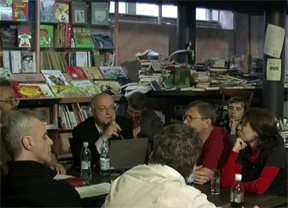
Organizer : Friends, we are very glad to welcome you all here, thanks for coming. We continue the VII Moscow International Festival “Biennale of Poets”, now we have an equator, and today we have a round table, which Alexander Barash and Vladimir Druk lead, and they will talk about a round table and what topics will be discussed here, and I think, an interesting conversation will be obtained.
Vladimir Druk: Good afternoon, we are all very glad to see you here today. For us, Alexander is a special day: this is the first event, the first event that we do as part of our new Keywords project, or keywords . Two words about this idea. The essence of the project in a nutshell can be determined as follows: life throws us key topics, and we are trying to find keywords to them. This will probably be a magazine, it will probably be an online publication that is not directly literary, that is, not so much the text as such is interested in, but the text is inside the context, the text as a reason for conversation, a reason to clash of opinions and as an occasion of attempts to transfer experience. This project was born from the concept of international Russian literature , which Alexander nominated several years ago, and which comes down to the fact that historically Russian literature became international. It doesn’t matter who lives where, the geography disappears, and nevertheless, there is a community in this literature-of course, this is not only a language, but also a kind of cultural pattern, some scenarios that we carry out in various ends in different ends of our ball.
The essence that unites us all is a kind of human scale. Therefore, we would like to talk not so much about concepts, not so much about theoretical layers as through the prism of real human experience, the experience of a small person on a big land that should somehow survive in today's world.
A round table is the first attempt to implement this idea. We called different people with very different views and, previously, felt for the turn of a given topic, it is called “not / translated experience”. Today we would like to talk about the experience of the Holocaust, experience after the Holocaust, the experience of today and yesterday in Russia, the experience of American or, in the broad sense, the experience of the Internet, information experience, the experience of Israeli, European ... We also visit our colleague from Canada - North American experience in this sense. I will now give the microphone to Alexander, and he will tell in more detail about the participants and about the topic of the table, and again thanks for that you came, I really hope for an interesting conversation. Alexander Barash.
Alexander Barash: The theme of our table is “not / translation of experience” - that is, the question is raised here whether we translate experience or unequerful. On this topic, of course, there are opposite opinions, and if there is a dispute and dialogue, we would be happy about this. It seems to me to say that the experience is unequerful, now the easiest way. This seems quite obvious on the wave of anti -globalization sentiments, the world again breaks up into autarkic communities, self -uniform conditions; The significance of private, private increases. What is natural after injuries of the 20th century, in many ways similar in different societies in various places of the world. Let's say Soviet experience. The experience of experiencing totalitarian pressure and attempts to eliminate the existence of not just private, but human as such, when a person is destroyed and physically, not to mention everything else. How much is in the relatively anthropomorphic world with which we all deal and in which we live in one way or another, does the experience of camps, the experience of concentration camps, the Stalinist camps? We know that Varlam Shalamov spoke on this subject: that this experience is simply “there”. Unfilled. A similar experience existed in many other communities and still exists, including Latin America, Asian countries. We will not delve into this particularly, but, say, the experience of the Holocaust - and half a century of correlation with it all over the world, from different sides, can help working with Soviet totalitarian experience. There is a Jewish experience, Israeli. There is a German experience, the experience of the Germans experiencing what happened to them for 12 years from 1933 to 1945, and, as far as I know, they were found - albeit with inescapable injuries - but still to human, civilized and anthropomorphic. This topic, I hope, will be affected today. As for Israeli experience, I will give some models that I saw while living in Israel and translating modern Jewish poets. The experience of Pagisa, who was born in 1930 in Bukovina, was very significant, in 1941, together with his grandparents, he was deprived of the concentration camp in Ukraine and in 1946 came to Palestine. His native language was the German language, He did not know Hebrew at all, existed only in German European culture, but switched to Hebrew. And in his poems, as far as I see this, he tried in every poem to re -pass this experience and survive like a person, as a private person, to escape after the disaster. And this, it turns out, is as difficult as surviving directly during the disaster, although it may sound somewhat blasphemous, one thing is physical destruction, another thing is survival in human conditions. But so far in Israel there are several psychiatric clinics for those who mentally have not experienced disasters ... To survive mentally, mentally after the Soviet era - probably, it is just as difficult. And therefore, models are important how others survived in such cases. Here are two poems Dana Pagis, which, it seems to me, are significant in this sense. "Graduation exam":
"If I'm not mistaken:
Lightning that went out, only now
Pierces the eye.
Air in the place of a cut hand
Causes the stump "
- No, not so. The memory is not here.
What you say is allegory.
But you, my worker, you
Must be accurate. I expected more from you.
Well, nothing, do not be afraid. You will not fail.
Think. Think again well and tell me:
Where is the memory?
Who struck?
What is cut off?
What is here, among other things? Higher power requires: at the time of unbearable pain - to think , to see, to call what is happening. And another text. "Comment":
From the very beginning, the forces were unequal: Satan is a very large rank in heaven, and Job from the flesh and blood. But even without this, the competition was not honest. Job, who lost his whole wealth, lost his sons and daughters and was amazed at leprosy, did not know at all that this was a competition.
Since he complained too much, the judge ordered him to shut up. Since Job obeyed and fell silent, he won, without knowing him, his enemy. And so: wealth was returned to him, sons and daughters are given - new, it is clear - and the pain of the loss of the first children was removed.
We might think that this compensation is the worst of all. They might have thought that the worst of all, the ignorance of Job, who did not understand that he had won, and whom. But in fact, the worst thing is that Job never existed, but was only a parable.
Now I want to transfer the microphone to Vladislav Kulakov. The topic, as I understand it, is a private poetic statement, as far as a free personal, private statement in the conditions of totalitarianism. We have given a wonderful experience of the Lianozovo school, Vsevolod Nekrasov ...
Vladimir Druk: I forgot to offer the regulation. Let's in a circle, participants in the round table are 3-5 minutes. If a question arises or someone wants to answer - please, then we move on to the next. We will make one circle, then in a minute the second circle: maybe someone will have some echoes or replicas.
Vladislav Kulakov: What Alexander said is interesting and important, at first I will say a few words about it. Naturally, I have my own point of view on this, and if we talk about the main stated topic “NOT / Translation of experience”, then this issue can and should be resolved at different levels, that is, there is a level of fiction, literary, poetic or philological. It can be said - and at a determined level it is known that poetry is unequivocal, and on the other hand, there is a general cultural level, general historical, general philosophical, and in this sense we translate the experience, and the language of translation is art, and poetry as the basis of art in this matter plays a crucial role. As for the experiments that are discussed here, about the tragic experiments of the 20th century, I believe that the very horror of the Holocaust, any genocide, as Shalamov said, cannot be the basis for a work of art in general, there is a “Gulag Archipelago”, there are Shalamov, and on this, I think, the literature of the other as such ... The main statement is already there; This does not mean that these topics cannot be applied, you can’t build an aesthetics on this, because it is something beyond, because the experience itself, what happened, disasters of the 20th century, changed a person and humanity, and the experience of living after these disasters. And the very famous question that was asked Adorno about how poetry after the Holocaust is possible is a key moment for the emergence of a cultural life after death. After the catastrophe - the Soviet or Holocaust, in principle, this is all one - it is important, and we can already summarize this experience, and the German experience of the second half of the 20th century is also, of course, about how this was experienced by art after this nightmare, which was inflicted not only in Germany and Russia, but to all of humanity. And in this sense, the experience of the art of the second half of the 20th century is very significant, and the Lianozovo group, but, of course, this is not only the Lianozovo group, but what we call unofficial literature of the second half of the 20th century is non -certificate literature. Similar things were happening in German literature, and this experience was broadcast at a certain stage, but at first it developed independently. At a certain moment, an acquaintance occurred and even, as you know, in the late 80s, when the Soviet government collapsed and when the iron curtain disappeared, a personal meeting of representatives of the Lianozovo group - the Russian school of specific poetry - and the German classics of concreteists took place. It was a very significant meeting. By that time, they knew about each other, and what Vsevolod Nikolaevich Nekrasov said, that everyone reached everything with his mind, they reached about the same things, this is significant, and this experience is the basis of the culture that now exists and determines the cultural situation. And it is already quite articulated, but we will always talk about it now, and we will keep it in mind, because new generations will keep this in mind. Perhaps everything.
Vladimir Druk : Are there any questions?
Alexander Barash: Not yet ... Alexey Prokopyev, please. I think that, first of all, we must congratulate Alexei, yesterday he had a big day. With the Nobel Prize!
Alexey Prokopyev: Thank you, Naturally, with the Nobel Prize, they will never give me, of course, of course, because I translated not only the transmitter, but the chairman of the editorial commission for the translation. They are the Swedes - and the Swedish poet gave a prize in 2 decades, even more, I congratulate all translators, both in Russian and in all other languages, but let's return to our topic. I heard key concepts in this topic of translationability, I will start with this. Since I, as everyone understood, the translator, God himself told me to talk about it, narrowing a little topic to the German poetry, which I do most. There were a lot of fracture eras in German poetry, but I would like to talk in relation to the 20th century about two - of course, the beginning of the 20th century, right in front of the war, this is early expressionism, the early one is not in the sense of immature, but chronologically just before the war everything happened there, although many connect German expressionism with the horrors of the First World War. This is the beginning of modernism, and if you look at the past XX century - I do not know how to do, through these horrors, blood - a little impassive, from the height of the impassive spirit, and weapons of mass destruction, and the death machine that we have invented is also a product of modernism. It is not known what influenced, but it can be said: it is great that the 20th century faded and brought, here I agree with Vladislav Kulakov, the experience with which we will now live. This experience is that the translation is not a translation from outside; The translation, if you take a poetic text, is a translation up and inside, and therefore any poetic translation is a poetic action, that is, here it coincides with poetry. The second turning point for me is associated with the name of Tselan, of course, for which his work was a means of survival, and, by the way, he also engaged in translations, and it seems to me that in the 20th century it is not possible to be in literature, not in contact with this activity, because any creative effort is also a translation. German expressionists laid the foundation for modernism, that is, they repaired expressive means in all types of arts - not only in poetry, this applies to theater and cinema, and captures all areas of art. You can talk about them for a long time, but the most interesting thing that they wrote the most important before the First World War, before these horrors, the foreboding indicated little that all this would happen, and only the death of the Titanic in 1912 was a fatal omen, but in general everyone hoped for the peaceful coexistence of the peoples and the possibilities of technology to reconcile all, it was very hoping that the wars would end, but it would not be fighting for anything, but it was not to fight for anything, but it turned out to be not to fight. So. Expressionism is a repair of the language of arts, because the words have ceased to mean anything in the era of the decomposition of a large style, and a new page of the history of art has begun, and now, through expressionists and Celanes, it is clear that the poetic language of Nietzsche is a anticipation of postmodernism. Oddly enough, in the history of creativity, everything follows sequentially, one after another, exists at the same time. And then many of Nietzsche’s verses become clear, which did not succumb to translation in any way, because they did not see them as sounding completely modern, all the warnings that were relevant for the 20th century sounded in them. Let's get back to Tselan. Tselan made the language of his works and he once again emphasized with particular force what is characteristic only for the 20th century: if before work coincides with culture, now creativity is fighting with it, and culture is a certain inhibitory factor, and sometimes even an antagonistic beast -like creature, which aggressively and pushes all living things or kills it. Here I would like to say a little about speculations on the famous phrase Adorno that (I quote shortened), "after Aushwitz to write poetry is barbarism." This phrase sounds like this: “Criticism of culture reveals itself before the last step of the dialectic of culture and barbarism. Writing poetry after Auschwitz is barbarism. It undermines the understanding of why it has become impossible to write poetry today. ” He writes about the understanding of why it is impossible to write poetry, and not about the fact that it is impossible to write poetry, and later, realizing that he was misunderstood: “Perennial suffering has the same right to expression, as well as a person tortured by disease, a person has the right to complain and whimper, to howl and yell in pain,” therefore, it is incorrect and wrong, that after Auschwitz, poetry will probably ask a less cultural question: and a less cultural question: A Is it possible to live on after Auschwitz? And then the answer is that when people are all similar and speak in the dead language, this leads to Auschwitz and says that the survivors are surrounded by cold and indifference as a kind of pacness of bourgeois subjectivity. That is, the poet, unlike a person, should not be guided by the motive for self -preservation - this is all for now. I am very glad that immediately after Vlad Kulakov received a microphone because he said that poetry is unequerful. I would clarify: the words are indistinguishable, but just poetry, oddly enough, is translated, because it is not a translation of cultural concepts, but immanent concepts, what is hidden in it as a grain.
Vladislav Kulakov: Alexey was ahead of my reservation, I myself wanted to do it myself, that is, it must be more correct to say this: poetry is unequerful, but it must be translated, and then it will be translated ultimately. As for the quote from Adorno, thanks to Alexei I know that this is all true, but I perceived her so from the very beginning, that is, I meant that life and poetry are one thing. Thank you.
Alexander Makarov-Koro : poetry is non-transmitted, unequivocal of the word, but we translate the context if the translator is capable of this. When a brilliant translator, he may meet samples ...
A replica from the hall : about the ingenious translator - he can obscure and translate, some translations have suffered.
Alexander Makarov-Koro : by the way, there is nothing wrong with that.
Alexander Barash: We were talking about Soviet experience and about German experience. The experience of totalitarian influence on a person and his reaction-complicity, rejection-always has some roots in some layers of culture, mentality. Maybe we will now try to touch on the example of the transition of a wonderful, prosperous, civilized country (with all his imperial pros and cons) to a terrible, crazy totalitarian dictatorship, and how this is perceived by a person who is one of the private private and human literature in Russian literature. Anna Golubkova.
Anna Golubkova: Before moving on to Vasily Vasilievich, I would also like to touch on the essence of the problem of translation, which rests on European culture, of course, in the era of romanticism. And Tyutchev brilliantly expressed two key problems: “How to express yourself to the heart, how to understand you?” - We have two points here: a person whose personal individual experience should be expressed and encoded so that others can understand him, and we have a recipient who should somehow decode this experience. This is a very big, important and difficult problem, its framework includes the problem of translating a poetic text, but this problem is related, first of all, to individual experience, which is difficult to formalize and is difficult to reproduce. If we talk about totalitarianism, then his main feature, as everyone who grew up in the Soviet Union, is probably known, is the unification of experience. That is, people brought up in a totalitarian state from childhood receive very clearly defined information, and their unified experience - maybe this is all the horror of totalitarianism - that a person is not given the opportunity to grow individually, grow into a person.
As for Vasily Vasilyevich Rozanov, he, of course, was anti -Tutaline in his nature, if only simply because he was different, and any attempts to define him as Pushkin, almost as the Lord God can be done only apophatically - than Rozanov is not . Rozanov does not have the problem of expressing his experience, he does not think about it, he tries to be adequate to himself at any time, and, although, perhaps, this is also partly such a pronounced position, but the problem of understanding him also did not worry. It is known what his book “Solved” begins: and at least to anyone , that is, I write for myself and for anyone, and I don’t care how it will be read. He had a long development period, in this development there were completely different stages, and at one of these stages he encountered two types of rudiment - I can not even say “totalitarianism”. Before, I want to disagree with the fact that everything was fine in the Russian Empire - and suddenly the Communists appeared, in fact this is far from the case.
Firstly, there was a censorship, there were ideological persecution of not only revolutionaries, social democrats, there were persecution of people of another religion, for example, Prince Sergey Volkonsky in his memoirs is very outraged that only an Orthodox person can make a career in the Russian Empire, that the violent Russification, the violent imposition of Orthodoxy in the same Poland. It is impossible to say that suddenly the totalitarianism appeared from nowhere, his rudiments were, and it was no coincidence that the immigrants of the Russian revolutionary movers from the families of priests, the icons of Russian social democracy Chernyshevsky and Dobrolyubov became the ideologists of the Russian revolutionary movement ...
Replica from the hall : It is good that they have nothing to do with literature.
Anna Golubkova: But they had a great relationship to Russian literature centrism. And returning to Rozanov-he devoted a lot of effort to fight the heritage of the 60s and 70s, with unambiguousness, with the totalitarianism of the discourse and his famous “polemic with God”, bright, in the 1900s grew from the 60s-70s, because Gogol was an exemplary writer for Chernyshevsky and Dobrolyubov, a revolutionary protested protest The orientation writer-naturalist, who shows how not to live. We all took place at school, we all know this. It was Rozanov’s merit that he began this polemic back in 1891 and during the manifestation of Russian modernism and actually fought from the very beginning and one of the first showed all the narrowness, the limitations of this understanding and literature, and the approach to life.
Replica from the hall : remark. It seems to me that the personality grows from this individual or not, it is very individual and does not depend on the era, society, the formation, and so on, and to say that with unified experience, the personality cannot grow-it seems to me that this is a very strong statement, and this means that, relatively speaking, in the 60s and 70s we could not grow a person, it seems to me that this is wrong.
Anna Golubkova: I did not say that I could not grow up.
Replica from the hall: I heard it, and it will be in the record.
Anna Golubkova: I said that the experience was unified, and in no case did I want to be understood so that a personality could grow in a totalitarian state. The problem of understanding, so difficult for romantics, in the presence of a certain general experience, is facilitated at some stage, and at some is more complicated.
Vladimir Druk: Dear colleagues, these are some kind of deep Russian problems related to Russia, with our culture, nevertheless, I wanted to introduce our guest, Canadian poet Louis-Philippa Eber, and let's transfer to several other cultural coordinates.
Alexander Barash: And let's see how these experiments coincide and translated. I would not insist that these are completely different experiments, but let's see.
Louis-Philipp Eber: The literary world is deceptive, because the written word lives not when it is written, but only when it is read. Some of my students at my seminar ask me a question, for example, how to describe a chair. It would seem that it’s easier - to describe a chair, of course, everyone wants to describe their own native chair. And when a person writes that he sat on a chair , he saw a chair , and people read, if you check, it turns out that each of the readers does not see the chair that the author saw, but sees some kind of close chair for him. Of course, you can use clarifications, to say that this is a red chair, and a slightly different picture will appear, or, say, a long red sunlock - and still everyone will see something of their own; And this is both weakness and the power of a literary statement. In essence, each time we are dealing with the fact that in the heads of our readers, that is, we go inside.
I talked about this as the failure of writing, this is not powerlessness and this is not omnipotence, this is unlimited, that is, we abandon our power and transfer this power to readers. When moving from one language to another, a double translation difficulty arises, because when even we write in the same language with the reader and when we speak of some realities that we want to present and convey to our readers, we are faced with difficulties.
Vladimir Druk: Thank you. Are there any questions, remarks?
Alexey Prokopyev: There is a replica. It said that totalitarianism unifies the culture, language, all the work of people. I did not finish, the words adornously expressed in connection with the disaster, there is an indication of the fact that experience is unified in any case, not necessarily totalitarianism, he speaks of bourgeois subjectivity ... We are talking about totalitarianism , totalitarianism , but the general significance of this experience, the literature that we are talking about, and in particular, is also that the language has a power discourse and the language possesses the language, and The artist always remains with this problem. In the 20th century, modernists and postmodernists actualized this problem and made the subject of their artistic consideration, but these, of course, are completely incomparable things - the catastrophe and the authority of the language. But for aesthetics and art, things are real, and therefore everything coincided here, and this problem remains everywhere, it is not a bourgeoisie, not in democracy, the language socializes us, and this socialization can be called culture. The artist should always solve this problem, break out for these limits, and only then can he find the right to artistic statement there.
Anna Golubkova: The possibility of understanding may decrease from this.
Alexey Prokopyev: Naturally, yes
Alexander Barash: We continue our conversation, and I want to give the floor to Ilya Kukulin. In anticipation of this round table, we spoke with Ilya, wrote off, and he wrote that there are interesting American studies of recent times, where the emphasis is put just on the fact that we translate the experience. Thanks to what and in what conditions?
Ilya Kukulin: Good afternoon! When we say that Varlam Shalamov wrote that the experience of the camps is not applied to anything and that he is absolutely useless, we should think about what the writer specifically had in mind: in which area this experience is useless if the Shalamov wrote about him and sought to publish or, in any case, to spread his stories? If he considered the experience of the camps absolutely useless and non-translated, he would not write about him. I believe that Shalamov considered this experience, so to speak, non -reliable. Unlike Solzhenitsyn, Shalamov believed that the memories of camps cannot be described teleologically, in the categories of personal growth and enrichment of the inner world (this was written by philologist Elena Mikhailik). This position does not mean that this experience is meaningless in principle. The impossibility of integrating the catastrophic events of the twentieth century in the teleological perspective, apparently, was also recognized by Israeli historians, they insist that they need to say not X Olokost , but W OA -a catastrophe: the Holocaust is a sacrifice, that is, an action aimed at creating a meaning. Shoa is a catastrophe, the destruction of human lives that cannot be given meaning, cannot be justified.
Now what I wanted to say, preparing for this discussion. Before experience can be translated, you should think about the conditions under which it can be divided by another person. This reflection precedes translatedness, and in Russia there are problems with such preliminary work. In the last issue of the magazine “History Questions” for 2010, a letter of military historian General Mikryukov, who fell upon a modern presentation of the history of World War II in Russian school textbooks, was printed. This letter ended with a statement that "people who know it firsthand to write about the war." This statement, in my opinion, is strange from a scientific point of view: after all, scientists often write about what they know from books and other sources, that is, “firsthand”. But from a cultural point of view, this statement is very characteristic, because the word in the first time in Soviet history has a rich cultural semantics.
Oh, years of youth Nemile,
Her cruel troubles.
It was a father, then suddenly he is an enemy.
And mother?
But it is said: two worlds,
And nothing about mothers ...
And here, where - behind the flood
Those years - you hurried barefoot
You are called the outfit
Not even a son, but a son ...
And how to live a guy with that nickname,
How to serve an unknown time -
Firsthand
Not from the book
The author of these lines interprets ...
- wrote Alexander Trifonovich Tvardovsky in the poem “By the right of memory”, testifying to his right to speak on behalf of the children of dispossessed;
In sports jackets boys,
With brutal greed, shells,
About the past, knowing firsthand
They shout in the audiences ...
-P Isal Yaroslav Smelyakov, who spent many years in the Stalinist camps, about pop poetry in the spirit of Voznesensky-Evtushenko.
Leonid Kostyukov : This is as if one poem.
Ilya Kukulin: I think that the similarity of these poems that throws into the ears indicates a deep problem that exists in the Soviet and post -Soviet culture, namely, that the traumatic experience we have made from the Russian past is thought as an unrequited experience of the victim . A person who is known bodily is known, but a literal experience can not be known: he seems to become invalid. This problem is visible by a very large number of signs. It seems to me that the camp topic after the majority of people who were ready to share the experienced, went mainly into the category of mass culture. Examples are the film by Nikita Mikhalkov “Tired by the Sun 2”, Roman Alexander Bushkov, Andrei Konstantinov and Evgenia Zashenkov “The Second Spartak uprising” ... You can list for a long time. What does not happen at all in the literature of the West, which we talked about with Alexander Barash when preparing this round table.
A few years ago, a special issue of Studies in Novel magazine, prepared by Belgian scientists, Stef Crees and Gertht Bulets, was published in the United States. Creus and Bulans in his introductory article and especially the crepe in his own article in this issue wrote that Shoa as a catastrophic event made translated, mutual understanding experiments of ethnic purges and discrimination on ethnicity that took place in the 20th century. People from Africa, authors of post -colonial prose, subjected to various kinds of repressions and deportations, comprehend their experience, translate, for example, for Asian authors and European through the experience of the Holocaust.
And here I have to remind you, the Anglo-German sociologist Ulrich Beck in the book “Power and its opponents in the era of globalism” expressed this idea as radically as possible. “Unfortunately,” wrote Ulrich Beck, “the Americanization of the Holocaust was the only way of its internationalization.” In the conditions of globalization, not only the parcellation that Alexander Barash is talking about, not only splitting into separate societies and clusters of the world, but also an idea that, nevertheless, the post-traumatic experience of different clusters should somehow be translated and correlated. It seems to me that in these conditions the reflection of the problem of such translatedness in Russian culture is extremely important, in which, I believe, the idea that experience cannot be transmitted in vile, and I will not go into details due to the brevity of time in how it can be done. It seems to me that this for quite some time, albeit in parts, in small steps, has been engaged in Russian non -certificate literature, starting with the Lianozovites, Varlam Shalamov and some other authors. The most important thing here, as it seems to me, is a reflection of the boundaries of personal experience and the boundaries of the human person.
Where the individuals are interpreted as different , based on the assumption that their experience is irritated to each other and everyone has their own configuration of borders, there, oddly enough, this idea of the possibility of translation begins. It’s like with the translation of poetry: poetry cannot be translated, but poetry can be translated, realizing what is translated: words, context? I think it depends on the specific this case; I think that a universal algorithm describing how this or that poem is translated, let my colleagues be corrected, who translated more than I may not exist.
Understanding the individualism of each experience is a heavy mental stress. I would like to tell our Canadian colleague that in Russia we faced a problem simultaneously combating hard structuring of experience and struggle for such structuring. We are facing a problem of double complexity, which has formed in the post -Soviet period: it is necessary to simultaneously seek to understand how a person changes himself - and it happens that he changes himself - during competition in a market society, and at the same time in the conditions of modern democracy, to comprehend the boundaries of post -traumatic experience ascending to totalitarianism - as a unique and requiring translation precisely. Thank you for your attention.
Vladimir Druk: Thank you very much. We continue the discussion, I want to convey the word to Victor Korkia, the poet, playwright, to the person with whom we argue and almost never agree, although we have been friends for many years. Victor Korkia.
Victor Korkia: I wanted to say that we call some words in other words, we mean others - and the result is a completely different meaning, because it is not yet clear whether it is the tables. And when we concern such problems, here in addition to philological problems, mental, historical, political and too many gradations arise, especially if it concerns a poetic text. I will express my opinion: I think this is really impossible. It is possible to take into account for people who at a serious level speak a foreign language, some achievements and try to do something like that in their poetry, but another question is that you can show some things, and for this there is a poetic translation as a kind of cultural function.
I also translated, and, frankly, I also had experience when I began to translate the Polish poetess Vladislav Shimborskaya, and no one printed it. And the colleague who helped me with the interferences said: “Wait 10-15 years old, she will be given the Nobel Prize - and they will begin to print it,” and indeed, not even 15 years have passed since she received this award, and my translations began to print.
It makes sense to identify a completely different topic, although it adjacent to this one. The fact is that we are in front - now a fashionable word, I hear it all the time, the word challenge - we are before the challenge, which, perhaps, has never been in culture. Here they said that there are phenomena where counter -cultural reactions are more interesting than cultural. I will quote one wonderful poet Igor Shklyarevsky, who somehow said to me in a private conversation: “You know, while politicians talk about peaceful coexistence, languages are fighting each other to death,” - this is approximately. Я никогда не учил английский язык, я учил в школе немецкий, а потом самостоятельно немного французский, но сегодня я больше всего знаю английский, потому что каждый день компьютер заставляет меня учить английский язык. Я не хочу сказать, что мне это не нужно и не интересно, но это происходит помимо моей воли.
Если мы будем говорить о людях, а здесь большинство пишут по-русски, то мы сейчас ощутили проблему, которую 20 лет назад, наверное, ощущали поэты малых народов России: мы внутренне ощущаем, что наши слова замыкаются на этом пространстве, а пространство стало мировым - и как это преодолеть? Потому что никакой перевод адекватно не может передать… Можно передать мысль Адорно или Хайдеггера, но ощущение Пушкина передать нельзя, очей очарованье – это ничто на другом языке, это по-русски замечательно, и есть вещи, которые находится вне слов, между слов в энергетических пространствах, это не реально.
Реплика из зала : Почему этой проблемы не было раньше?
Виктор Коркия: Этой проблемы не было раньше по одной причине: дело в том что 100 лет назад ситуация была принципиальной иной. Когда поэт писал свои стихи, то его поэтический талант был неким усилителем его слова, а теперь усилитель, который я держу в руках ( показывает микрофон )…
Владимир Друк: Хорошо чтобы ты его держал ближе.
Виктор Коркия: …и вот усилитель, который смотрит на меня и тот факт, что у меня в руках микрофон, означает, что в данный момент у меня в руках власть, и это очень серьезные вещи. А тогда нужно было быть Есениным, Маяковским или Пикассо. А сейчас - нет, достаточно взять в руки микрофон, и чтобы на тебя направили камеру. Если ты человек, это уже интересно, то есть мы получили совершенно другие технологические обстоятельства, и эти обстоятельства будут усиливаться. И я хочу сказать два слова о тоталитаризме и Холокосте: я подозреваю, что те вещи, которые проявились в политике, гораздо больше связаны с технологическими вещами, нежели с общественно-экономическими. Я подозреваю, что тоталитаризм, в том виде, в котором мы его знаем, - это продукт совершенно определенной технологической эпохи, которую можно назвать газетной . Это не значит, что в телевизионную эпоху не бывает каких-то страшных вещей, но это будет по-другому, потому что здесь нужна картинка, и поэтому мы получаем теперь 11 сентября, а там были другие вещи …
Владимир Друк: Получив микрофон, и таким образом перехватив власть у Коркия, я хочу сделать маленькую ремарку. Мне довольно странно, что мы ни слова пока не сказали про новый травматический опыт, про опыт 11 сентября в Нью-Йорке, про опыт Беслана, про опыт взрывов на Пушкинской, про израильский опыт, про иерусалимские автобусы … Это наш холокост, это холокост сегодняшнего дня, он касается всех, и в этом смысле травматика Холокоста поставила нас всех вместе на одну чашку весов, а с другой стороны весов что-то другое, но здесь мы все одинаково обречены. Да, мы все сейчас одинаково обречены в этом смысле, и та индустриальная или коммуникационная новая ситуация, о которой говорил Коркия, сегодня ставит нас рядом. Да, кто схватил микрофон и выхватил камеру – герой, но он герой на секунду …
Виктор Коркия: Буквально два слова... Уже после Эйнштейна мы знаем, что пространство - это есть время, это серьезно; если ты сегодня схватил все пространство, то значит, ты схватил вечность, это одно и то же, мы с тобой об этом много переписывались, я хочу по-своему сказать – это терроризм. Дело в том, что вокруг терроризма все время складывается сложная и разветвленная мифология вместо того, чтобы сказать о простых и очевидных вещах. Простые и очевидные вещи ужасны: почему взрывают автобусы, почему налетают на больницы и так далее? Потому что все остальное жутко защищено. Уберите охрану с государственных объектов - и террористы будут взрывать не больницы.
Владимир Друк: Нет, здесь не в этом дело, не в терроризме как таковом, а именно в травматическом опыте, я про это говорил…И вторая вещь, о которой я хотел сказать: новая коммуникационная ситуация заключается в том, что если мы говорим про опыт, в опыте действует механизм памяти, а сейчас возникает совершенно парадоксальная ситуация. С одной стороны, мы все более и более оцифрованы и все больше отдокументированы, и компьютерные технологии позволяют нам наш опыт сохранить, и, таким образом, человечество каждую секунду производит терабайты и терабайты цифровой памяти, а с другой стороны эта память больше никого не интересует как таковая.
И здесь возникает эффект ленты : лента новостей, лента - как хотите ее назовите, но сегодня это одна из интересных вещей, которая происходит с нашим опытом: опыт как таковой исчезает, становится секундным. Это новый злодей, вырывающийся к микрофону, к которому сегодня обращены камеры, - он калиф на час или на секунду, он получает крошечную долю славы. Кто-то говорил, что все имеем шанс на 15 минут славы, сегодня перестроено на 15 секунд, но сам эффект того, что не существует вчера .
Память есть гигантская терабайтная - никто не знает, что делать. Google не знает, как избавиться от этой памяти, Yahoo или Yandex не знают, что делать с хранилищами этого информационного мусора, как выделить там хоть что-нибудь ценное. И это при том, что художественное высказывание не подлежит сегодня нормальному поиску в интернете, не может найти Google художественное высказывание в интернете, только логически выстроенный или маркетинговый текст. Так вот: возникает эффект нового публичного одиночества , если можно так выразиться. Мы - Homo Virtualis , мы все становимся виртуальными, мы абсолютно одиноки, хоть во френденте ЖЖ или на Facebook, просто на новостной ленте, но мы строем идем к полной виртуализации, и развиртаулизация грозит горьким похмельем.
И еще одно замечание: кто-то говорил про общий язык, и это, естественно, сводится к мифу о Вавилонской башне. В иудаизме эта история мудрецами Талмуда трактуется следующим образом: Всевышний разрушил тот общий, единый язык, разделил его на множество языков, чтобы одноязычие людей с дурными наклонностями не привело человечество к катастрофе - так написано в Талмуде…
Я передаю слово Александру, и он представит следующего участника стола.
Александр Бараш: Я надеюсь, что Леонид Костюков, расширит эту тему не как просто литературную, а как тему литературного существования, соотношения поэта, писателя с разными тоталитарными ситуациями: языковой, социокультурной, что было раньше, что есть сейчас, пожалуйста, Леонид Костюков.
Леонид Костюков: Спасибо. Я очень сильно сменю дискурс, как принято говорить, удачно вышло, что я последний, говорю в каком-то смысле отдельно, потому что все здесь выступили как исследователи, а я выступлю как исследуемое , потому что я буду говорить о своем личном опыте. Второе - я очень сильно понижу пафос, потому что буду говорить о том, что действительно видел и знаю не понаслышке, то есть лагеря и Холокост и так далее знаю понаслышке, и, может, что будет самое удивительное, я в конечном итоге довольно резко изменю вектор того, о чем идет речь. Я начал писать в 1982 году, был жив Брежнев, был какая-то форма понижения тоталитаризма. Анна Андреевна Ахматова такого рода эпохи называла вегетарианскими, как вы помните, то есть, условно говоря, чтобы понести какое-то мучение, сесть в тюрьму и так далее, нужно было предпринимать специальные усилия; если ты такие усилия не предпринимал, то жил тихо. Я начинал писать один, потом возникло мы, и, начиная с некоторого момента, я буду говорить о нас. Когда я начал писать, тут очень важный момент, надо было определить, что ты готов поставить на этот алтарь, если сказать мягко и без пафоса: какие издержки ты готов нести? Я был готов нести такие издержки – долго писать в стол, писать и выкидывать, это относится к письму, творчеству и так далее, в свободном обществе или не свободном, то есть я был готов потратить очень большой труд. Далее, в тот момент, когда я буду писать хорошо, как я думал, я был готов писать абсолютно в стол, то есть я был готов к тому, что СССР, который я полагал вечным, никогда не станет меня печатать, я на это шел по доброй воле. И третий пункт, может быть, не такой ощутимый, что в ментальном плане с этого момента я писатель, я литератор. То есть до этого дня я был инженером, или мнс, или аспирантом, который кроме всего еще что-то писал, а начиная с этого дня я писатель, который находится в теле инженера, который играет роль инженера, то есть внешне мало что меняется, но идет перенос веса в эту сторону. И в связи с этим переносом веса я был готов (математик, инженер, мнс и так далее) не достигать успеха в этой сфере, потому что вес вынесен, и не сделать никакой карьеры. То есть я был готов к опыту аутсайдера , и я не мог не думать о том, что, может быть, ситуация в обществе изменится - а изменится, мы полагали, только к худшему, - и общество и эта ситуация потребуют от меня большего - пойти на какие-то мучения, страдания, в тюрьму и так далее, и там стоял вопрос: хватит ли у тебя на это сил, воли? Через 29 лет, в 2011 году, что мы видим? Мы видим, что те издержки, которые мы хотели нести, год от года становились все меньше и меньше и в итоге - представьте себе, что ты ходишь в одну и ту же столовую и 30 лет назад называл ее тошниловкой , это была какая-то омерзительная столовая и постепенно в ней становится все лучше и лучше. И сейчас ты идешь со своим другом и говоришь: пошли в тошниловку, мы всегда туда ходим, - он входит в эту тошниловку и говорит: «Да, какая это тошниловка, это великолепное место, тут очень вкусно кормят, очень дешево и уютно». Я, может быть, сам не отметил бы этого, но мой друг Виталий Пуханов, которого многие здесь знают, в одной минуте ходу отсюда сказал: «Мы готовы были что-то отдать за то, что мы поэты и писатели, а вышло так, что нам сейчас по 45-50 лет, и все что у нас есть, дала нам литература». То есть от нас не потребовалось никаких издержек, никаких жертв. Понятно, что я сейчас говорю не об опыте сочувствия, сострадания, я говорю о существовании литератора, о чем и надо говорить, и вышло так, что, напротив того, от нас не потребовали ничего, а нам взамен что-то дали. На первый взгляд, это очень хорошо, на второй взгляд некоторые гештальты остались недостроенные. Есть известные строки Бориса Леонидовича: «…оставлена вакансия поэта, она опасна, если не пуста». Вакансия на данный момент не опасна; есть опасение, что она пуста. В том, как мы существуем (тут я уже говорю мы ), есть моменты абсолютного достоинства, когда понимаешь некоторую адекватность того, что ты дал, и того, что ты взял, ты даешь урок физики, химии, математики, берешь 1200-1500 и все счастливы, все отлично, потому что этот баш на баш хороший. Вот момент неполной адекватности: я несу свою книгу в издательство, и мне там говорят: «Старичок, это великолепно, мы обязательно будем печатать, только как найдем деньги». Я понимаю, хорошие люди по моей вине встали немного в неловкую позицию, потому что моя книга денег им не даст, она не окупится, они вынуждены искать деньги на стороне, чтобы из доброго отношения издать мою книгу. Здесь есть некий момент общественного договора. Блок в свое время сказал, что издательство Всемирной литературы, когда люди были заняты переводами и им за это давали огромные гонорары по тем временам, им давали гонорары, даже если они не делали эти переводы, даже если эти переводы не печатались, там была какая-то грантовая лажа в 1917-1918 году, и он сказал: «Нам, по сути дела, платят за то, чтобы мы не писали свои стихи». Сейчас есть такая ситуация, и я думаю, что она не только в Москве, я думаю, она в цивилизованном западном мире - общество в какой-то степени откупается от поэтов и писателей, чтобы не читать то что они пишут. Вы можете это писать, вы можете это печатать, вы можете устраивать фестивали, периодические издания, вы можете на это жить, вот вам стипендии, гранты, только не лезьте к нам, к некому внешнему кругу с тем, чем вы заняты. Оттенок этого есть, одних это унижает и нервирует больше других, других – меньше, меня, честно говоря, меньше, мне на это абсолютно плевать. Я хотел сказать, что, может быть, люди моего поколения, немного постарше и немного моложе, то есть люди примерно плюс-минус 50 лет оказались не совсем готовы к таким уютным контрактным западным цивилизованным условиям существования. Я специально в том, что сейчас высказываю, вынес за скобки все сложности, связанные собственно с письмом, потому что это не тема нашего стола - сказать: да, перед поэтом или писателям находится чистый лист, и он находится в конфликтной ситуации, потому что на него давят и Толстой и Достоевский, и Чехов, и Гоголь, и Пушкин, и язык, и задача невербальное делать вербальным, это наши издержки, но это и наше happiness. Об этом мы сейчас не говорим, а говорим о том, кто нам мешает. Мы ждали, что нам будут мешать со средней силой, но нам никто не мешает. Это не значит спасибо Путину и «Единой России», ни в коем случае так меня не воспринимайте, но это значит, что есть некоторый уют , к которому, может быть, мы не были готовы.
Владимир Друк: У нас наступает предел с регламентом, поэтому давайте сосредоточимся. Каждый имеет 30 секунд для итоговой реплики.
Алексей Прокопьев: Мы договаривались не говорить о текстах, а только о текстах, вписанных в контекст и я сейчас прочитаю текст, который вписывается в контекст, это стихотворение Целана «Анабасис». Перевод ценен для меня тем, что это опыт совместной работы Татьяны Баскаковой и Натальи Азаровой, которые вместе перевели, то есть я вначале сделал остов, скелет, рыбу, а потом мы вместе привели его в состояние готового стихотворения. «Анабасис» не имеет отношения к известному произведению Ксенофонта, поскольку значение слова Анабасис – это, вы знаете, с греческого, - движение наверх и движение вспять, возвращение, греки возвращались из Малой Азии, в горы поднимались, это было возвращение домой и движение наверх, в этом смысле связано с Ксенофонтом, больше ни в каком. Anabasis.
This
тесно меж стен вписанное
неудобоходимое-истинное
восхождение вспять
в светлое сердцем Сбылось.
There.
Слого- и
волнорезы, море-
цв е ты, в даль –
в невидаль – вдающиеся.
After:
бакенов,
стонущих бакенов строй,
с теми
дивно-секундно скачущими
дыхательными рефлексами –: свето-
колокольные тоны (дон-,
динн-, одинн-,
unde suspirat
cor ), –
from-
изнывающие,
взывающие, наши.
Видимое, слышимое,
освобождаясь –
Свод-Слово:
В Одном.
Thank you.
Леонид Костюков: С кажу несколько слов об общей теме: я как человек, который всегда имел не меньше отношений с художественной прозой, чем с поэзией, могу исходя из этого сказать, что какой-то самый главный опыт, конечно же, переводим. Я помню, мне было 15 лет и я был московским школьником, а Максу Фришу было, когда он написал «Homo Faber», наверное, лет 50, и он был швейцарский писатель. Но у меня не было важнее и ближе этого опыта - «Homo Faber»Макса Фриша, и не стоял вопрос о переводимости опыта, то есть здесь есть альтернатива.
Александр Бараш: Спасибо. Ilya Kukulin.
Илья Кукулин: Мне показалось важным то, что сказал Владимир Друк. В современном мире мы постоянно наблюдаем, как сообщения о катастрофах, репрессиях и их жертвах, которые нуждаются в нашем сопереживании и памяти, постоянно «стираются» следующими новостями -- об этом писали Поль Вирильо и другие теоретики информационного общества. Мне кажется, что именно в нашем опыте довольно много такого рода переживаний, которые постоянно смываются, уходят, никак не могут стать центральными. Опыт счастья или опыт письма могут оказаться переводимыми именно благодаря осознанию их уникальности и непереводимости. Оно позволяет предотвратить то стирание, о котором говорили некоторые сидящие за этим столом. Леонид Костюков сказал: опыт должен быть ценным. Я бы сформулировал иначе: когда мы его интерпретируем как уникальный, мы тем самым уже в рамках культуры Нового времени интерпретируем как ценный. Thank you for your attention.
Александр Бараш: Спасибо. Луи-Филипп Эбер.
Луи Филипп Эбер: Я вернусь к своей метафоре, в которой я говорил про красный стул, мы подойдем к нему с трех сторон. Мне случилось переводить одну английскую книгу на французский язык, в которой рассказывалось о плаванье вдоль тихоокеанского побережья и о той работе, которую делал капитан во время этого плаванья. Что мы теряем в переводе? Англичане были исконными мореплавателями, у них было по 25 слов на каждый мореходный предмет, на который во французском языке существовало одно слово, это жутко обедняло французский текст, мы вынуждены были повторять по 25 раз то, что они каждый раз называли новым словом. С другой стороны, я как-то участвовал в одном университетском семинаре, и там изучалась одна из моих книг, и какой-то студент расшифровывал мое стихотворение и все переврал что можно, я попросил слово и сказал ему, что все не так, а он мне ответил: «Мне наплевать, что вы думаете, а меня интересуют те мысли, которые приходят мне в голову по поводу вашего текста», - то есть его собственный опыт больше, чем мой. И последнее - писатели опасные люди, потому что когда они видят красный стул, они могут сказать: «Он вовсе не красный», - кто им запретит? Thank you.
Александр Бараш: Виктор Коркия.
Виктор Коркия: Я хотел как раз добавить: да, трактовка важнее текста. Я хотел бы ответить на серьезный вызов. Пока вы со своим другом разговаривали о том, о чем вы разговаривали, мы с другом тоже много разговаривали примерно на эти же темы, и у меня один очень простой вопрос: сколько раз вы выступали по телевизору?
Леонид Костюков: Пять раз меня туда звали - и я пять раз отказывался.
Виктор Коркия: Это то, о чем я говорю.
Леонид Костюков: А какое отношение это имеет к литературе?
Виктор Коркия: Это имеет гигантское отношение к литературе. В одном замечательном фильме «Успех», где Филатов играет, где они Чехова ставят, помните, он говорит:
- Слушай, выйди туда.
- Но они же меня увидят.
- Выйди.
- Они увидят.
- Да не видит тебя никто.
Что вы говорите, вас никто не слышит, это все заглушило - все, что там идет, все заглушило, поэтому вы рассчитываете на простую вещь: я со своим приятелем, который сейчас живет в Америке, замечательный драматург Антохин, мы считали, что хорошая пьеса - та, которую выкинул в форточку, а через год увидел, что висят афиши премьеры. В то время, во время Фриша это было так, но сейчас другое время, мы перешли в другую цивилизацию, мы ее плохо знаем. Если Друк раз в неделю по российскому телевидению будет выступать, он через 3 года будет нобелевским лауреатом, если он не будет выступать по российскому телевидению, мы будем собираться за этим столом, за которым сидят 15 человек.
Владими Друк: Спасибо. Anna Golubkova.
Анна Голубкова: Проблема перевода была бы совершенно неразрешимой, но, как показывает нам известная история человечества, все время что-то меняется, но что-то все время остается и тем же самым, то есть, тем не менее, несмотря ни на что, мы все-таки можем попытаться понять человека, который жил в Древнем Египте, или своего соседа, просто все зависит от степени усилий и от нашего желания. Я очень рада, что этот проект возник, который поможет нам понять друг друга и разные культуры
У меня пару слов по поводу Лёниного выступления о том, что вакансия поэта не опасна, это правда, но не пуста, и, конечно, развитие культуры претерпевает разные стадии, и Бог знает, на какой стадии мы сейчас находимся. Конечно, многое изменилось, но функция поэзии в этом мире не изменилась и не изменится. Поэзия - это и есть основополагающее именование бытия сущности вещей, как говорил Хайдеггер или кто-то еще по этому поводу говорил, и это никогда не изменится
Леонид Костюков: Я имел в виду: пуста или не пуста в том смысле, в котором писал Борис Леонидович Пастернак, непосредственно в длящуюся гражданскую войну.
Я хочу сказать, что все остальные проблемы - СМИ и прочее - это вторичные проблемы.
Владимир Друк: Я согласен с Ильей Кукулиным, который согласен со мной, смайл, что проблема в том, что мы не успеваем. Сейчас лента, стирающая опыт, не дает возможности ни по каким психическим законам этот опыт пережить. И прав Виктор, что новая коммуникационная ситуация не дает возможность его ни нормально транслировать, ни нормально воспринимать. Все время переключаются парадигмы. Я сейчас видел нищенку в метро, которая просила милостыню, но в вагоне ее просто никто не слышал, не потому что не хотели услышать, а потому что было шумно, потому что было окно открыто, потому что кондиционер отсутствовал. Почему отсутствовал кондиционер, вообще никто не знает – может, потому что люди равнодушны, может, они милостыню не хотят давать и так далее и так далее… Мы существуем в какой-то цепочке постоянного непереживания опыта. Поэтому мы никогда не знаем, как мы выступаем, в какой парадигме, это опыт обмана или это опыт беды, это опыт права голоса или опыт возможности быть услышанным и задача услышать самим.
Можно построить систему координат, в которой все выглядит, будто мы понимаем друг друга, в которой мы все лучше и лучше понимаем друг друга. А можно взять, и посмотреть с другой стороны и сказать, что это все разные степени непонимания. И мне это кажется более честно: признать - мы не понимаем друг друга, и это будет исходная точка, это будет та трагедия, которая может заставить нас слышать друг друга.
Александр Бараш: Я думаю, что на этом мы сегодня остановимся. Это первое обсуждение в рамках проекта «Ключевые слова», мы и дальше будем продолжать этот разговор; это некие намеки на то, что должно последовать. Мне кажется наиболее любопытным, как это решается конкретно в литературе, в текстах, и будет очень любопытно взглянуть - и мы собираемся это поддерживать и развивать, - как на текстуальном, вербальном уровне решается проблема понимания, проблема взаимопонимания, проблема высказывания... А пока я хочу поблагодарить всех участников, огромное спасибо! Мы начали разговор, мы его, надеюсь, продолжим. Thank you very much.