
Translated material
Political discount
The economy pays for risks
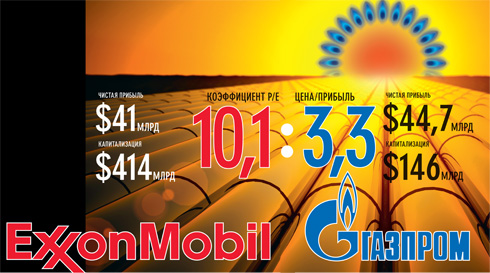
Source: Troika-Dialog, Bloomberg
Putin's discount. Money loves silence, and large - especially, and therefore prefer autocrats, not subject to all sorts of nonsense there like a regular change of first persons - this is well known. However, the example of Russia demonstrates exactly the opposite Russian stock market is traditionally closely related to oil price, but the paradox: in 2011, the cost of a barrel was stably high, and Russian stock indices were constantly lower than the expectations. In general, the Russian market demonstrated a 40–50 percent discount-a discount on the price of shares compared to other large developing economies, for example, Brazil.
At its peak in May 2008, the total capitalization of the market, that is, the total value of all shares of Russian companies traded on all stock exchanges within the country or beyond its borders, was $ 1.6 trillion, which was almost equal to the annual volume of Russian GDP. Today, four years later, the volume of GDP has practically not changed, but the value of Russian shares collapsed to $ 800 billion, that is, the market “was dried up” almost half.
10: 3 In favor of Exxon, the underestimation of the Russian stock market is easiest to illustrate through the comparison of Gazprom, the largest in capitalization of the Russian company, with the similar Western corporation Exxonmobil, which is traditionally a leader among American public companies. The comparison becomes even more legitimate, taking into account the fact that both structures belong to the oil and gas sector.
These two companies are the most profitable in the world. Last year, Gazprom’s net profit amounted to $ 44.7 billion (according to Troika-Dialog IR), which is even higher than the EXXONMOBIL net profit-$ 41 billion (according to the Bloomberg agency). Provided that the shareholders would have equal access to the distribution of net profit in the form of dividends, and the prospects for the growth of both companies would be estimated in similar quantities, their capitalization should be more or less equal. However, the current capitalization of Exxonmobil is $ 414 billion, and Gazprom is $ 146 billion.
This means that the market considers Exxonmobil almost three times more valuable company than Gazprom, although their profit is almost the same. Investbankers and analysts of the stock market usually express this value through the r/e coefficient
* * From English. Price/Earnings Ratio - Price/Profit ratio: Relationship of the market capitalization of the company (total value of its shares) to annual net profit. This coefficient for Gazprom is 3.3, and for Exxonmobil - 10.1.
Perhaps someone will consider the comparison of the company working in difficult Russian conditions with the largest American corporation, which has more than 100 years of work in the market. Well, you can offer closer examples for comparison. Take the Brazilian analogue of Gazprom, a semi -state oil and gas giant Petrobras. Its r/e coefficient is 9.4, which puts it on almost one level with Exxonmobil.
Of course, different countries and sectors are characterized by different r/e coefficients. For the most developed states with a diversified market, such as, for example, the United States, its value is approaching 15. For a developing market with a predominance of raw materials, as Brazil, the coefficient usually ranges from 8–10.
In structural terms, the economy of Russia and Brazil is quite similar. The level of economic development and dependence on the raw material sector is also generally similar. Today, however, the average price/profit coefficient in Russia is 4.5, and in Brazil - 8. The significant difference between the two countries is that Russia is an authoritarian state, and Brazil is democracy. Therefore, Brazil’s stock market has already returned to pre -crisis positions, and Russia still remains at the level of just 50% of the peak indicators of May 2008, when Gazprom’s capitalization was $ 360 billion.
"
Today, the average r/e coefficient (price/profit) in Russia is 4.5, and in Brazil - 8. The significant difference between the two countries is that Russia is an authoritarian state, and Brazil is democracy
"
The market without confidence why are affairs in the Russian stock market go so badly? There are many reasons for this, including how mass privatization went in in the 1990s. In 2010, sales of shares first placed on the exchange (IPO - initial public proposals) amounted to only 0.1% of Russia's GDP. Almost all IPOs are carried out abroad, mainly in London, since company owners understand that in the domestic market they are not protected from unpredictable state intervention. Moreover, they are afraid not so much of the unexpected growth of taxes as direct confiscation of assets. The latest Russian history is rich in similar examples: Yukos, “United Machine-Building Plants”, “VSMPO Avisma”, “RUSSNELA”, “Euroset”.
Another reason is that the internal demand for shares in Russia is basically not encouraged. The lack of pension reform led to the fact that the funds of pension funds (and this is the so -called long money) make up only 2% of GDP, and share investment funds with their miserable total volumes of 0.3% of GDP are generally almost invisible in the market. Even the total cost of Russian corporate bonds does not rise above 6% of GDP.
Therefore, the stock market in Russia remains very small and depends on speculative demand from foreign players, the behavior of which is extremely instability. As a result, the Russian stock market is characterized by high volatility, which was demonstrated by a sharp fall (as much as 80%) from May to October 2008. Large -scale pension reform leading to the formation of large private pension funds could significantly stimulate the market. This is exactly what happened in Poland, the stock market of which has now become the largest in Eastern Europe: shares of more than 500 companies are quoted on it - compared to 314 in Russia.
The key condition for the growth of the stock market is to ensure the supremacy of the law. The basic reason that shares holders do not expect dividends from the profits of Russian companies is the belief that these funds will eventually get to someone else. Pure profit in Russian practice is to a certain extent the theoretical concept, and dividends - that is, the funds actually paid to shareholders - remain small. In addition, shareholders are afraid for the fate of net profit, not distributed as dividends.
Most companies pay only part of their profit in the form of dividends, since they want to leave funds for development. From the huge profit of Gazprom, shareholders are paid $ 2 billion, Exxonmobil - $ 9 billion. The shareholders of the latter believe that Exxonmobil management disposes of the company's funds in an optimal way, and therefore are not offended that the total dividends are only 2.2% of the market value of the company: Gazprom has twice as much.
The destruction of the cost of a serious problem in Russia is certainly corruption. About two -thirds of companies quoted on Russian exchanges belong to the state or are controlled. Against their background, as Boris Nemtsov and Vladimir Milov indicate in his brochure Putin and Gazprom, the Russian gas monopoly is especially distinguished.
From the point of view of shareholders, the main problem of Gazprom is huge and ineffective capital investments, which last year amounted to $ 50 billion. Moreover, the final figure has increased significantly compared to the planned one, although the minority shareholders always seek to reduce it.
Instead of investing in Gazprom gas and oil, it prefers to spend funds on unnecessary gas pipelines. Although, having spent only $ 3.5 billion, he could modernize the Ukrainian gas pipeline system connecting Russia and Europe, whose capacity is 120 billion cubic meters of natural gas per year. Instead, Gazprom stubbornly builds new branches bypassing Ukraine: North Stream (55 billion cubic meters per year), and South Stream (63 billion cubic meters). According to forecasts, the South Stream will cost $ 30 billion, and the Nord Stream will cost half this amount. Why in vain spend $ 45 billion? The answer is far from considerations of economic efficiency, because 1 km of Gazprom’s pipeline costs 2-3 times more than in other similar projects.
In closed reports, investment banks carefully denote 70% of Gazprom’s long -term investments euphemisms “Value Distruction”, which means corruption and squandering of funds in normal language. Thus, Gazprom has already wasted a fantastic amount of about $ 35 billion, which were rightfully supposed to belong to the Russian budget and shareholders of the company.
In addition, Nemtsov and Milov describe in detail the methods of withdrawal of assets from Gazprom by selling companies such as Sogaz, Gazfontank, Gazprombank and Gazprom-Media holding for nothing, while Sibneft was bought by Gazprom.
* Sibneft was bought from Roman Abramovich in 2005 for $ 13 billion. Plus, there are separate problems of the opacity of gas markets in the CIS countries. Thus, the total volume of meaningless embezzlement and corruption costs of Gazprom can be estimated at $ 40 billion per year, which is 90% of the company's net profit. As a result, shareholders cannot count on any benefit from the ownership of Gazprom shares, except for dividends.

Useful protests all this squandering funds by state corporations becomes possible because the country's leadership does not interfere with this. It is logical to assume that if, as a result of a political struggle, this leadership will lose some of their power, the embezzlement will cease to feel safe and limit their appetites, fearing the legal consequences. In commercially, this will contribute to more effective corporate governance. That is why it can be expected that the softening or restriction of authoritarian power will lead to an increase in prices for shares of Russian companies. And this means that the growth of political activity in Russia leads to a decrease in a discount on Russian securities. The most striking example of the fact that political protests can be a positive factor, and stagnation, called stability in Russia, is negative, is Ukraine to the “Orange Revolution”. For a long time, the country's stock market, which suffered from the terrible quality of corporate governance, was in decline, during the struggle for the presidency, it grew twice in two months. Alas, the “Orange Government” subsequently did not live up to market expectations, but this is a completely different story.
The main conclusion is that the apology for political stability in conditions of a political regime unfavorable for business has led to the depreciation of the Russian stock market. This “stability” allowed privileged players from among Putin's friends to take key posts in the management of the state corporation and in various ways to transfer these companies to their personal accounts - by withdrawing assets, kickbacks or transfer pricing.
A low assessment of the Russian shares market is caused by the poor quality of corporate governance arising from the authoritarian style of public administration, and a general disrespect for the law. If the quality of corporate governance in Russia was the same as in Brazil, the total capitalization of Russian companies would have grown by $ 620 billion.
In other words, the owners of Russian shares - the state, Russian and foreign shareholders - today $ 620 billion is poorer than they could be if the law and well -working democratic institutions ruled in Russia. It is this amount of losses that draws up the “Putin discount”.
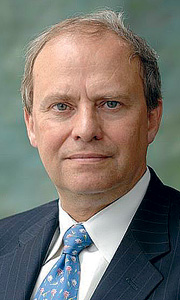 |
Anders Oslund in the past is an economic adviser to the governments of Russia, Ukraine and Kyrgyzstan, the author of several books about the Russian economy, including “How Russia has become a market economy” (1995), “The capitalist revolution in Russia” (2007).
Translated from English by Sergey Afonin, Anna Oslund