
Translated material
Cansat championship, or experiments in a tin bank
Many young people in different countries today dream of becoming astronauts and developers of space aircraft. Confirmation of this - Cansat championships held in many countries of the world (USA, Japan, Netherlands, Norway, etc.). Cansat is a youth competition for the development and creation of teaching satellite layouts that fit in a regular bank from under soda drinks, hence the name of the competition from two English words: Can -a tin bank and SAT ( Satellite) -a satellite.
The Cansat championship sets to arouse interest in innovations in the field of aerospace sciences and technologies, introduce them to the principles of the work of satellites, missiles, organizing work at missile training grounds, contribute to the practical assimilation of knowledge in the field of radio communications, transmission of data, ballistics and mechanics, and teach schoolchildren to work skills in the team.
The requirements for the training "satellite" cansat are as follows:
- the weight should not exceed 350 grams, provided that all the equipment, with the exception of the parachute and the antenna installation of the GPS, should fit inside the standard tin can (volume 0.33 l);
- It is not allowed to add parts or measuring devices with a total value of over $ 512;
- There are restrictions on the flight time (120 s) and the descent speed (812 m/s), the operating time of the Cansat’s “satellite” transmitter should be at least 3 hours, and all its components must withstand overloads up to 20 g;
- The "satellite" has the main and additional tasks. The main task is to measure temperature and pressure in a real time in the process of reducing the “satellite”. An additional task is related to the implementation of special marks invented by the participants themselves. For example, an analysis of the environmental situation and meteorological conditions, measurement of acceleration and turbulence, video recording, monitoring of atmospheric temperature distribution, clarification of the “satellite” position in space, etc. The flight of the fantasy of the participants is limited only to the cost of the components used.
The Cansat project in Russia is carried out by three organizations: the Memorial Museum of Cosmonautics (MMK), the Research Institute of Nuclear Physics named after D.V. Skobellitsyna Moscow State University (NIIIIF Moscow State University) and North-West Interregional Public Organization of the Cosmonautics Federation of the Russian Federation. Working group of the Cansat project in Russia ”: O.Yu. Frost, head. Department of MMK, V.V. Radchenko, deputy. Director for scientific work of NIIIF MSU N.N. Vedenkin, chief developer of the Russian designer Cansat and the technical manager of the project, senior researcher, Niiiaf of Moscow State University. The project will be implemented in several stages.
The championship has Napoleonic goals: to popularize the achievements of domestic missile technology and astronautics, to involve students in projects related to innovative technologies, to introduce them directly to the design process, from creating models and, ultimately, launching the students of the “satellites” of cansat. Schoolchildren will learn to work in the team, sharing responsibilities among themselves and establishing interaction with the support of the supervisor - teacher of the school. Moreover, all the information related to the Cansat project is presented in English, so the participants simultaneously recognize and remember specialized physical terms.
The organizers of the competition provide the participants with the basic designer developed by the NIIIF MSU, which includes a microcontroller, a temperature sensor, a pressure sensor and a bearing a radio modulus. In addition to the standard elements of the device, each team has the ability to install other original nodes and devices on it if they are laid in the installed dimensions, mass and cost of the apparatus. So, participants can not only construct the device, but also fulfill with its help a public or scientific-fabric task for their “satellite”, and then use the results when studying at their school.
According to the Cansat championship plan, the teams after participating in the qualifying session and after passing the expert commission will continue to work on their apparatus and demonstrate the results of their work at the real training ground in Kaluga in early May. It is there that the winners will be named.
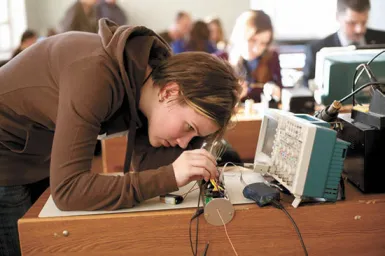
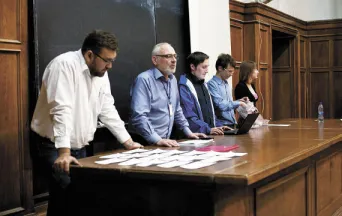
The qualifying session at the MMK and Niiyaf Moscow State University took place on January 28-29, 2012. 28 teams defended their projects. The geography of the participants is vast: Moscow, Kazan, Minsk, Kaluga, Arkhangelsk, St. Petersburg, Samara, Chuvashia, Yakutia-and this is far from a complete list. The defense took place in two days. On the first day, one half of the participants defended their projects, the second - tested equipment in the laboratories of Moscow State University. On the second day, streams changed places. In addition, educational classes and workshops at the Physics Faculty of Moscow State University were provided for the participants in the competition: lectures on space physics and urgent problems of modern physics, classes in the nuclear workshop of the NIIIF MSU under the motto “Repeat the Nobel Experiments”, master classes on working with on-board electronics, and a mobile planetarium worked in the Hall of CFA.
Each team introduced the expert commission to the project’s explanatory note, the presentation and the layout of their “satellite”. Participants were supposed to demonstrate the concept of the project, the complexity and scale of the tasks set, present a description of the design of the devices and the technological level of the implementation of their project. All participants presented their projects with knowledge of the matter, demonstrating a creative approach, a high technical level of training, new ideas, the coherence of the team’s work and a real desire to win.
According to the results of the qualifying session, the 17 best teams were selected to launch their “satellites” with a rocket to a height of about 2 km at the training ground in Kaluga (May 2012).
Participation in the Cansat in Russia project is the first small steps that can lead to big changes. Now the names and surnames of the championship participants are unknown, but time will pass, and the country will recognize its new heroes.
Elena Grigoryeva,
Employee of the Information and Analytical
Department of Niiif Moscow State University.
The photo is represented by the author