
Translated material
Universities and revolution
In recent years, we can observe an increase in activity, including political, students of Russian universities. This, on the one hand, pleases, on the other hand, causes anxiety. Students at all times took an active part in various forms of social life, including its most extreme manifestations, for example, in political terror and revolutions. The question arises: why, in some cases, universities become a “melting boiler” for revolutions, and in others nothing of the kind happens? To understand this issue, the easiest way to turn to the past, to history. A convenient example is Russian and German educational institutions of the XIX century. The problems associated with the development of the student movement in Russia and Germany were approximately the same - it just ended differently.
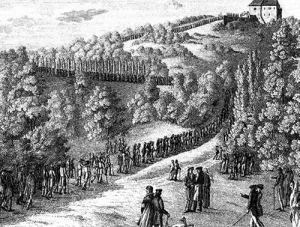
The rise of the student movement in Germany begins during the Napoleonic Wars. German universities played a noticeable role in the liberation movement. One of the most famous examples is the “Corps of Freedom” by Adolf von Luttsov, which included approximately 3,000 students and teachers. After the war, numerous student societies arise throughout Germany. The point of the highest rise in the student movement is considered to be a student holiday near the Varburg Castle in Thuringia in October 1817, at which representatives of all universities rejected the restoration policy and proclaimed the idea of German unity.
The growing student movement threatened to develop into a revolution. The authorities managed to prevent undesirable development of events, and in the way very remarkable. Speaking very simplified, the authorities abandoned attempts to suppress student activity, but created opportunities for its peaceful application. And the main, although not the only point of application was science. This happened in the framework of the process, which was raped at that time in a completely natural way. We are talking about the emergence of a new type of universities - classic universities in which education was closely related to scientific research (before that education was at universities, and science in academies). The classic university primarily played the role of the Center for the Development of Science, which made it possible to make training in it successful.
Such universities made it possible not only to study, but also in their free time to study science. It is clear when you understand the texts of Aristotle, put experiments with electricity or dissect some fish-here it is no longer before the revolution. This made it possible to occupy the bulk of students with a useful business, and then the whole struggle with the revolution was reduced to catching single terrorists. Moreover, even if these terrorists turned out to be students (and often exactly so happened), the authorities tried not to extend the negative attitude towards them to the rest of the student.
At the same time, student self -government developed, which made it possible to realize their potential to those who did not limit their lives to the laboratory. Of course, some protective measures were taken - in particular, a ban on holding political meetings within the walls of the university was introduced.
In Russia, the formation of university education took place in a peculiar way, but in general, the current system resembled German. The scientific potential of Russian universities gradually increased. During the great reforms of Alexander II, significant liberalization of the entire system of popular education occurred. The university charter of 1863 is considered the most liberal among all university charters of the Russian Empire, and this despite the fact that the government had to conduct difficult work to eradicate various terrorist groups (Karakozovites, Nechaevs, etc.). As a result, students studied, and not engaged in politics.
The student unrest from time to time was in most cases caused by attempts by the government or universities to “tighten the nuts”. In the last year of the reign of Alexander II (during the reforms of M.T. Loris-Melikov), the process of developing student self-government (the right to create mutual assistance, literary and scientific circles, readers, participate in gatherings) was activated.
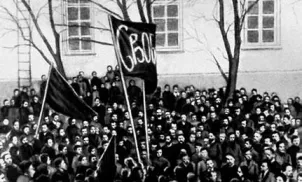
With the entry into the throne of Alexander III, everything went in a completely different way: the authorities began to devote the main time to the fight against student movements and restraint (as they would say in our time - to build a vertical of power). Even those weak sprouts of student self -government that began to appear during the reign of Alexander II were exterminated, all student organizations were certainly prohibited. The university autonomy was significantly limited, in particular, the election of rectors was canceled (according to the Charter of 1863, the rector was elected by the University Council and was only approved in this position by the emperor, according to the charter of 1884, the head of the university was nominated by the Minister of Education, and then the high decree of the emperor was appointed four years). Tuition fees were halved in order to cut off from the formation of the poor, i.e., in the opinion of the authorities, unreliable children. Training, in many cases, has come down to preparation for public service, and not to engage in science. The result is known - two revolutions that destroyed the country and gave rise to one of the most bloody regimes in the history of mankind.
But the point is not only that the two lines of behavior led to various political results. Science and education in the modern world have important utilitarian significance, which in this case should also be borne in mind. The first described path - the application of students' activity to study and work - led to the rapid development of science and to the creation of what they are called innovative economy today. The second way - the suppression of revolutionary sentiments among students - led to a revolution, followed by millions of victims of the Gulag, and then the raw material "needle", on which the Russian economy is now sitting.
Science and development of student self -government are the best vaccinations from revolutions. But an excess of restrictions and lack of science do not lead to anything good ... at least for those who do not consider the revolution a blessing.
Evgeny Sheval