
Translated material
Divorce in Iranian
Oscar for sociality
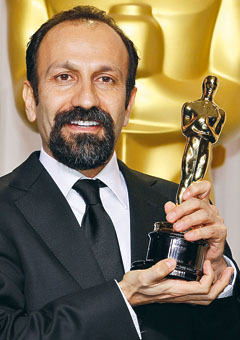
The taste of Oscar. Someone was surprised that the award of the American movie academy for the best non -ang-speaking film went this year “The Divorce of Nadera and Simin” Iranz Asgara Farhadi. But only those who did not see the film could not be amazed that he managed to win at the Berlin festival. Iranian cinema is a social phenomenon, because it arose and preserves the face in the country with hard religious restrictions
“Divorce of Nadera and Simin” is a very free film for a totalitarian state. After all, the reason for the divorce is that the wife is eager to emigrate, not seeing for the daughter of prospects to live in Iran (in the USSR or GDR the director would be given a wolf ticket for this), but the husband does not want to leave, but only because he cannot quit his father, who has Alzheimer's disease. Another problem hits the core of Muslim morality: what is a sin for a hired nurse - to help replace the clothes with an intelligible helpless old man or leave it as it is, since according to a religious law you can not touch a stranger man?
Culmination is the court. But not about the divorce, but about the miscarriage that happened at the nurse. She accuses her employer, who rudely pushed her (when he put out the door, angry with her inattention to the sick father). Here the film turns into almost Hitchcokovsky thriller with a mass of interested parties, nuances, reflexions, games and secrets. The recognition of situations brought the film success in the West: both Oscar and € 10 million at the box office of France, Italy and Germany.
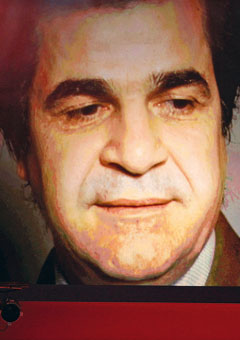
While working on the film, director Farhadi had to repent. But not for the fact that his heroine does not see the prospects in Iran, but for the fact that he blurred something about Iranian censorship and, in particular, the arrest of the famous, who shot the acutely social films of director Jafar Panahi (he was put for six years with a ban on the next twenty professional activities and traveling abroad). Farhadi repented, and the authorities allowed him to complete the picture, and then nominated it on the Oscar. But still it seems that the idyllic relationship of the Iranian authorities with cinema, which lasted almost two decades, is the end. And the reason will be precisely the Oscar, coupled with the indignant world - from Spielberg and Coppola to Frederick Mitteran - the arrest of Panahi. 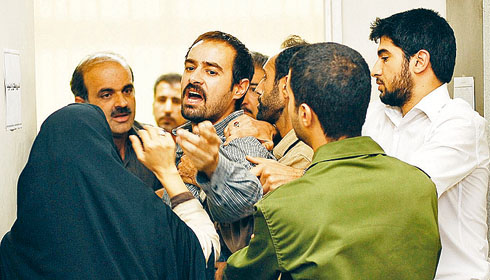

Fashion for Iranian
A movie in Iran did not seem to have executed a direct social order. But it did not contradict state -ide, which did not prevent him from conquering Western intellectuals. The peak of the hobby of Iranian cinema came in the world in the 1990s. The fashion for Iranian cinema replaced the fashion for Chinese, which arose in the late 80s, and in the late 90s lost fashion for Japanese, then South Korean, then Latin American. So: there were a lot of clever men in America and Europe, convinced in the 90s, that Iranian culture is opposed to global decay, with which the vicious American-European civilization is unable to glorify.
In the late 90s, the Iranians won the main festivals in Cannes (the “taste of cherries” of Abbas Kiarosts), Venice (“Circle” by Jafar Panahi), received a nomination for “Oscar” (“Children of Heaven” Majad Majidi). Two Iranian directors - mentioned by Kiarasts (about whom Hodar said that the cinema in his development has passed the path from Griffith to Kisarosts) and Mohsen Mahmalbaf were included in the unspoken cohort of modern classics. Then the panakhs and Majidi ranked the masters, and in the 2000s-asgar Farhadi, the youngest of the glorious Iranian film. He made only five paintings, but their rating was constantly growing on the main filmmaker website www.imdb.com. As a result, the “Divorce of Nadera and Simin” reached the 69th place there in the list of 250 best films of all time. "
Iranian films of the 90s-by no means dissident, on the contrary, they affirmed Muslim values
”Iranian directors remained to work in their country, although they shot mainly for foreign money, primarily French. The regime did not disturb. After all, the films of the 90s (see the wonderful“ mirror ”of Panahi) are by no means dissident, on the contrary, they affirmed Muslim values. For example, they showed that poverty should not be proud and poverty. The poor are honest and clergy. Experienced, developed, because they are developed, developed, developed, developed, because they are developed, developed, developed. They are forced to change the professions.
  |
At the same time, the Iranians already, unlike the Chinese, did not emphasize their eastern mystery and fundamental dissimilarity to the rest of the world. Yes, a strange “uniform” of women who do not even take off black dresses and scarves at home. Yes, Islam. But all actions and motivations in Iranian films are absolutely clear. The same people. This is where the “Divorce of Nadera and Simin” plays today. The same West, but not spoiled by individualism, the desire for power and pursuit of money.
The end of the idyll
But the further, the more socially sharp paintings appeared. Panahs put it for a reason. His “Circle” defeated in the 2000th in Iran was prohibited, because he narrated about women who escaped from prison, and actually proved that women in the country are powerless. “Offside”, who took the second most important prize of Berlinal in 2006, also narrated about the lawlessness of women, who are not even allowed in Iran even to football.
The first real dissident in Iranian cinema - feminist margin Satrapi also arose, the real great -great -grandson of the Persian Shah, who ruled in the 19th century. Her animated persons, made in co -authorship with a vychanent, is a critical, caustic, but at the same time a full view of the history of modern Iran. The film has become a world sensation. He received one of the prizes in Cannes, was nominated for France for Oscar.
Finally, Cinoculassice Abbas Kiarasti actually became a creative emigrant, who participated in writing scenarios for the convicted Panahu. Back in 1997, having received the main Cannes prize from the hands of Catherine Deneuve for his “taste of cherries”, he refrained from returning to Tehran for a week, since Denev hugged and kissed him on the stage, and Iran’s laws prohibit touching the opposite sex, not autumn. Kirosti made two of his last films abroad: “Copy is true” with Juliette Binosh - in Italy, which has not yet been released “end” in Japan. During the break, he put in London the opera of Mozart "everyone does this." He spoke sharply in defense of Panahi. And he said that the Iranian government does not need his films.
Further development of the situation largely depends on how Farhadi does. Whether he will lie with his “Oscar” near Ahmadinejad or (given that after “Oscar” he probably has proposals from Western producers) will risk becoming a citizen of the world.