
Translated material
After Pushkinskaya: how to live now?
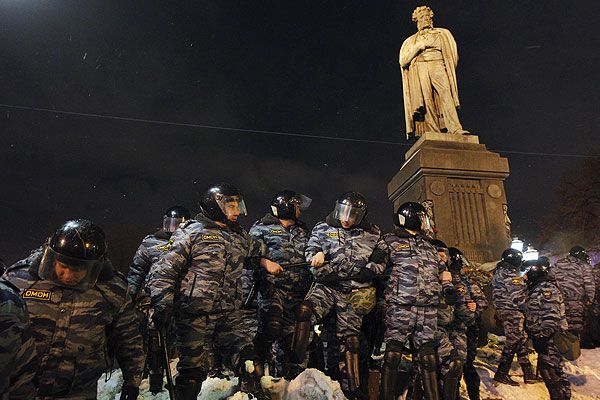 Photo: Reuters
 The acceleration of the rally on Pushkinskaya seems to have indicated a certain tendency in relations between power and protesters. Publicpost talked about this with people far from politics, but in a wave of civil activity of recent months.
Dmitry Kustov, programmer:
Before that, my wife and I did not take part in protest rallies. They decided to go to the rally for the first time after the election to the State Duma on December 4. For the most part, probably because of Navalny. He seems to us the face of a modern non -systemic Russian opposition. What could be observed before, at rallies of disagreements, did not cause desire to join.
It did not seem to me that on March 5 there was acceleration on March 5. They gave everyone to speak, detained only those who decided to stay in the square. I could not come to this rally, as I worked. I looked in the record.
There is no point in strengthening repression. The system has long been debugged and worked out at the same rallies of disagreements. But the security forces will not disperse peaceful thousands of processions. This gives the people a certain chance to softly continue to push their position. I am against radical measures, and most adequate Russians too.
Civil activity will directly depend on the actions of the future government. If they begin to tighten the nuts, then the rallies will continue and will become more massive and radical. I think the authorities understand this and in the near future will make concessions in order to repay this seething.
Ivan Navparenko, translator, musician:
.jpg)
I went to the first rally in 1991 with my parents. Since December 5, I was on all major promotions.
There is nothing new in acceleration on Pushkinskaya, the line was not designated - it continues. The authorities will behave like that if the account of participants in unauthorized shares will not go thousands of. What will happen in this case is incomprehensible.
The appointment of experienced security forces for key positions makes you think that repression may intensify after Putin’s final coming to power. At the same time, the radicals will be stiffer, and they will give a little “consonant” disagreements to release steam.
My forecasts for the nearest future civil activity in Russia are surprisingly optimistic. I was an observer in the presidential election. And other observers that I had to work with, people are very different, not only socially close, but at the same time charged for the same goal. In the change of paradigm, not only the "creative class" is interested in at all, sorry for the swear word. And this common land underfoot, which does not require cultural and "sincere" kinship, can become the basis for something very important, it seems to me. The guy from the Putin corps “for clean elections” was impressed, who was quite seriously trying to participate, and the Putin observer, who voted for Prokhorov, and at the right time, suddenly began to help to defend the observance of 68 articles of the FZG. I think we will succeed.
Sergey Vasiliev, artist, artistic director of the "Casteful Pierrot":
I went to rallies in 1991, when I was 16 years old. Then there was a break, and again began to walk in December. In the spring of 2010, I was at a rally of Arkhnadzorovsky, against the approval of the new general plan of Moscow, but it was not political.
Events on Pushkinskaya showed that the protest may lose mass. Acceleration took place as follows: most of the usual citizens left, there were people who clearly wanted to stand to the end, and people remained, including me who hesitated, waited. The police gave time to everyone who does not want to enter into a force clash, to leave, and the rest began to accept.
The repressive device is inevitably interested in intensifying. They probably will promote their roles in every way on the sidelines of the authorities, talk about what well done they are, how can they well disperse all ... Another question is, profitable or do it need this itself? It may not be beneficial and not necessary.
Civil activity in Russia is inevitable, for some time, it will subside-it was growing so far there was a prospect associated with the period of such an interrevation. And now people have no understanding, what, in fact, is further? Until there is any clear message to which all these rallies, at which this warming up of the atmosphere is aimed at, activity will probably subside. As soon as such an occasion appears-a new law or referendum, or something else, it will intensify.
Igor Gulin, poet:
.jpg)
I went to rallies quite a few years ago when they planted Khodorkovsky and some NBPshniks. Then he stopped for a long time. And now he started again. On December 5, he missed, as he was not in Moscow, and the latter also almost missed, as he went to trial at the suspects of Pussy Riot. I went to everything else.
Yesterday I saw only out of the corner of my eye some remnants of the rally. It’s just fun to wave the ribbons, probably it will not work anymore. There is no longer any unity in the ranks of protesters, even structural, (the march of nationalists and something like that), but many people seem to be ready to do something else and are not going to leave. Whether the repressive apparatus will intensify in the future, I do not know.
Yesterday's partial failures seem to act on people more inspiring-as the need to continue something, and not to recognize the defeat, so, apparently, civil activity will develop, although it may not be as euphoric as in the period between the elections. 
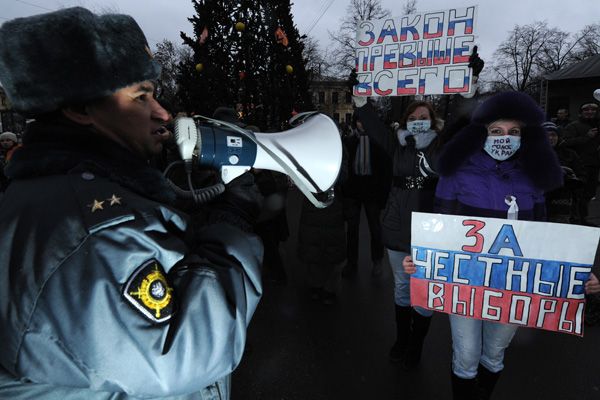
From December 4, the day of elections to the State Duma, protest activity does not subside in Russia. Residents of cities who do not agree with the results of voting and outraged by falsifications and violations, massively go out into the streets.