
Translated material
Carousel leader
Analysis of the results of the presidential election: Putin's minority should respect the opinion of the vast majority of the country's population
Supporters of Putin repeat that "the minority should respect the opinion of the majority." This is true: the Putin minority should respect the opinion of the vast majority of the country's population. After all, the majority of the country's population never voted for Putin and EP, which follows even from the official data of the CEC. But the real social base of EP and Putin in the country, of course, is even lower ...
Now we are all actively trying to convince us that the elections have shown that the majority of the country's population is for Putin. Exactly so: not “ the majority of voting ” and not even “ the majority of voters” , namely, “ the majority of the country for Putin” .
Check.
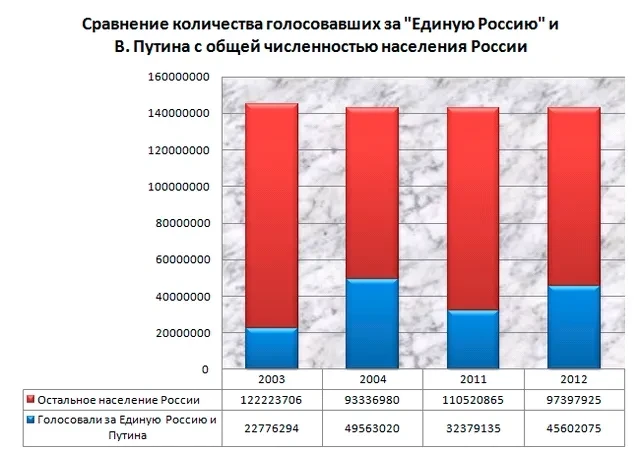
Supporters of Putin repeat that " the minority should respect the opinion of the majority ." This is true: the Putin minority should respect the opinion of the vast majority of the country's population.
After all, the majority of the country's population never voted for Putin and EP, which follows even from the official data of the CEC. But the real social base of EP and Putin in the country, of course, is even lower at the level of 2003, when Russia had the last federal elections without mass falsifications.
If someone is still not aware of the main methods of falsification, I will explain. The main resource of votes for the party of power and its candidates has long been a vote at home:
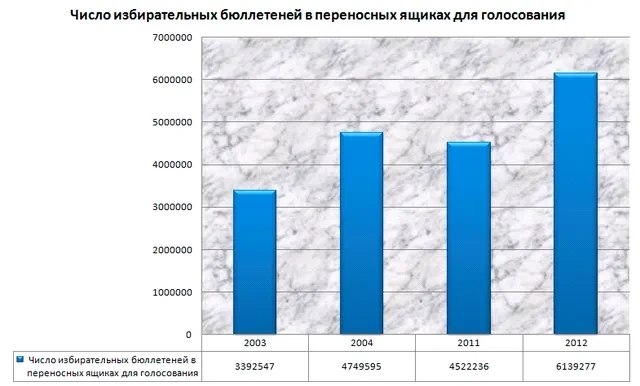
As you can see, since 2003 it has grown in a shock pace, increasing by 2.7 million and reaching 6.1 million .
The PEC members have long been accustomed to the “ initiative detours ” of residential quarters with portable urns, almost knocking on the apartments and allowing anyone to vote, then making it out with fake applications. Often, even dumber is made: the contents of portable boxes are elementarily replaced with a pre -printed “left” circulation of ballots with pre -affixed checks opposite the desired column. Therefore, we can confidently assume that almost 100% portable boxes give results only in support of the authorities.
But in relation to the 2012 election, 1% of the vote is 716.7 thousand bulletins , so that only a vote at home could immediately give more than 8.5% of the vote .
Now - on absenteeism (OS). According to the law, the voter who on the voting day will not be able to arrive at the site where he is included in the voter list, has the right to get OS and take part in the elections in any area where he will be on the voting day. Upon presentation of the OS on the day of voting, the voter must be included in the additional list of voters, and the OS itself must be seized (by the way, in the last elections, additional lists of voters began to form just like that-without any OS at all).
And if the OU was not seized, then a citizen with him can go to another site and vote as many times as he likes. So in all elections, the "carousels" were organized. In the formal statistics of the citizen voted according to the OS, it enters only where he passes this certificate. In other words, the number of voting along the OS, which we see in the GAS “Elections”, can be safely multiplied by at least 3 (and you can hardly have time to vote less than three times a day, especially if you are delivered to different sections by bus).
If the OU is not passed, then at the time of leaving the site the voter simply becomes included in the additional list of voters on a common basis.
Therefore, it is not surprising to observe the following picture:
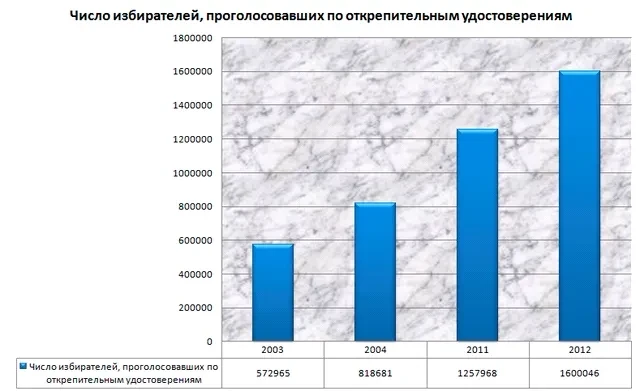
We get another 2.2% of the vote. And remember that this is three times less than really voted along the OS.
By the way, in the 2012 elections, the situation generally went beyond the line of good and evil: the “ continuous production cycle” workers who were working on service buses and voted repeatedly in different sections, even without absenteeism, which almost everywhere simply ended , were massively included in the additional lists of voters. And we will never know how many such additional lists in different areas were, because these lists are protected by the law on personal data. We will never know exactly how many times the same people have voted on these lists in different areas.
Moreover, “temporary polling stations” were organized specially for them. For example, such as plot No. 3377 in the village of Mosrentgen (10 km from the Moscow Ring Road), in the construction market, between shopping tents with nails, doors and shawarma.
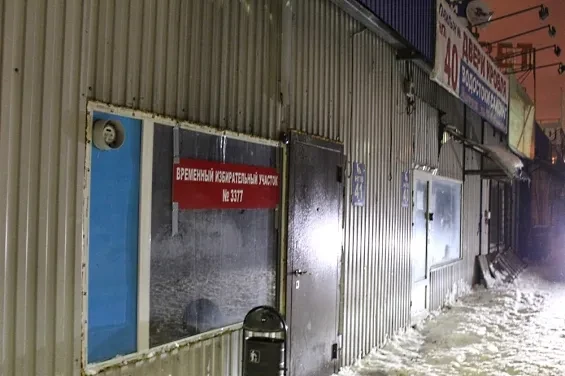
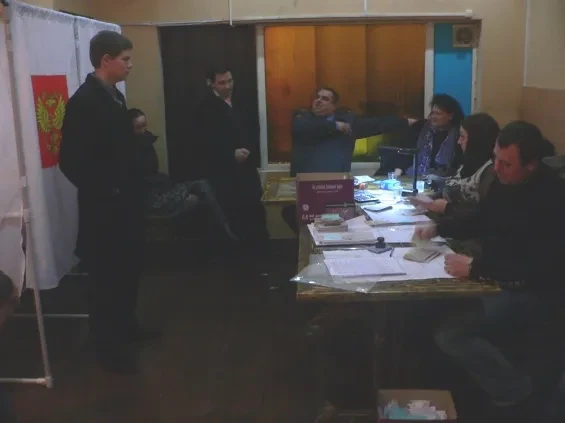
87%voted for Putin there. Nobody saw voters.
In general, falsification technologies in this election were noticeably enriched. Most of them are manipulations with voter lists. For example, a new, original way has appeared: in the book of voters, according to which the ballots are issued, the number of apartments in really existing houses is fictitious, which is not every voter and will notice. Finally, the last resource is an early vote.
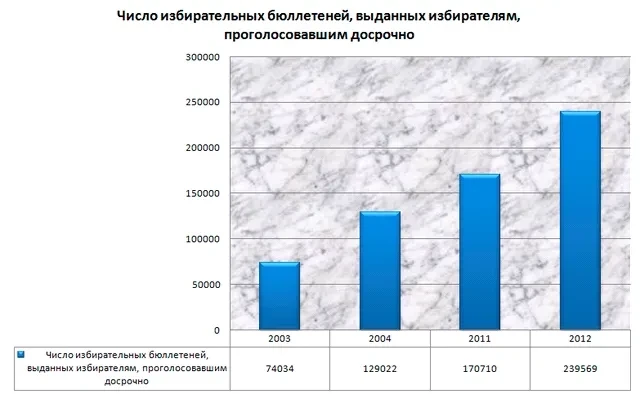
It is curious that we have limited the early voting with pomp not so long ago. The results of "restrictions" are evident. We get another 0.33% of the vote.
By the way, in fact, if anyone has a question: how can an early vote, in principle, be a falsification mechanism? - I will reply that stored ballots early voted voters are very easily replaced at night with a pre -printed “left” circulation of ballots with ticks put in the right places.
Thus, now we can evaluate the total resource of the above three methods. It is equivalent to 11% of the vote (based on the appearance in the 2012 elections). But we recall that the “carousel” has not yet been fully taken into account here. Considering that one bus per day could give 1000-1500 votes, the total number of votes that could be falsified, thus, is quite capable of reaching 1-2% , in addition to the existing 11% . Thus, we can talk at least about 12-13% of the votes assigned. And Putin, as we know, according to official figures, scored 63.6% .
Let's evaluate how it looks:
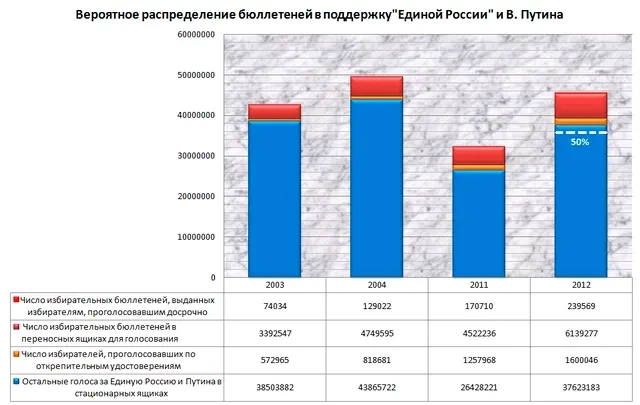
50% of the votes for winning in the first round is 35.8 million people, and Putin without portable boxes, without absenteeism and voted ahead of schedule, “received”, as far as possible, only 37.6 million - a little more than 52%. And if you take away from these 52% “carousel”, as well as stuffing and rewriting the final protocols (and it is unlikely that the share of such violations was less than 2%) - it is possible to assume with a high degree of probability that Putin could not gain sufficient real number of votes for winning the first round .
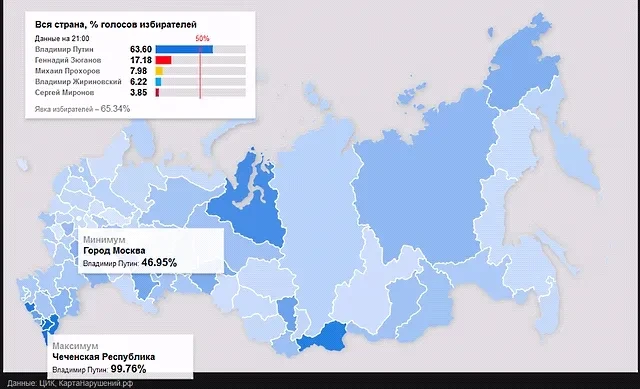
The most close to reality the level of support can be considered the one showed by Moscow. Analyst Alexander Kireev investigated the current situation and came to the conclusion that Putin in Moscow almost accurately “ got into the result of the EP in the Duma elections ” - almost 47%, that it is contrary to trends in all other regions of the country (there is a share of votes in favor of Putin is clearly higher than in favor of the EP three months earlier). Especially notable are the results in the CAO - the district, the most opposition in relation to the authorities. For example, “ Putin’s Arbat has the largest fall compared to the result of“ Osra ”... There were 63% for United Russia, but it became 40% for Putin.” He is sure that a clear pattern is traced: Putin received much more than United Russia, primarily in those areas where there were sets of processing electoral ballots (Koibi) . In the Duma elections, the same Koiba saved these sites from falsifications, which allows you to determine the real results of the EP in Moscow as a whole in December 2011 - 24–25% with a 50% explicit . Now there were 47% for Putin with a turnout of almost 58% . This realistic picture completely fits into what is now visible to other large cities. Thus, if Putin’s spokesman considers the issue of recognizing the presidential elections closed-we consider no less closed the question of recognizing parliamentary elections.
An unconditional innovation this year was a system of webcam with online broadcasting, complicating the stuffing and stupid rewriting of protocols at a low turnout. It was precisely because of this that the unprecedentedly large-scale “carousel” campaign was required: firstly, it was necessary to somehow ensure the masses on the screens, and secondly-to organize temporary areas, where, of course, there were no webcams spinning. Already on March 4, it became clear that the webcams on which 13 billion rubles were spent were not able to prevent the “carousels”, and the concealment of archives with records in the bowels of the Ministry of Communications made them useless for further analysis of the past elections.
But the main thing: even if we assume that Putin was actually able to tear out a little more than 50% of the votes, this does not mean at all that he won honestly how the propagandists are trying to prove. The election campaign was not honest from the moment Putin refused to go on vacation using the loophole in the legislation and announcing that the Prime Minister is not a civil servant, but only by a person who replaces the state position (lawyers who wrote such an editorial of the Law, accordingly, can be considered only by persons with a legal diploma). Putin refused to participate in the debates with his own candidates himself, motivating the failure of his time, as well as the need to go on vacation - but he found time to come and perform on mass shares in his support, without worrying about any vacation.
Finally, according to the Medialogi company , designed for 02.27.2012, Putin’s mention in the media was more than 1.5 times higher than the mention of all other candidates combined . The campaign for Putin actually brazenly masked in the media under the "information lighting" of his activities as the Prime Minister.
The problem of the opposition now, in comparison with the post -sophisticated situation in December, only in one - in the absence of murderous obvious evidence of falsifications , since this time the emphasis was made by the authorities on such methods that are not amenable to accurate calculation and fixation . That is, it is impossible to understand exactly how many “temporary polling stations” were formed throughout the country, how many additional lists were on each polling station and how many voters were in such lists; It is also impossible to evaluate how many buses with the “carousel” prayed throughout the country between the sections ... there is only one thing clear: there were so many violations that, given all the above, all the other falsification methods, taken together, all the injustice of the election campaign itself, we can assume that Putin did not win the first round, which means that it is safe not to recognize the legimacy of the current presidential election .
Power itself knows the price of these elections well. Preliminary results have not yet been announced, the internal troops and reinforced police detachments were pulled into the capital, and irrigated vehicles entered the central streets, which rose between potential danger and the most important government buildings with an iron wall. Moscow, and therefore the whole country, seemed to be prepared for war - it was not mentioned aloud, but it was clear to everyone: if that - the authorities would not stand at the price. However, this was not required.
Putin felt like the winner in the evening on the same day, on the Manezhnaya Square, where thousands of people with the flags and banners gave out by organized groups.
“We showed that no one can impose anything for us! Nobody and nothing! We showed that our people are able to easily distinguish a desire for novelty, to update from political provocations that set only one goal - to ruin Russian statehood and usurp power, ”Putin shouted into the microphone.
After a few hours, during the television station with Nizhny Tagil, having listened to the memorized congratulations of the workers, he again demonstrated that it was for him that the country is divided into “his” and “strangers”: “You put in the place of people who were recovered ... It turned out that your intellectual level is two orders of magnitude higher than those who considered themselves a person at which God fell asleep ... You showed what the Russian people are. You have shown that you are a cut above any loafer, any talker. ”
And this says a person who positions himself as a national leader? He is not even trying to be the president of the whole country - he is the president of only that part that voted for him.
And what part voted for him? Let's see:
The tension in society, which began to grow immediately after the elections to the State Duma, did not disappear with the end of the presidential election.
Stability, under the banners of which Putin enters the third term, has come to an end.