
Translated material
Who is mr. Putin?
Journalist Trudi Rubin now knows the answer
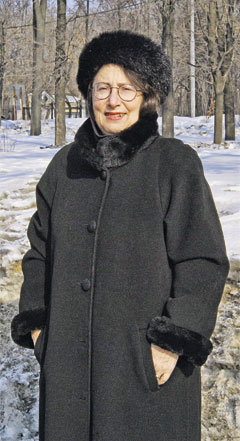 |
Who is Mister Putin? - 12 years ago, when Vladimir Putin was at the very beginning of his first presidential term, the international observer and columnist of the PHILADELPHIA ENQUIERR newspaper Trudi Rubin at the plenary meeting of the World Economic Forum in Davos asked this question. In March 2012, she arrived in Russia. The New Times asked: does she now know the answer?
Nobody understood 12 years ago: Putin is the man Anatoly Sobchak (the first democratic mayor of St. Petersburg) with everything that is attached to this, including the idea of the new Russia, or is he a KGB person? I was then amazed that none of the representatives of the Russian delegation, and there were Mikhail Kasyanov (then Prime Minister), Anatoly Chubais, etc., could not answer my question. The answer was silence. The hall laughed, and they continued to be silent. Then it seemed to me that they were afraid of something. And this, of course, in itself was an answer. Today, watching the elections for which I came to Russia, analyzing what happened over the past 12 years, it seems to me obvious: Putin is a politician who is more comfortable in the Soviet past and is more convenient to operate with Soviet ideas about life and politics. He is a man of the past, not the future.
What do you mean by these concepts - “past”, “future”? I came to the Soviet Union as a journalist, worked under the journalistic exchange program in the Moscow News newspaper, where you and I shared one office, so for me the “past” is a country in which everything was controlled from above, while dynamism, initiative, individualism were considered (by the authorities) as a threat. I was talking here with businessmen now, and they told me about bribes that have to be paid at every step, about ships that make decisions not on the basis of the law, but something else, about a system in which some rules are close to power, and others for everyone else. There is no honest game here. Yes, there is no absolutely honest game in any country, but there is a desire to more or less adhere to its framework, in Russia it is not at all. This is all the past. As for the future, I also saw him here, including on Pushkinskaya Square: I saw people who feel like citizens who worked as observers in the elections who want changes. But listening to Putin’s victorious speech (on Manezhnaya Square), I again saw a person who believes that all changes are possible only on top, that individual action, initiative should be under control. He believes that people do not know enough, understand that to choose governors to be able to understand (political) alternatives and make an independent choice. Meanwhile, I saw this new generation, the generation of the Internet, people who are quite capable of making a conscious choice that, if equal rules of the game appear, could become a catalyst for the development of Russia. In the end, Russia is far from a third world country, but its main product is as before, oil and gas, and tens of thousands of brilliant young people leave Russia-there are many of them in the United States, there are many of them in Silicon Valley. Why are they there, not here?
“We are not a herd” you wrote about the “Arab Spring”, not a day or two spent two on Tahrir Square in Cairo and in general in the countries of the region: how much the current protests in Russia are similar to what was in the same Egypt? A lot similar. Let me give you an example: when I wrote about protests on Tahrir Square, who organized young and well-understood Internet technologies, at some point I went to the poor, working area of Cairo, sat in a cafe and listened to what people were talking about. And they repeated the same phrase: before these young guys went to Tahrir, we were convinced that the changes were impossible, that we - so they said so - donkeys, we could not defeat the system, we are doomed to it. And these young guys, they said, made us think that we are actually not donkeys and we have strength to change everything. Then I caught a taxi: the taxi driver on the floor lay a plastic bag. He explained to me: “Before, to Tahrir, I just threw the garbage out the window because it was not my country, now I started this plastic bag, because after what happened, I said to myself:“ Now it is my country, and I have to behave accordingly. ” Yesterday I talked with Mikhail Dmitriev, the head of the CSR (center of strategic developments), and he told me that when they did their study, people who participated in focal groups in different cities repeated the same phrase: “We are not a herd.” It was struck by me that in Egypt and in Russia, people qualify their lawlessness with similar definitions. That is, here and here it is a matter of the dignity of people, respect for them. The situation in Egypt was blown up by the story of Khalid Said, a young man from Alexandria, whom the policeman pulled out of the Internet cafe and hit his head against the metal rail-because he wrote about corruption in his blog. Relatives were given the body and - that’s it. And people went to Tahrir with the slogan “We are all Khalid Said”, they demanded justice, justice, referring to justice. They demanded that they give a voice, the opportunity to choose leaders, have a law that is one for privileged layers and for the poor. And in Russia, a generation has grown now, which wants more than just stability: the right to choose, respect for oneself, recognition of their rights to dignity.
The broth for the radicals, however, “Arab Spring” brought chaos with them, violence in relation to the Copts-Christians in Egypt, the dominance of Islamic orthodox, etc., not to mention the fact that the military in the same Egypt, who are still a part of responsibility for the victims for Tahrir. In Russia, this is often given as an example, arguing the thesis that the alternative to Putin's stability is “brown”, as a result of which Russia will again plunge into darkness. What will you answer? Firstly, Egypt is much poorer than Russia both from the point of view of the economy and from the point of view of the level of education. Secondly, the reason that the Muslim Brothers received many votes (in the parliamentary elections) is that the authoritarian regime did not allow political parties and the only place where political organizations could have formed, there were mosques. Russia is a country that is in Europe with one foot. This is a modern country with a developed economy, although it is still too dependent on natural resources, here in cities, especially in the center, the middle class has been formed - the basis for healthy democracy. Russia, it seems to me, is ready to have an open political system in which various political addictions will compete, of course, within the framework of the law. As for the danger of coming to the authorities of “brown”, such ideas grow in those societies where young people are deprived of prospects, since corruption does not allow creating businesses, which means jobs, and where there is no field for free competition of various political views. By the way, what else is Egypt and Russia are similar: in Egypt, the basic media, television channels are primarily in the hands of the power elite. This does not allow free to discuss the problems existing in society, gives rise to all false fears about the threat of minorities- on the one hand, and contributes to the emergence of the nationalism of the worst its own
wa - on the other. Egypt is just an example of how control over the media drives the situation into a dead end, creates problems that otherwise could solve through discussion - as it happens in Europe, where immigration is also a very hot topic, or in the USA. In short, it seems to me that the argument “if we open the political system, then the extreme radicals will come to power” is untenable, for the radicals, the nutrient broth is just a closed system.