
Translated material
Popular and practical
There are very different reasons for meetings. This time, scientific journalists from Russia and Germany gathered in the same hall during the forum “Scientific Journalism: Features of the Profession and the Possibility of Education”, which took place on March 5, 2012 as part of the Popular Science project. This is the second of the three events organized by the German cultural center. Goethe ( www.goethe.de/moskau ) during the year of Germany in Russia. Sergei Popov talks about his impressions.
In just a day, it is difficult to discuss all aspects associated with the popularization of science and scientific journalism. However, the selection of various speakers, among which were editors of magazines, and teachers of the journalism faculties, television people, and developers of multimedia educational projects, made it possible to affect various topics. Moreover, the leading forum - Ivan Zasursky - was very liberal, and at the cost of a short way out of the regulations, the speakers were able to deploy their reports, and listeners - to ask all questions and get exhaustive answers.
It seems to me indicative that German speakers spoke mainly about applied sciences. Ditmar Piper, editor of the magazines “ Spiegel Wissen” and “Spiegel Geschichte ”, even emphasized that he could and would like to write about cosmology, but this goes beyond the magazine project, as, according to publishers, he will not find enough mass demand. Therefore, the “Spiegel Knowledge” number can be completely devoted to back pain (all the issues of this magazine are thematic), but not the search for the Higgs boson.
Perhaps it was the attention to applied topics that directly concern everyone who gave rise to an expert on the media in Stuttgart Klaus Grabovsky to talk about the fact that a scientific journalist cannot be just an ideal translator from the language of science to the language of “pedestrians”, but should have his own point of view. True, I have it on this occasion.
Another important point raised by Klaus Grabovsky is associated with the reputation of journalists. Problems with distortion of information on the way from laboratories in the media exist in Russia and Germany (and indeed everywhere, as the listeners noted). Therefore, it is important, Grabovsky believes that scientists in their environment disseminate information about good and bad journalists. This would avoid the emergence of poor -quality materials (just no one would talk with all overp Gocusing journalists) and would facilitate the passage of information in the media through more qualified popularizers.
Grigory Tarasevich and his colleagues from the “Russian Reporter” are practically not faced with the problem of refusal from scientists to communicate with media representatives. In general, this is not surprising. As the head of the science department, Gregory is not only trying to select people with a natural science education (believing that in our country humanitarian education is less likely to prepare for the work of a scientific journalist), but also actively prepares new personnel at the annual summer school.
Many speakers had natural education, but not everything that can not be said about the editor of the Russian edition of New Scientist Ivan Okhapkina managed to actively and fruitfully work in science. He talked about how they solve problems with the localization of translated materials in their editorial office and promised that in a few months the portal of the Russian New Scientist will change significantly for the better.
Scientific and popular sites are very different. There are both simple and rather sophisticated projects. One of them was described by Judit Hartle and Oliver Zamson. This is Futurenow.cw.ce , created by Deutsche Welle (“German wave”). The site is not only available in seven languages, including Russian. It contains very difficult organized materials such as Webdocumenta-Threes. The report was dedicated to one of them. Of course, enough applied. Apparently, it is possible to implement such projects in many ways because the “German wave” is a non -profit organization.
Applied topics that cause the immediate interest of practical German viewers are the main ones for the Quarks & Co. program, presented by a monica of the scallop. It was interesting to compare the level of special effects used in “Quarks & Co.”, with what you can see in the Russian program of the Echperimation on the Science 2.0 channel, which was told by its presenter Anton Voitskhovsky. Technical capabilities (and, apparently, funds) are clearly more of ours.
It is interesting that with the availability of versions of magazines and sites for IPAC^ and other tablets we have better. The practical conservative “spigel” is in no hurry to make “knowledge” and “history” for its projects, believing that advanced users have too large requirements, and there are not many of them so far to get involved in the development of special versions of publications (only the main magazine “Spiegel” exists in versions for tablets).
Nevertheless, there is more and more accessible through the Internet, and the final report of the Folker Grassmuk was devoted to the digital revolution that makes the data open. You can argue with something in his presentation, but with the fact that the Gapminder.org project is very good-no.
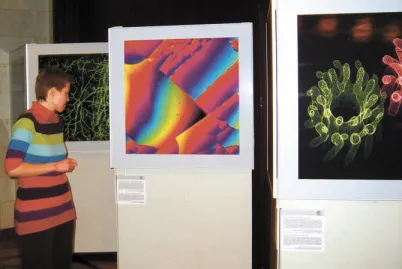
No matter how you argue with the fact that four dozen images presented at the exhibition “Pictures from the World of Science” are simply fascinating. The opening of the exhibition ended the forum "Scientific Journalism: Features of the Profession and the possibility of learning." The exhibition will go in the cultural center. Goethe until the end of April.
Forum program, information about the participants www.goethe.de/ins/ru/mos/ Ver/RU8855939V.htm
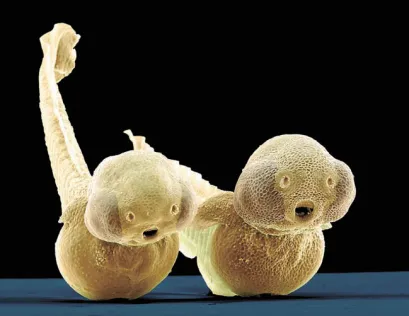
Scientists love to use the fish “ Danio Rerio ” fish as a model, conducting research in the field of development biology. Within three months, this organism grows from a fertilized egg to a sexually mature individual. The photograph shows larvae at a two -day age; The rotary hole is already clearly visible. Surrounded by ciliates of the hollows, which at first glance may seem eyes, in fact - future organs of smell. Scientists of the Institute of Biology of the Development of Society. Max Planck, using the example of Danio Rerio embryo, study the development of tissues and organs. The left of the embryos shown here has a genetic defect that causes problems in the development of the skin.