
Translated material
Dancing men of Conan-Dyul in Rus'
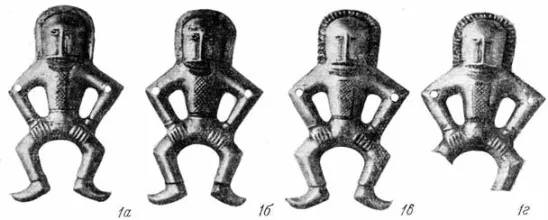
More than a hundred years ago in Ukraine, in Pox, in the village of Martynovka, a treasure of silver products was discovered - 116 things. Among them, 4 figures of the men, as it were, in the dance - the legs, the arms “into the sides” - and five figures of animals with a mane - either horses, or legs with hooves, but there is no horse tail (lion's tail) and a large mouth is opened. The treasure first went around the hands, then it was collected by collectors and archaeologists, and in the end of antiquity turned out to be part of the Kiev Museum, partly in British. Until now, the treasure attracts the attention of ufologists as a “testimony” of visiting the Earth by heavenly aliens (I think this can be left without consideration), but archaeologists initially do not deprive him of his attention.
The famous Russian archaeologist-systematizer A.A. Spitsyn already in Soviet times dated the Martynovsky treasure of the VI - VII centuries BC. e., that is, the Dokiev time, and attributed him to the "antiquities of the Ants", that is, the early Slavs. After 10 years, the Hungarian archaeologist Nandor Fettih revised this definition and attributed to the culture of the Avars - nomads who "accepted the Slavs" by the annals and at one time associated with the detectives, the ancestors of the Hungarians. Of course, he chose horses from horses and lions: nomads did not go on lions. Another Hungarian, D. Laszlo, added the assumption that the figures were overlays on the saddle bow.
Academician B.A. Rybakov in 1953 fiercely defended Spitsyn's point of view on the grounds that antiquity found in the basin of the tributary of the Dnieper - the River of the dew, from which he deduced the name of Rusich and Russians, and on the figures of dancing men he saw embroidered shirts (shaved rectangles on his chest). Just by this time, Stalin defeated the teachings of academician Marra, and it became possible to engage in ethnic roots of the Russian people. Rybakov published in the Almanac “Soviet Archeology” the article “Ancient Rus. On the issue of the formation of the nucleus of the Old Russian nationality in the light of the works of I.V. Stalin ". Thanks to the authority of Rybakov in albums, textbooks and reference books, Martynov’s images of “golden -haired horses and golden -haired husbands” (formulating Rybakov) and fisherman reconstruction of the costume of the early Slavs began to be reproduced.
Meanwhile, the Martynovsky treasure has not yet been scientifically published or truly studied. The scientists who studied him were not lucky. A large study of the antiquities of the Ants, made an extremely meticulous researcher G.F. Korzukhina, she could not print during her life. Another meticulous researcher, student of Rybakova A.K. Ambrose also could not publish his work on the Martynovsky treasure during his lifetime. Meanwhile, having selected some similar finds, he found that zoomorphic figures are not horses, but lions, which called into question both nomads and early Slavs.
In those years, Soviet archeology did not really need meticulous studies of things-give it ideologically necessary conclusions, and only in the “dashing 90s” these works were still printed. Then two more monographs appeared about Martynovsky treasure and “Anti antiquities” - Ukrainian and Austrian. Antiquities were attributed to the Penkovo culture - one of several truly associated with the early Slavs. But the “dancing men” remained a mystery - neither the function of these images, nor their meaning were disclosed.
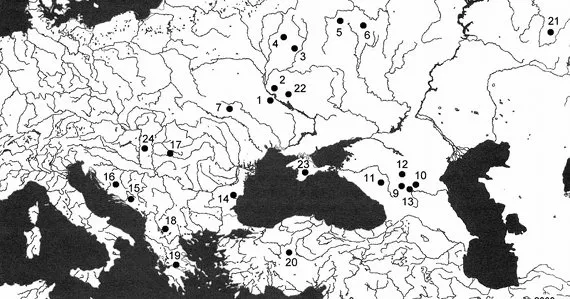
In the new millennium, they took up the talented researcher Olga Alekseevna Shcheglova, working at the Institute for the History of Material Culture of the Russian Academy of Sciences in St. Petersburg and teaching at the Department of Archeology of the University. Continuing the case of G.F. Korzukhina, she collected information about all similar finds (a map is given). They were distributed from Greece, Hungary and even Spain to the North Caucasus and the Volga region. It became finally clear that the “skates” were not horses at all, namely lions. On many of the same figures, this was clearly visible.
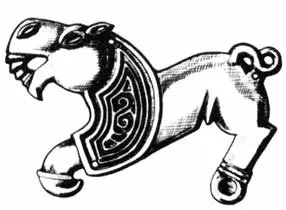
The little man also became clearer - the shabby rectangle on his chest did not at all portray an embroidered shirt. It was embroidery on a Byzantine type tunic. And the whole combination of men with the lions Shcheglov found a convincing interpretation. Throughout Europe, the images of the Christian motive “Daniel with the Lions” - about the prophet abandoned lions to be torn apart, but praying them with a prayer and an appeal to the Lord, diverged from Byzantium. These artistic images crossed religious boundaries and were also popular outside the biblical world. As for the fact that they were ahead of the actual advancement of Christianity to the Slavs, this is always the case: formal borrowings from the foci of civilization always go ahead of the perception of the essence.
Here, in a barbaric environment, I liked not so much the peace of predators as a clash of an unarmed person with predators and the upcoming torment. In these foreign areas, where the content of the Christian legend did not reach and where the lions were unfamiliar, they gradually turned into predatory horses. How these cast figures were used, it is not yet clear - either like overlays on the belt, or like chest jewelry, or flaunted on a shield, or, most likely, fixed on the equipment of a combat horse.
The article by O. A. Shcheglova “The Secret of“ Dancing Men ”and“ Traces of unprecedented animals ”. Anthropic and zoomorphic images in early Slavic metal-plastics were published in the collection “Slavic-Russian jewelry and its origins”, dedicated to the 100th anniversary of the birth of G.F. Korzukhina. In this fitness, one of the main techniques of archaeological research was revealed - the General collection of analogies, cataloging, and overkill of angles. And, accordingly, the need for an archaeologist to have extensive erudition and the gift of unexpected links. That is, the same thing is required as the detective.
The epigraph from A. Conan-Dyul (“Dancing men”) suggested her article Shcheglova::
“ - Did you write this? There is not a single person on the whole globe, except for the members of our gang who would know the secret of dancing men. How could you write this?
“ What is invented by one person may be understood by another, ” said Holmes ... ”
I admired the grace of this article and decided to share my impression with readers.
Lev Klein