
Translated material
Speak without knowing the language
There is a belief about linguists: these people may not know a single language except their own, but speak any. In February 2012, any person who found himself in Moscow could experience this condition-the sixth International Language Festival, which has been organizing the Moscow Youth Esperanto Club for several years in a row. To sing in Irish, write in Arabic letters and listen to the incredible speech of the Circassians, consisting of almost one consonants. This fascinating event is told by Olga Blacksaya.
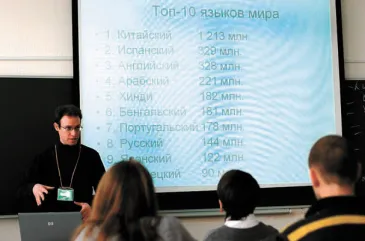
Mid -February, the most severe Moscow frosts this year and Sunday. In order to come to the Russian University of Friendship of Peoples in the morning, where the festival was held, a certain willpower is needed. As it turned out, many possess it: this year, according to the organizers, about a thousand people visited the festival. Most are schoolchildren and students, philologists, linguists, teachers and simply interested in languages. The entrance to the festival was free, although the organizers asked to pre -register on the site.
Briefly, the festival can be called a collection of lectures on different languages, linguistics and linguistics and quite a bit - about culture. This main part of the program was opened by a quiz for the participants, followed by the short performances of the lecturers representing their presentations - a kind of advertising. It is not surprising - in total, the program announced about 100 topics, divided into 7 temporary blocks of 40 minutes. It is very difficult to navigate in such an abundance, and a preliminary announcement helps to choose the most interesting presentations. However, it was no less strong and acute regret from the fact that it is impossible to be everywhere at the same time.
The “heart” of the festival is a set of lectures-lessons, mainly about various languages, known and little-known, natural and artificial (except Esperanto, visitors could learn, for example, about the language of Tokipon or elven), living and already dead. Of course, it is impossible to truly call these stories lectures, since in 40 minutes the one language is impossible to tell not only everything, but even a small part. But this was not a goal. Rather, it is more correct to talk about small lessons, only, unlike lessons, the topic of classes was very extensive - to tell about everything right away.
The lecturers had a difficult task - it is concise to describe that in one language or another special language, and then be sure to give the listeners this language to try - to taste, by ear and even on hand. Writing unusual letters unfamiliar words - the experience is not the most common, but, as I can now say, unusually interesting.
To do this, all possible means went into business - from rather strict grammatical tables and analyzing the structure of words or sentences to songs and poems. One of the lecturers gives preference to the “classic” style of presentation, someone, on the contrary, believes that it is more interesting to listen to live speech or even talk to yourself. But you can safely say: in no case it was bored, and each presentation -or lesson -a small work of pedagogical art -remembered for.
If these classes were rather educational and practical, then lectures on linguistics and philology were closer to the popular science genre. Here you could find out how and why, in fact, the language is studied. In addition, part of the lectures was cultural and entertaining-from acquaintance with the Chinese tea ceremony to the master class game (Yakut Wargan). I could not visit the last part of the program-I wanted to know more about the languages themselves. However, I dare to think that it was no less exciting.
The main organizer of the Moscow Language Festival is the Moscow Youth Esperanto Club EK Masi, this year-together with the Russian University of Friendship of Peoples. If we talk about the world as a whole, then such festivals are quite often held at the initiative of the Esperantists - language lovers and especially the ideology of Esperanto. The first event of this kind took place in 1995 in France (G. Tour), gathering about 800 students. He was initiated by the American linguist and public figure Esperantist Danis Kif. Similar events are held in other countries: Venezuela, Slovakia, Ukraine, Ukraine, Finland, France, Sweden, etc. In Russia, the Chuvash Esperanto Association is especially active in Russia, which has already organized 14 festivals of republican languages since 1996 (2-3 thousand people each). Festivals regularly also take place in Volgograd, Ulyanovsk, St. Petersburg. In Moscow in 2012, the languages festival passed the sixth time.
The fact that the festival is organized by Esperantists sometimes becomes the reason for the accusations that the event is used only to “recruit” new adherents. Without touching in this case, Esperanto’s language is the very ideology of the language, which may be a reason to talk about the strong social orientation of this movement, say that at the Moscow festival itself, the participant himself was free to choose whether he wanted to know something about Esperanto or not.
Irina Goncharova, Coordinator of Esperanto Club EK Masi, director of the Moscow Festival of Languages, answers questions:
-Please tell us a little about the Moscow Youth Esperanto Club. Who can enter it?
- A member of the club can become every ending course of the international language of Esperanto or speaks this language and interested in club activities, for example, in foreign tourism or organizing club events, such as a language festival.
- How did the language festival appear in Moscow and how did it change over the past time?
-Over 10 years, observing the development of the festival of languages in Cheboksary, the guys of our Esperanto club could still not decide to repeat the feat of colleagues in our metropolis. The case, misunderstanding, courage, enthusiasm-and support of the stranger Evgeny Vladimirovich Mark-Lov, director of the boarding school "Intellectual" under the government of Moscow, where the first Moscow festival of languages took place, helped. 33 languages were presented on it, and the standard school hall was cramped for 300 of our guests.
Since then, the festival has grown significantly. This year, at MMFYA-6, we already represented 70 languages, 20 lectures on linguistics and 10 cultural events. The spacious premises of the Russian University of Friendship of Peoples accommodated more than a thousand guests.
-Who organizes the festival, except for the Moscow Youth Esperanto Club? Are the organizers change from year to year? Who can take part in the preparation of the festival?
-The team of the Moscow Youth Esperanto Club is significantly supplemented by young and brilliantly talented linguists of the leading language universities of the capital: Moscow State University, RSU, MGLU. It is they who provide the high scientific level of our program, which we have the right to be proud of. The composition of the organizational team MMFYA is changing from time to once, I think, at 30 percent. And this pleases: constant updating helps to maintain festive mood and enthusiasm, while newcomers have someone to learn. Participation in the preparation of the festival can be taken by any initiative person who is carried away by our business and is ready to work with enthusiasm for free. After all, we are in the full sense of the word volunteer movement. You just need to contact the organizers (contacts on the site [1]) and come to the meeting!
- However, probably, some financial support is still needed. Who provides it?
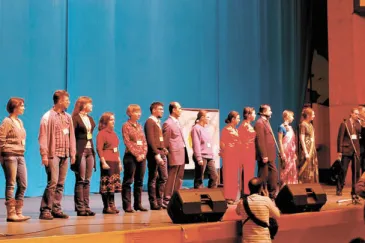
- Our huge festival is a low -budget event. A number of the most important things - from printing diplomas to the provision of premises - take upon itself the receiving party. Thus, any site inviting us is a full -fledged co -organizer of the festival. The necessary "live" money consists of voluntary donations of guests and participants in the holiday.
- Are there any statistics of participants - who usually comes to the festival? How many participants, according to your estimates, was this year?
-A variety of people, mostly still young people. Recently, the festival has been gaining all the most popular among schoolchildren. This year, according to our spreading calculations, from 1000 to 1200 people visited the festival.
- Who usually becomes a lecturer of the festival, and who can become them? Are there any requirements for presentations and lectures?
- Any person who is able to tell about the language competently and with love! For beginners-and we have a lot of such at each festival-a preliminary consultation of a linguist-expert is mandatory. The main requirement for the structure of the speech is that the 60-70 % of the time is devoted to the language.
- What is the task of the program committee - is there any “limit” in languages or in the number of lectures on the language?
- The ideology of our festival: "All languages are equal rights and opportunities!" Therefore, we try to organize the program so that each language is presented 2 times. The exception is Esperanto, because one of the goals of the organizers is its popularization. Therefore, Esperanto is presented 4-5 times. Interestingly, the brightest pages of the festival are presentations and lectures on the Russian language, they always enjoy great success. With in mind that English is currently widespread, we try to tell something new about this language, invite speakers, arrange interactive, expanding the presentation framework. All the events of the series “A different format” and lectures are held once.
-In the current program, priority is clearly given to stories about languages in comparison with popular science lectures. Is it a conscious policy or is it just that it happens? How is the program compiled?
- Absolutely conscious policy. Priority will remain behind the presentations of languages, this is the main structural unit of the festival, this is its idea and the essence. The lecture form appeared in us at the 4th year of life, and aroused great interest among the public. Now we think how to satisfy this interest to the detriment of presentations.
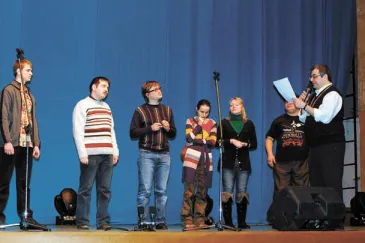
The program is compiled from the proposals of presenters of previous festivals and from new offers that have no limit.
- What are the plans for the program committee for next year? Will the festival be held, and what can be changed in it?
- Why for the future? Last year, we knocked out of the schedule, having spent several small ones instead of the large festival. That is, this year you need to spend two large ones! We dream of doing this in our usual dates - on the last Sunday of October. Follow advertising on our website!
Photos of S. Kuznetsov