
Translated material
Analog AAAS was created in Russia
Alexey Elyashevich, Chairman of the Council of St. Petersburg Department of Rasn, Dokt. physical mat. Sciences, professor of St. Petersburg State Polytechnic University talks about the goals of the new organization.
At the beginning of this year, with an interval of exactly one month in Moscow, two events occurred, which can give an impetus to a noticeable activation of the scientific community. So, on January 24, 2012, the first conference of the Russian Association of Assistance to Science (Rashan) was held in the building of the Public Chamber, and on February 24, the Society of Scientists (OHR) was formed, which is described in this issue of the newspaper.
The forum of races was attended by delegates from 34 regions. The model of the new organization was the American Association of Science (The American Association for the Advancement of Science) is an international non-profit organization that has more than 160-year history (1848) and containing several hundred thousand individual and collective members [1].
Opening the first conference of Rashan, the chairman of the Presidium of Rashan Academician Evgeny Velikhov called this day of the birthday of the new organization, and on the day of conception-on April 17 last year, when he made a report “On the need to create a Russian Association of Science” at the 21st annual conference of the St. Petersburg Union of Scientists. On November 16, 2011, Rashan was officially registered. Now, in 50 regions of Russia, regional branches have been created, and in all regions, except Moscow and St. Petersburg, the organization of regional branches has taken upon the public chambers of the constituent entities of the Federation.
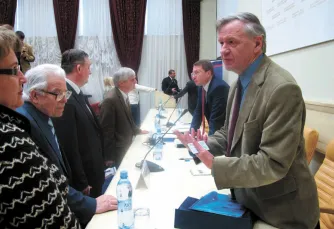
Rasun positions itself as an organization striving to become a kind of third force, which, interacting with the Ministry of Science and Education and the Russian Academy of Sciences, will be able to have a significant impact on the increase in the role of science in the life of our state and society. It expects to become a mass organization, preserving high requirements for scientists accepted into their composition, education figures, engineers, scientific journalists, businessmen who use science in their business. To join the races, you need to have a recommendation from its two members, and an informal requirement not prescribed in the charter, there was a wish that the candidates for Rashan had at least two publications in scientific publications over the past three years.
According to the adopted charter, the highest governing body of Rashan is the All -Russian Conference, convened at least once every five years. In the period between conferences, the provision of the RA SN body is the Plenum, and the permanent governing collegial body is the Presidium.
At first glance, the fear expressed by one of the organizers of the Society of Scientists by Alexander Fradkov is justified that “Rashan will represent the interests of“ large scientific capital ”, and not“ scientific manufacturers ” - active scientific groups, in which, as a rule, an advanced science is made” [2].
However, such a fear may not be justified if effectively working scientists enter and develop practical activities in races. And such a prospect is not utopian. Members of the St. Petersburg Union of Scientists, uniting precisely such scientists, since January 2011, took an active part in developing the concept of races, developing key provisions of the charter, formulating the conditions for admission to the association and many ideological provisions, as well as in the creation of the St. Petersburg regional branch of races.
Lev Borkin, one of the founders of the St. Petersburg Union of Scientists, whose authority in the scientific world, is by no means determined by its titles, entered the Presidium of Ras. In the course of his programmatic speech, he proposed to create within the framework of the races, following the example of AAAS among others, the financial, regional (for work with branches) and the expert commission, as well as committees for the development of policy in the field of science, education, in the field of technology and innovation. In addition, he spoke for the creation of scientific ethics committees, the freedom of scientific information and responsibility of scientists, on scientific policy, etc.
The need to solve the general problems facing Russian science and education see a real possibility of constructive cooperation between races and onr. The society created by “from below” will be able to better reflect and formulate the requirements of scientists, and the races can submit and lobby for reasonable, well -reasoned, realistic proposals, drawn up in the form of carefully worked out projects, promoted in the authorities at the regional and federal levels.
Of course, how effective the activity of races will be can be judged only after years, and answering the question: “What is the benefit of the organizations created now?”, I would recall Benjamin Franklin’s answer to the question: “What is the benefit of electricity you discovered?” “No, like from a newborn child.”
1. The AAAS affiliated member has been the St. Petersburg Union of Scientists since 1995, and the academician of the Russian Academy of Sciences E.P. Velikhov is one of the three Russian scientists - members of AAAS, who have the right to decide vote.
2. Alexander Fradkov. Power and reason. TRV-hunger, No. 96, dated January 31, 2012, p. 6.
From the editorial office:
The Presidium-in fact, the highest governing body of RASN-included: Academician of the Russian Academy of Sciences, President of the Kurchatov Institute Yevgeny Velikhov, head of the Kurchatov Institute Mikhail Kovalchuk, member of the Public Chamber Maxim Viktorov, former member of the OP, rector of the New Siberian Institute Nadezhda Vavilin, Chairman of the Board of the St. Petersburg Union Leo Borkin, Professor. SPbSU, neurolinguist Tatyana Chernigov and Rector RUDN Vladimir Filippov. One of the conference participants, Sergei Kozyrev from the St. Petersburg State Polytechnic University, spoke out against the candidacy of Filippov, but there were no other votes against.
About how the tasks of the new organization of the deputy are seen. Glavred TRV-hunger Mikhail Gelfand, can be judged by the video of his performance ( www.youtube.com/v/15ptbvupr4q ). Using a baby’s metaphor proposed by E.P. Velikhov to describe the birth of a new organization, Gelfand noted that “in order for the child to publish the first scream, he is slapping him. I will try to fulfill this function and state that Russian science is in the systemic crisis. ” The subjects of his speeches were, in particular, underfunding of scientific funds, the lack of mechanisms of independent examination of scientific projects, degradation of the science management system and the scientific community itself.
Speech by M.S. Gelfand http://trv-sciense.ru/?p=14762
Fragments of the speech L.Ya. Borkina http://trv-science.ru/?p=14771