
Translated material
The lost Russian satellite "Express-am4" will befell the fate of the "phobos-group": it will be drowned at the end of March
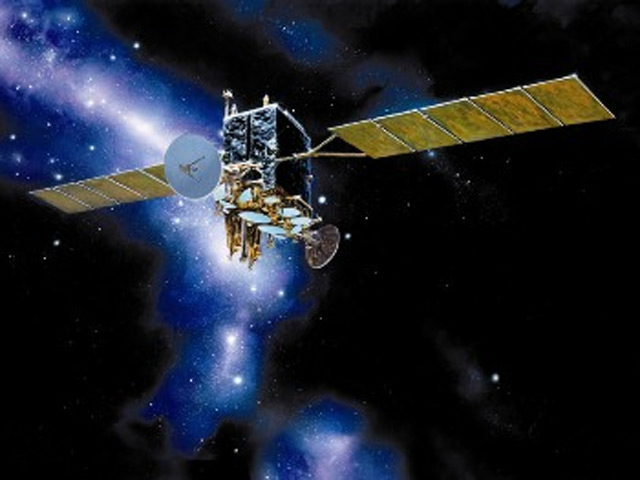
The Russian telecommunications satellite of Express-AM4 , which was brought to an unprofitable orbit in August last year, will be flooded in the Pacific Ocean at the end of March, Interfax reports with reference as Deputy General Director of the Economics and Finance of the Space Communication enterprise Denisa Pivnyuk.
Speaking at the Satellite 2012 conference in Washington, he said that the satellite will be flooded from March 20 to 26. According to him, the device was not damaged, but within seven months he was in an unleasable orbit, constantly passing through the radiation belts of the Earth, and this affected it in no best way.
As a result of this, the term of its active existence was reduced. He also noted that numerous scenarios of salvation of the satellite were rejected.
Express-AM4 telecommunications satellite was designed and manufactured in the framework of cooperation between the European company Astrium and the Khrunichev GKNPC by order of the FSUE Space Communications. A satellite of 5775 kg weighing on the basis of the Eurostar E3000 platform, it is equipped with 24 transponders of the C-band, 28 KUU bands, two cas-band and three L-band to ensure sustainable covering the entire territory of Russia and the CIS countries.
On August 18, 2011, the Express-AM4 apparatus was launched from the Baikonur cosmodrome by the Proton-M launch vehicle. However, due to the introduction of erroneous parameters to the flight assignment of erroneous parameters, the Breez-M accelerated unit brought a satellite into an unlimited orbit. The company "Space Communications" recognized that due to the impossibility of transferring the device to geostationary orbit, its use for the purpose is impossible.
Earlier it was reported that OSAO "Ingosstrakh" paid the Space Communications to the enterprise an insurance amount in the amount of more than 7.5 billion rubles.
It is also reported that the launch of the Russian multi -purpose laboratory module "Science" to the International Space Station (ISS) has been postponed from 2013 to 2014.
The source of Interfax in the rocket and space industry did not specify the reason for the next transfer of the launch of the module. Initially, the launch of the module was planned in 2007 and was repeatedly delayed for various reasons, including due to a lack of money for its construction, as well as due to changes in its purpose. The last time of its launch was called 2013.