
Translated material
Medvedev instructed the government by September to think about a decrease in the Gosdoli in banks
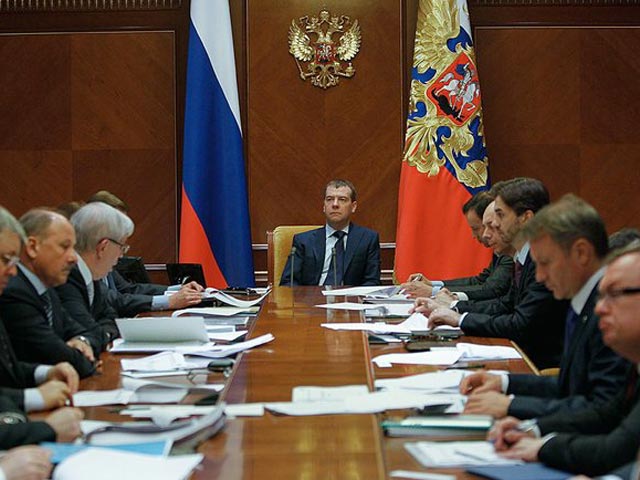
Russian President Dmitry Medvedev signed a list of instructions following a meeting on economic issues on March 12, the Kremlin press service said.
He instructed the government together with the Central Bank until September 1 to prepare proposals for making changes to the legislation regarding a reduction in the state of the state to a level of less than 50% in banks with state participation, Interfax reports.
At the same time, proposals should be prepared to create the Institute of Financial Ombudsman and the Council of Financial Stability. In addition, on September 1, proposals should be prepared to stimulate cashless payments, as well as a change in the investment strategy for placing funds of pension funds.
The state directly controls the two system -forming banks - VTB and Rosselkhozbank. A few more credit organizations belong to the State Corporation "Bank for Development and Foreign Economic Activities (Vnesheconombank)".
The country's largest bank, Sberbank of the Russian Federation, is controlled by the Bank of Russia, which is not included in the executive system.
According to the privatization plan, the government from 2011 to 2013 plans to sell 35.5% minus one promotion of VTB. In 2011, the first 10% of the shares from this package were privatized, in 2012 it is supposed to sell the next 10%. The state currently owns 75.5% of VTB shares.
Rosselkhozbank is 100% belongs to the state. The government privatization plan provides for the sale of 25% of the shares of the RSHB until 2015. The full exit of the Russian Federation from its capital is planned by 2017. Already in April 2012, partial "quasi -provatization" "Sberbank" may take place - the sale of 7.6% of shares on the market from the package of the Central Bank of the Russian Federation (57.6% in the authorized capital, 60.3% of the vote)
The plans of the Russian government to consolidate the sector and increase the minimum capital of banks to 1 billion rubles from 2015 commenting on the websiteinopressa.ru . So, for example, French La Tribune , citing a statement by the Minister of Finance Anton Siluanov, writes: “Despite the fact that the shareholders are warned and a delay, this news has the effect of an exploding bomb in Russian financial circles, reviving disputes, splitting economists over 10 years.”
Some experts believe that the size of the country justifies the existence of a large number of regional banks. However, the trust of Russians in banking institutions fell after two large-scale financial crises-the 1993 and 1998.
Opponents believe that the further existence of dubious banks with low capital is a threat to the stability of the system. “It is believed that small banks are allegedly more often involved in money laundering,” comments Maxim Osadchiy, Analyst BCF -Bank. “But in fact, in the last 24 cases of laundering, many institutions were noticed, the capital of which exceeds 1 billion rubles. Therefore, the main argument does not withstand criticism: healing is not related to the size.”