
Translated material
Damned pension question
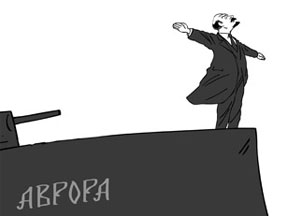
The problem of the growing deficit of the pension system leads the government to a difficult dilemma. It is necessary to either reduce the costs of the state by retirement, or increase taxes. Raising taxes - a blow to the economy. Reducing costs is fraught with mass protests. There is a great risk of politics "to leave everything as it is."
What to do with pensions? This issue does not give rest to the government. It seems to be clear: in order to maintain the trust of such an electorally significant social group as pensioners, it is necessary to increase it. Only now the pesonic fund in Russia is scarce, and the population is aging. Therefore, the deficit will increase over time, and even the current level of pensions will require more and more resources. And the most diverse responsible officials and experts are trying to come up with an acceptable way out of the situation.
The Ministry of Finance, as Izvestia writes, came up with the creation of individual accounts where future pensioners could voluntarily transfer money. These voluntary accumulations will be, respectively, an increase in a minimum pension guaranteed by the state. Such a practice exists in the USA: citizens themselves manage their pension account, at their choice, the funds are sent to the bank, insurance company, personal broker or to the share fund. This will allow you to get a greater profitability compared to the conservative and super -reidal investments of VEB (controls the pension savings of "silently"), which today demonstrates income below inflation. That is, negative.
VEBU and other operator of money of the funded system is prohibited from investing in papers even with medium reliability, and high -rental investments of large profits cannot be brought by definition. If the financial structure delivered from such restrictions is the operator of the funds of an individual citizen, then profitability can grow. Naturally, due to the growth of risks for pension savings - but the risks of an individual citizen, and not all participants in the system at once.
For the state, the massive introduction of a system of voluntary savings would “finally solve” the ill -fated pension issue: it would guarantee the minimum in which the citizen would not die of hunger, and he must accumulate everything else on his own. Approximately, in the Soviet Union, people set aside the money "for the funeral." Now, if the proposals of the Ministry of Finance are held in the government and parliament, they will save the money “retired”.
It is doubtful, it is true that the initiative will find a response from the broad masses. The trust in financial institutions among Russians is still relatively small, and the planning horizon “before retirement” is clearly not extending. Even the pensions campaign conducted by the Pension Fund for the co -financing of pensions, when the state added its own to the ruble voluntarily introduced by a citizen, it actually failed: less than 1.5 percent of the country's inhabitants (about 3 percent of able -bodied ones) took part in it. In the mass opening of voluntary personal accounts in this context, it is poorly believed.
The first deputy chairman of the Central Bank, Alexei Ulyukaev, has already made a proposal to remove from the state, has already been made by the first deputy chairman of the Central Bank in the program text, which recently published in Vedomosti. Ulyukaev also proposed other measures, say, "to return to the initial understanding of intercoral solidarity as primarily the solidarity of intra -family." Translated into Russian, this means that concern for the income of the elderly can be shifted from the shoulders of the state to the shoulders of children and grandchildren of a particular pensioner. Or: "The amount of a pension benefit should focus on the cost of living of a pensioner." Probably calculated by Rosstat, which can also give good savings for the state.
A different solution to the problem was recently proposed by the former Minister of Finance Alexei Kudrin and the famous economist Evsey Gurvich. In the article, published in the journal “Questions of Economics”, the authors substantiated the need to increase the retirement age by the fact that “intercoral solidarity” is restored in this way. That is, an imbalance is eliminated, when the retirement has been retired less than the now -working pays.
With the responsibility of the government in Russia and without a pension issue there are certain problems. And here is the question for politicians is super -sensitive. Surely both Vladimir Putin and Dmitry Medvedev, who will have to do something with pensions as the head of the government, have not forgotten the multimillion-dollar protests of pensioners throughout the country after monetizing benefits in 2005.
According to the Soviet representation, a person worked for the country all his life and now it should provide him with a worthy (at least not hungry) old age. The fact that the country is already different, and the relative minority of people directly works on it (that is, on the state) was not reflected in this view in any way. People seriously believe that the state “owes them”, and any attempts to reconsider this order are a violation of their basic rights. This is more serious than the right to elect and be beaten, for which hundreds of people went to the metropolitan square, and therefore even any discussion of the pension issue becomes painful and highly risk for the government.
This is what they remember (well, to those who have remembered something at all) in the whole extensive massif of Vladimir Putin's election promises. At whose expense? What difference does it make, probably at the expense of the state. Accordingly, there is a great risk that our first persons will not dare to go to any radical changes, trying to please the masses. Leaving everything as it is, using one after another palliative measures, it seems, is unlikely to come out. So, you have to increase taxes. And workers will have to pay more. To explain to pensioners that the harm to the national economy will not work: after all, "the state owes us."