
Translated material
Have mercy, Mr. President!
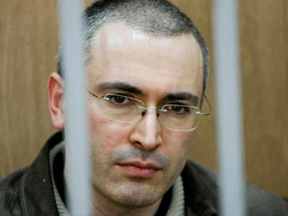
President Medvedev may have mercy on citizens whom the opposition considers political prisoners. At least Boris Nemtsov swears that it will be so. I am not very believed, because among the "Politicals" there is Mikhail Khodorkovsky. And Medvedev can tease the Putin's environment, but why did he need a conflict with the Putin?
In the political agenda, the theme of "liberation of political prisoners" suddenly arose again. Moreover, as if seriously, but returned her there - oddly enough - Boris Nemtsov. In general, of course, the price of the statements of our “irreconcilable oppositionists” is small-firstly, they are people who are not clothed with power, secondly, they feel the right to make words that are little correlated with the surrounding reality. However, in this case, Nemtsov told the “independent newspaper” that he heard “not in the Danilovsky market” about the pardon of political prisoners and, in general, “not a political scientist”, and therefore his information is “concrete”.
The opposition is hinting, so that he heard about the upcoming liberation from one of the high-ranking persons. That is: from President Medvedev, whom the opposition met in February. At that meeting, Medvedev was transferred to the “list of political prisoners”, and immediately after the presidential election, the departing president ordered the Prosecutor General’s office to consider it on the subject of whether the mentioned on the list was just in the list. All this adds to the words of Boris Nemtsov weight.
Moreover, in the list of political prisoners (according to the opposition) there is, say, Yukosovites Mikhail Khodorkovsky and Platon Lebedev. And Nemtsov believes them, pardon will also affect. It is already hard to believe in this. There are no obvious advantages for Medvedev in the liberation of the “Yukosovites”. Folk love can not be shot by such a manner, the number of fans of the former oligarch is measured in thousands, perhaps tens of thousands, but the number of those to whom Khodorkovsky is unsympathetic is more for a couple of orders.
Publicly, Medvedev throughout his entire presidential term tried to speak out in the “Khodorkovsky case” quite carefully. The brutality characteristic of Putin’s statements on the same topic (“the thief must sit in prison”, mentions of the murders in which the leaders of the Yukos are guilty) did not have Medvedev, and he even spoke out at the only Presidential career that Khodorkovsky was not dangerous for society. However, almost every time Medvedev emphasized that he had condemned the Khodorkovsky court, and he should not put pressure on the autonomous judiciary.
And this independent judiciary consistently refused Khodorkovsky in parole and rolled it for a second term precisely during the presidency of Dmitry Medvedev.
The softness of presidential rhetoric and measures to “humanize punishments” for the economic crimes that President Medvedev is proud of, thus, did not bring any personal benefit to the former head of the Yukos.
And with pardon everything is not easy. Although from Russian laws it is impossible to unequivocally understand what the pardon procedure should be, the authorities traditionally insist that pardon should be preceded by a request of the convict and would be better with repentance in committed acts. And the faults of the Yukos case, and most of the other “political prisoners” were not recognized from the opposition list, did not recognize the faults.
He has already promised a post at the head of the government. But before making it to the State Duma, and theoretically before its premiere approved, it will be possible to replay the appointment under some kind of far-fetched pretext. Why once again annoying the “senior in tandem” and faithful Putinites (the same deputy prime minister Igor Sechin, whom Khodorkovsky himself called the initiator of the “case of Yukos”) is absolutely incomprehensible. To release some National Bolshes from prison is one thing, letting go of Khodorkovsky’s prison-after all, a decision fraught with potential confrontation.
Unless the outgoing president needed to recall the Putin’s environment again for some reason that he still has a pair of trump cards in his sleeve. Nemtsov in such a context is a convenient channel for delivery of information to all interested parties, more conveniently than some Presidential Council for Human Rights. Since everyone who is interested in will hear the statement, but in which case it will be easily said that all this is pure drooping and there will be no pardon. "Well, you know Nemtsov."
Yes, we know Boris Nemtsov and may well believe that he gives the desired as real. It is entrusted, say, “comprehensively consider the issue”, and he already sees all the list mentioned in the Medvedev listed by Medvedev and hurries to declare this. Or is it generally some kind of uncomfortable exchange with the Kremlin, say, “a rumor in exchange for registration” of the Party of Freedom, where Nemtsov is one of the leaders. Finally, no one canceled the legal desire of the leader of Parnassus once again to remind himself of himself, and if no pardon will be reminded again, accusing the same Kremlin of complete ignoring the requirements of the opposition and disrupting the “constructive dialogue”.
Back in 2006-2007, the joke “If Putin went for a third term, Khodorkovsky will go to the second, was popular on the network.” Khodorkovsky “went for a second term”, Putin to the third. So far, everything has come true. “Political scientists from the Danilovsky market” were right, and the assumptions of all those who believed in the “Medvedev liberalization” to the capital's rallies were empty hopes.
It seems that today the former oligarch, according to the authorities, looks quite organically in the colony. We have “boys” political practices, dealt with the head of Yukos precisely in the framework of this paradigm, therefore, to sit for him until the “boys” decide that he was already “omitted” enough. The word "pardon" somehow poorly lays down in this context.