
Translated material
"I'm free!"
Natalia Moral - The New Times
"Have you ever entered the Domodedovo airport before?" -asked the border guard, turning over the pages of the passport of Natalia Morar last Monday, March 26, 2012.
“Yes, it happened,” she answered. It happened. On December 16, 2007, the New Times correspondent Natalia Moral, who was returning home from a business trip, was not allowed to the country: a week earlier in the magazine her famous investigation “Black Cash desk of the Kremlin” was published. At the end of February 2008, she and her husband, the chief editor of the magazine and a citizen of the Russian Federation Ilya Barabanov, spent three days in the arrival hall: but at the entrance to the country where she lived for more than six years, graduated with honors from Moscow State University, had a permanent job, loved and was loved, she was refused again-“in order to ensure the security of the state”, as all the departments answered, from the departments, from FSB to the General Prosecutor's Office. The New Times passed all instances, including the Constitutional Court of the Russian Federation (the case expects its consideration in the European Court of Human Rights in Strasbourg) - everything was useless. At the end of January 2012, the editor -in -chief of the magazine Yevgeny Albats was invited to the meeting of Russian President Dmitry Medvedev with the leaders of the print media (the meeting was in Sochi). There she turned to the president with a request: to end this monstrous injustice, to allow Natalia Morar to enter Russia. And on March 26, the border for the special correspondent of The New Times, and now one of the most popular journalists of Moldova, leading the daily television political talk show on the Publika TV channel Natalia Moral was opened. “Come on,” said the border lady. “The FSB border service, allowing or not allowing foreigners entering the country, focuses on the list of unwanted people provided to it. In this case, Morar is apparently excluded from the database, ”an unnamed source in one of the special services told the state agency of RIA Novosti. Thus ended the story that lasted 4 years, 3 months and 10 days. Stereotype: “And as if there were no these 1560 days” (Barabanov’s calculation). Were. What did they get of, how our Natasha Moral lived - asked The New Times
On December 16, 2007, the barrier sank. How soon did you understand that this is for a long time? At that very moment. There was no doubt that this was not an accident, not someone’s mistake.
Have you thought it would drag on more than four years? Then I could not think about anything at all. Then it seemed that life was over. Because my life, she was here in Moscow. I had to receive Russian citizenship, because immediately after the end of Moscow State University (in June 2007) I submitted documents. I dreamed of moving my mother, brother to Moscow. And suddenly all this did not happen. I returned to Chisinau, I had to build all relations from scratch after six and a half years of my life in Moscow. After all, I left the girl of 17 with a little years, immediately after the Lyceum. All friends and me entered Russian universities, they stayed here, and I returned to Moldova. It seemed: my God, the province, what should I do here? In the summer of 2008, I had a terrible depression, I then thought to leave journalism. This was probably a natural rejection reaction. But time passed, and I began to understand that everything is not so bad.
I met young guys, we created the Association of ThinkMoldova (“Think, Moldova”) and did about the same thing that the “I think” association once in Moscow: lectures at the university, meetings. They were invited mainly from opposition politicians who did not appear on the TV, we had the current Prime Minister Vlad Filat, and many of those who are in power today. I started from scratch, no one knew me there.
But the world press wrote a lot about you? I suddenly became known as a citizen of Moldova, who was sent from Russia, because she wrote some texts. But no one read them there, in Chisinau were not in the know all the details.
And the Moldovan authorities did not try to stand up for you? No. Then the Communists were still under power, they did not interfere in this story at all. Although we turned, and repeatedly, to different bodies, including the Ministry of Foreign Affairs of Moldova with a request to ask: for what such sins they sent me from Russia. But they did nothing. But I remember how in February 2008, when, after three days of sitting in the border zone of Domodedovo, I sat on the plane back to Chisinau, the pilot told me: “We all these days had the whole crew for you. You probably wrote the truth, since you treated you so. ”
"
Then it seemed that life was over. Because my life, she was here in Moscow. I had a terrible depression, I then thought to leave journalism at all
"
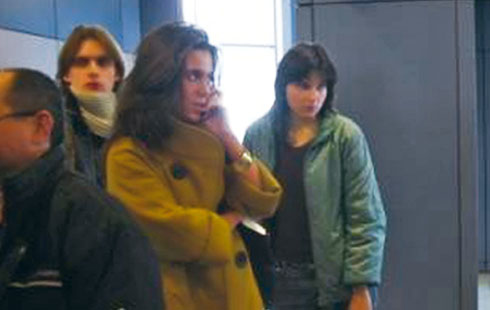
February 2008, an unsuccessful attempt to return to Russia: ahead of three days of sitting at the Domodedovo airport school and there were many those who stopped answering phone calls? There were such people in Moscow ... Then, two years later, they wrote letters, asked for forgiveness, but I did not even answer them. But this is normal, this is a school of life. Although, of course, there were more people who supported me - primarily colleagues in Moscow.
And in Chisinau? Under the Communists, the journalists, of course, suffered, but there was no such that someone was taken and sent. Therefore, my story was simply incomprehensible to many. Not to mention the fact that I was a stranger: a girl who, after school, left for Russia, and then for some reason she was thrown out of there. It was very difficult. I just wanted to forget and for the world to forget about me - it was the only desire.
And what was the reaction of home, mom? She was always afraid for me. After reading the next issue of The New Times, she called and said: “I’m just scared to think about how you go into the porch.” The most difficult moment was when Ilya and I were sitting in Domodedovo. Some anonyms began to call her at night, male voices said: "If your daughter does not calm down, then she will be calmed down, and in general she will finish poorly." When we returned to Chisinau from Domodedovo, my mother was in a coma - she did not speak for several days at all. The fourth day, I remember, burst into tears and said: "Mom, well, tell me something to understand what is happening." And she only then said that, it turns out, she was called and threatened her all this time. She then, probably, turned gray, old for 15 years. I filed an application with the local authorities, they conducted an audit, said that there was no reason to initiate a criminal case. Then, however, they told me that our local, Chisinau intelligence services, our information security service, are related to this.
That is, the Moldovan authorities did not want you either? They didn't want to. Moldova is generally a very cautious country. I continued to write for the magazine, went a lot, even made an investigation in Iceland
* * Natalya Morar, “From Peter to Reykjavik”, The New Times No. 42 of October 20 and “Russian Iceland”, No. 43 of October 27, 2008, but already in the summer of 2008 I realized: “I need to start my own story here.” Then I did not quite understand what I wanted. Moreover, then they left me from the International Committee for the Protection of Journalists in New York and reported that they nominated me for some scholarship: a year in the New York City University. Full support. But when the question got up to fly or not to fly, I decided not to fly, because I understood: if I fly to New York now, I will never return to Moldova again. And for some reason I intuitively felt that I needed to start my story at home.
And approximately then, the European Committee, representing the protection of people from countries with hard regimes, suggested that you leave for a year, at least for Mallorca - also full support, freedom of movement in Europe, apartment, conference, receptions - and you also refused. It is difficult for me to explain this, but I understood: if I leave, I will never return again. And I wanted to stay: in Moldova the electoral year, very little before the elections, the situation in the country is difficult: the Communists were in power for eight years, everything was cleaned, the opposition was not allowed on television, people are unhappy. Again, the same thing began, through which I went here in Moscow. These seats are in cafes, talking for life about how we will change the country. And then I decided to stay, refused both Mallorca and New York, not understanding what would happen. There was a feeling: his own among strangers, a stranger among their own.
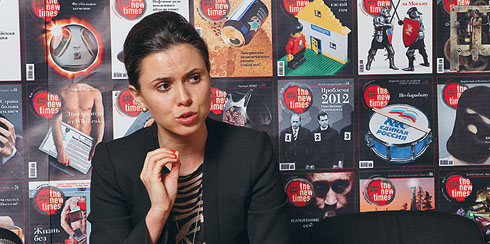
WHAT FOR THE MODERAL ? You grew up there, went to the Lyceum. Firstly, the language, of course, played an important role. I was still very poorly spoke in the Romanian language. I always spoke at home in Russian, although the parents were both Moldovans and both in their families spoke Romanian.
On Romanian or Moldavian? In Romanian: Moldavian language does not exist.
You will not be offended by these words at home? This is a fundamental position: the concept of “Moldavian language” appeared only under the Soviet regime. And be offended - for what? The Americans or the Australians are not offended by the fact that their language is English? So, my mother gave me to a Russian-speaking school, because it was the only opportunity to somehow provide a social elevator for children in the future.
Mom built your life in Moldova? No, that's why she gave me to a Russian school. Of course, in the 89th, in the 91st year, in the wake of national liberation, it became clear that it would be difficult for Russian-speaking. But Moldova did not follow the Baltic path. We did not deprive the Russian -speaking citizenship. The Russian language was not recognized as the second state, but it became the language of interethnic communication. Moldova is a multi -cultural, multinational country: almost 80% are ethnic Moldovans, some of them call themselves Romanians. But many Russians, Ukrainians, Gagauz, Bulgarians
* According to the latest population census in 2004, Moldovans account for 78.2%, Ukrainians - 8.4%, Russian - 5.8%, Gagauza - 4.4%, Bulgarians - 1.9%, the rest, including Jews and Gypsies, 1.3%. .
When you speak with the Romanians, do you have a problem of understanding? The accents are different, of course, but the Romanians from different parts of Romania also do not particularly understand each other, because the Bucharest accent, or the Moldavian accent, or Transylvanian accent is different Romanian accents. But this is one language, these are only traditions, it is one culture, it is one music. Since 1812, Moldova was part of the Russian Empire, then for a short period we became part of Romania, then, after the Molotov -Ribbentrop and the secret protocol, the Soviet troops entered the Russian field, and we returned to the Russian field. The independence of Moldova that it acquired after the collapse of the Soviet Union is, in fact, the first long period of national independence. We, as the Republic of Moldova, appeared only in the 91st year. The same part is small, 10 percent of the population, believes that we should return to Romania. About 40% believe that we should be closer to Russia. Not necessarily in the composition, but closer to Russia.
"
The most difficult moment was when Ilya and I were sitting in Domodedovo. Some anonyms began to call their mother at night, male voices said: “If your daughter does not calm down, then she will be calmed down, and in general she will finally finish”
"
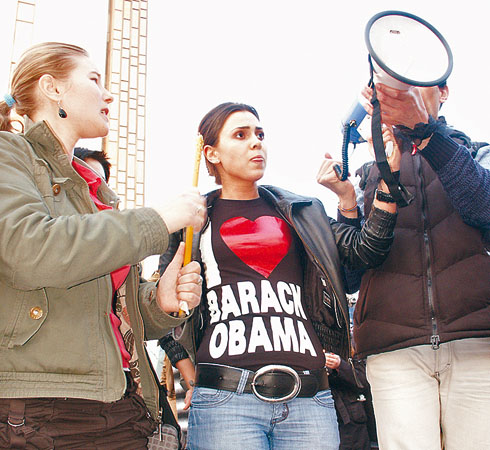
April 2009, after the riots in the center of Chisinau, Natalya Morar became the accused first, and then a witness in the criminal case of the pogrom in the building of the parliament
** Chisinau solitaire
So, you met your homeland, wrote for The New Times, and then unexpectedly for everyone in Moldova, the 2009 April Revolution happened. And again, all the world media wrote about you: “Natalia Moral is the face of the Moldavian revolution.” ** Everything is a myth. This was not a revolution, but I was not its face, or a mother Hari, or someone else - it all went with the light hand of Russian journalists who, who, like Gimpa or Urekhan,, with all due respect to them, said little, and they knew me, I was a journalist in The New Times, and therefore they wrote about me, they took me interviews.
How was everything really? April 5 (2009) We had elections. At night, everyone was waiting for the results: if the Communists again received 61 mandates in parliament, then they would have the right to elect their president. That is, the situation of 2001 and 2005 would be reproduced, when they had all the power - his president and full control over parliament. And in the morning they announce: the Communists have 60 mandates, that is, another mandate - and that’s all. It was clear: the Communists won again. They controlled all the national media during the campaign, in their hands there were law enforcement agencies and special services, a poor village that had no access to the Internet voted for them. This was preceded by many years of persecution of the opposition. A criminal case was then instituted for each opposition leader. To sit and does not twitch. We could not do anything, but it was impossible to remain silent. We, who voted against, just wanted to say: we are. In short, with several friends we met in a cafe, they began to think about which action to make. At first they thought - to take large checkered bags, with which migrant workers go, come to parliament and throw them: leave the country yourself, and we will stay here. Then the idea came to go out with candles. To organize the so -called day of national sorrow about the fact that the Communists returned to power again. It was at 11 a.m. We called everyone at 6 pm ...
And they called through Twitter? This is another myth: at that time we had several dozen accounts on Twitter. There was a group in “Odnoklassniki” - “I am an anti -communist” - “anti -communist sant”. There were groups on Facebook, sites, male, everything regarding the Internet. People arranged SMS newsletters. I personally came to several SSMEMs: "Come out." This blew in the air. When at six in the evening they came and saw an incredible crowd at the monument to Stefan Chel Mare on the Square of National Consent - we did not believe our eyes: from 10 to 15 thousand people came out - all decent people came to the square then. I think that then we experienced that you, in Moscow, when we came to Bolotnaya: we thought that we were one or two, but it turned out that there were many of us. And there was a feeling of victory. And then it was the next day, April 7, something happened, as a result of which the crowd defeated the parliament.
Your hypothesis? Provocation: the fact that people would come out, knew, and it was an ideal option for discrediting the opposition. Look, they set fire to the parliament, they scurry, take TVs, what do you want such power? And also tell that they are behind them Romanians. And everyone and people will believe, get scared.
But there were photos of those who smashed? The Communists remained in power for several months after that, created a parliamentary commission. The prosecutor's office was them, the Ministry of Internal Affairs were them, investigated. They had a huge number of different material evidence. This did not end. Then they talked that almost two buses of various documents were destroyed. Then the democrats came, created their parliamentary commission, changed the prosecutor. The result is the same. But everyone is obvious: there was a hand that brought, and then pushed the provocateurs.
Whose hand? Is this a Russian trace or Romanian? It seems that everyone was involved there. And maybe that's why they are still silent.
Under the cap
Are you still a witness in this case? Yes, I gave a non -disclosure subscription.
Okay, took into account. Then, after April 7, you had to hide, then house arrest, interrogations and so on - we wrote a lot about this, but from the stories of third parties. How was it? For four days I did not spend the night at home. And then this situation began to outraged me: I am not to blame for anything, so why should I hide? And I went home. Well, they will arrest and arrest. I did not even have time to go into the porch: a large, large physique of a young man in a civilian went out. "Girl, go through." I say: "On what basis?" He said: “To identify personality. Are there any documents with you? " I had documents with me, but I said: “No. I have documents upstairs, let's go up to the apartment. ” It was important for me to see my mother: I did not talk to my mother for five days, because I knew that they listened to us. But they put me in the car, began to carry in circles. They said that they were taken to the police department of the Chekana district, where I lived, and took a completely different place, to the organized crime department, this is a well -known place on the street of joy, Bucuria, but there are completely insoluble things. I was accepted by a huge outfit of people with machine guns. The deputy minister of the interior of the internal affairs Zubik immediately arrived. With me there were some people in civilian clothes. I said that without a lawyer I won’t go anywhere, I just won’t move. We must pay tribute that at least they observed it. They searched me, drove my fingers, took off their laces, a belt ... At that moment, the journalists already began to raise a wave of protest. The Russian press helped me a lot. When I was arrested, it was absolutely obvious that they would close me because they closed everyone. Then Venediktov (the editor -in -chief of Echo of Moscow) was in Strasbourg at the Parliamentary Assembly of the Council of Europe, and it is known that he called Mark Tkachuk, the then adviser to President Voronin, and said: “If at least one hair falls from the head of this girl, we will change our policy towards you, Mark. You must understand this. ” In short, instead of sending me to the camera, I was taken home.
What was most afraid of? I was afraid only for my mother. I was no longer afraid for myself. There was such a feeling ... Well, as if it was not all with me, as if I were watching everything from the outside. They took me home, put a post at the entrance. Early in the morning, at half -time, they had already come to me with the agenda and the next day they kept the whole day in the prosecutor's office. On the same day, the court took place. Прокуратура потребовала 30 дней ареста в СИЗО. Судья дал домашний арест. Десять дней.
Вербовать пытались? Certainly. Подходили, начинали рассказывать всякие истории из моей личной московской жизни. «А у вас, Наталья, когда-то волосы были длиннее». Или: «А как там поживает ваша подруга Алла? А у Ильи как дела?» — причем с добрыми лицами, с улыбкой. Короче, давали понять, что если я буду хорошо себя вести, то, может быть, со мной поступят лучше, чем с другими. Я им просто улыбалась и говорила: «Бесполезно». Я просто им говорила: «Даже не пытайтесь. Я прекрасно понимаю, зачем вы это делаете. Не пытайтесь».
Пугали? Ну да… «От 8 до 15 лет лишения свободы». Мне и домашнего ареста хватило: ни интернета, ни телефона. Я к окну не могла подойти. Помню, однажды подошла к окну, они моментально позвонили на домашний номер, мама ответила. Ребята, которые дежурили у подъезда, сказали: пусть она не подходит, потому что кто-то может это интерпретировать как вступление в контакт с кем-то извне. Это был сложный период. Это была вторая большая моя трагедия. Первая — 16 декабря 2007 года. Вторая — 7 апреля 2009-го. Мне до сих пор сложно об этом говорить. Не могу отделаться от этого странного ощущения: кто-то просто попользовался нами — использовали в своих целях здоровый протест молодых людей. И до сих пор не известно кто.
Мое мнение: пока не уйдут все участники тех событий, как коммунисты, так и тогдашняя оппозиция, то есть нынешняя власть, пока они не уйдут с политической сцены, мы правды не узнаем. Смотрите, в прошлом году оправдали министра внутренних дел, который был министром тогда, в апреле 2009 года. Уже при демократах оправдали, ни в чем не виноват, оказывается. Никто так и не объяснил, почему полиция не защитила здание парламента и президентуры. Почему в переулках стояли автобусы с омоном, а перед зданием парламента и президентуры стоял один кордон 18-летних карабинеров? Почему не защищали главные здания в стране? Почему открыли двери погромщикам, позволили залезть на крышу? Никто не заставит меня поверить, что любой проходящий мимо человек может залезть на крышу президентуры. Ну, представьте себе, на крышу Кремля залезет кто-то и повесит флаг другого государства, неважно, Евросоюза, Румынии. Ответов так и нет.
Когда вас переквалифицировали из обвиняемой в свидетели? 29 июля (2009 года) у нас состоялись досрочные выборы, оппозиция пришла к власти, был создан альянс «За европейскую интеграцию». И новый прокурор первым делом снял обвинение, кажется, с десяти человек, которые проходили по этому делу в качестве обвиняемых. В том числе и с меня. Мы просто целым списком шли.
Однако каждый раз, когда у вас выходит острая программа, вас снова тягают в прокуратуру. Хотя у власти все тот же «Альянс за европейскую интеграцию»! Я не могу об этом говорить.
"
Никто так и не объяснил, почему полиция не защитила здание парламента и президентуры? Почему открыли двери погромщикам, позволили залезть на крышу? Никто не заставит меня поверить, что любой проходящий мимо человек может залезть на крышу президентуры
"
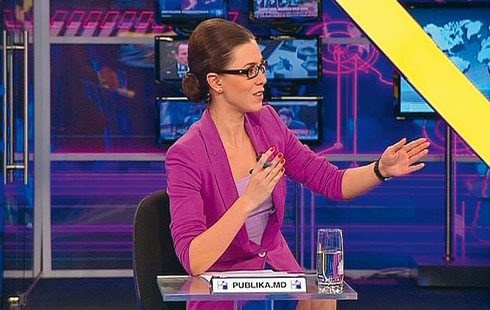
Апрель 2010 г., на только что открывшемся канале Publika TV Наталья Морарь запускает телешоу FabrikaНа Фабрике А как вы стали телевизионным журналистом? Сначала я писала колонки для «Радио Свобода»: мне нужна была пауза, я должна была понять, что я буду дальше делать. Потому что две такие трагедии меньше чем за два года — это было слишком. А потом, в начале 2010 года, стал готовиться к запуску канал Publika TV. Меня пригласили, я пришла, и 7 апреля, как раз-таки 7 апреля 2010 года, мы запустились. Проблема для меня была в том, что я изначально думала делать еженедельное политическое шоу в прямом эфире на русском языке. Но тогдашний менеджер, который занимался запуском, румын Серджиу Тоадер — это великий человек, который запустил не одно телевидение, всю жизнь проработал в медийном бизнесе, сам живет в Новой Зеландии, так вот он убедил меня, что я должна вести ежедневную программу в прайм-тайм, главное ток-шоу и — на румынском языке. Это при том что я тогда на румынском двух слов связать не могла.
Publika — прорумынский канал? Нет, мы не прорумынский, не пророссийский, мы нормальный, новостной, работающий в эфире 24 часа в сутки молдавский канал. Мы совершенно одинаково освещаем все румынские и российские события. Я веду итоговую программу дня, политическое ток-шоу, которое называется Fabrika. Причем, по-румынски правильно было писать Fabrica, но мы специально написали через «кей». Вот это «кей» — это из русского языка. Мы хотели подчеркнуть, что мы космополиты. А название «Фабрика» — как фабрика производства политических смыслов. Вот такая идея. Но сначала мне пришлось выучить румынский: я занималась с преподавателем каждый день по многу часов — я ведь раньше думала только по-русски. И журналистское сообщество меня восприняло поначалу крайне критично: говорили, почему это главное ток-шоу ведет журналистка, говорящая по-румынски с жутким русским акцентом?
Судя по тому, что о вас пишут, вы весьма жестко настроены по отношению к нынешней власти, хотя это уже не коммунисты — демократы. Why? Потому что серьезных реформ так и не случилось. Обещания остались на бумаге, коррупция цветет пышным цветом, силовые органы приватизированы разными партиями и политиками, у всех свои бизнес-интересы. Общество разделено, политики эксплуатируют фобии людей: коммунисты — русскоговорящий электорат, либералы — тех, кто говорит по-румынски. Каждый обрабатывает свою поляну и натравливает людей друг на друга. Одни стращают угрозой объединения с Румынией, другие — влиянием России, напоминанием о временах, когда вошли советские танки и многие люди были отправлены по этапам в Сибирь. Понимаете, когда тебе нечего предложить, когда ты не в состоянии предложить сколько-нибудь адекватный план развития экономики, тогда и начинаются разговоры о национальном вопросе и языке. This is the simplest. А я убеждена: мы — суверенная страна, у больших держав — большая политика, а у маленьких, таких как Молдова, должна быть умная политика. Нам необходимо создать гражданскую нацию. Только так мы станем частью большой Европы. А так — флаги Евросоюза висят на каждом углу, а по сути, за исключением того, что есть свобода СМИ, мало что изменилось.
Действительно Путин — по-прежнему самый популярный политик Молдавии? Да, он популярнее всех местных политиков. Удивительно, но есть люди, у которых родственники были сосланы в Сибирь, но они продолжали считать советскую власть единственно верной, единственно возможной. И, как и Путин, считают, что распад СССР — главная трагедия ХХ века, которая когда-либо с нами со всеми произошла. Они, с одной стороны, хотят в Европу, а с другой, как только в Европе начался кризис, принялись говорить о «Евроазиатском союзе»… Еще два года назад 62% были за евроинтеграцию, сейчас — около 40%.
Наташка, каково это — быть красивой, успешной женщиной в патриархальном обществе? Я ненавижу эти вопросы, не обижайтесь.
И тем не менее ровно за это вас всегда в обществе, где место женщины сами знаете где, будут больше всего ненавидеть. Мне было всегда все равно, что обо мне говорили и говорят.
Правда, что вы самый высокооплачиваемый журналист в Молдове? Никогда не говори, кого любишь, никогда не говори, за кого голосуешь, и никогда не говори, какую зарплату получаешь.
В политику молдавскую пойдете? Never say "never." I don't know. Я не исключаю для себя никаких вариантов.
Пока вы не стали президентом, расскажите: каково жить без главы государства 2,5 года — Молдавия вошла в Книгу рекордов Гиннесса? На удивление нормально. Survived. Проблема в том, что, поскольку президент не избран, всегда, как дамоклов меч, довлеет риск досрочных выборов, а никто никогда не запускает реформы перед досрочными выборами, никто не инвестирует, когда есть шанс, что власть сменится, никто не готов к долгосрочным проектам. Я в некоторой степени разочарована демократами. Я не верю в чудеса, которые сбываются назавтра, это невозможно. Но я ожидала от них только одного: соблюдения правил, четких правил игры, которые будут одинаковы для всех. Вместо этого они неоднократно под себя меняли законы. Причем меняли так, чтобы коммунисты от этого потеряли, а они от этого выиграли. Все время пытаются себя обезопасить. Все время боятся возвращения коммунистов к власти. Мне кажется, неважно, кто находится у власти. Главное, чтобы они приходили в результате честной политической, открытой электоральной игры.
Как в Молдавии восприняли назначение вице-премьера по ВПК Дмитрия Рогозина представителем президента России по Приднестровью? С опаской: его считают ястребом. Не говоря уже о том, что молдавские власти узнали об этом из сообщений СМИ. С другой стороны, с избранием главой Приднестровья Евгения Шевчука ситуация стала там меняться: регион становится более открытым. Они готовы идти на диалог, садиться за стол переговоров и цивилизованно, рационально, а не эмоционально обсуждать разного рода вопросы. А вот официальный Кишинев говорить серьезно об объединении страны, как мне кажется, боится. Боится 260-тысячного русскоязычного электората, боится и не понимает, как заседать в одном парламенте с депутатами от Приднестровья, с которыми 20 лет не общались… Хотя в последние два года действительно активизировался процесс переговоров между Россией и Германией, которые очень активно обсуждают вопрос решения Приднестровского конфликта. Россия хочет этот вопрос закрыть — возможно, ей нужна success story после скандала с Грузией. Подходит ли для этого Рогозин — не знаю. Хотела бы сама ему все эти вопросы задать.
"
Я убеждена: мы — суверенная страна, у больших держав — большая политика, а у маленьких, таких как Молдова, должна быть умная политика. Нам необходимо создать гражданскую нацию
"
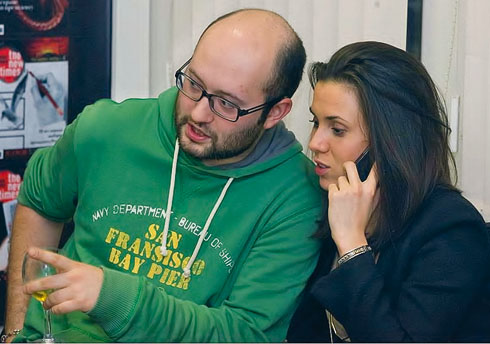
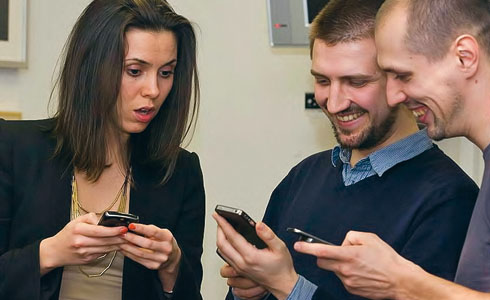
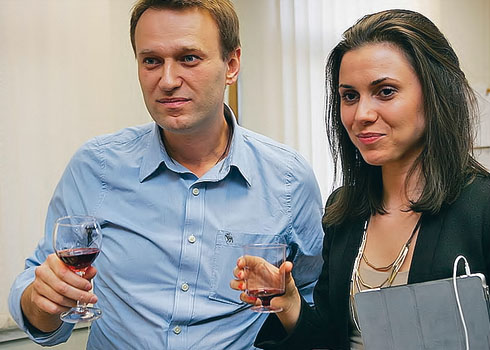
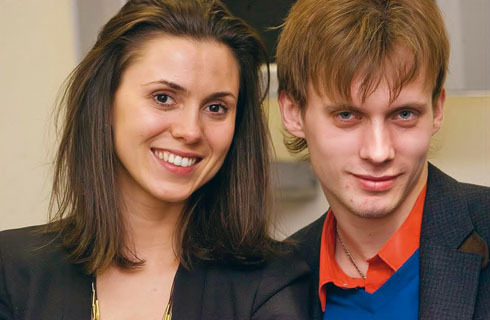
Март 2012 г., в редакции The New Times будущего президента Молдавии встречают друзья, близкие и будущий президент России Алексей Навальный :) Здесь и там После этих четырех с лишним лет, после всего, что с вами произошло, и когда вас выкинули из России, и когда сейчас открыли границу, что вы чувствуете, находясь здесь, в Москве? Я вчера проснулась, посмотрела в окно на Лесную улицу и поняла: мне здесь очень хорошо. Very. Но здесь я — в гостях. Мой дом теперь там. Хотя я по-прежнему болею всем тем, что происходит в России. Когда были Болотная, Сахарова — я все читала, следила буквально по часам.
Так, может, стоит вернуться? Нет — это уже ваша история, а не моя. Моя история — каждый день следить за тем, чтобы правила игры дома, в Молдове, соблюдались. Потому что свобода, она же не получается навсегда и забесплатно, за нее нужно бороться все время, постоянно, и это не то, что дается, а то, что берется, и это нужно брать каждый день.