
Translated material
"Pirates" may appear in Germany parliament
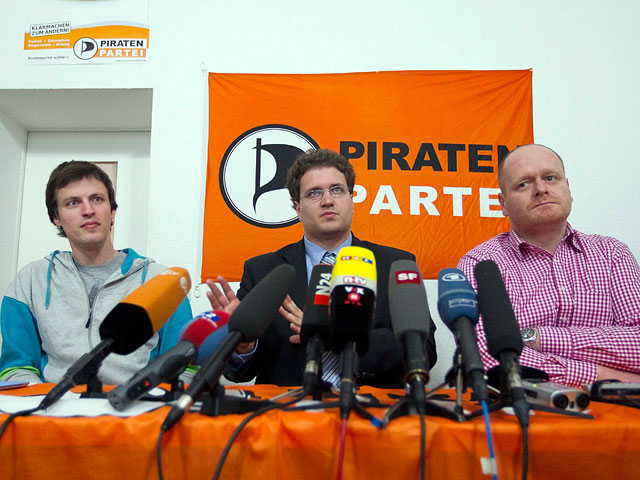
In Germany, the popularity of the Pirates party is growing rapidly. According to the hundred -bands conducted by the German Forsa Institute, in the upcoming elections to the Bundestag "Robbers", advocating the Internet, they can count on 12% of the votes, Reuters reports.
This is their best result from the moment the party was founded in 2006, as well as a guarantee of receiving places in the Bundestag, for which the parties must be overcome by a barrier of 5%.
Earlier, in September last year, the Pirates made a real splash, having received 8.9% of the vote in the Berlin Parliament, and on March 25 they repeated success, gaining 7.4% of the vote to Landtag (local parliament) of the SAAR federal land (West Germany).
Analysts believe that in the upcoming elections in the lands in Schleswig -Holstein and North Rhine - Westphalia (the most populated region of Germany), the Pirates also have good chances.
Bundestag elections are scheduled for September 2013. In 2009, Pirates managed to gain only 2% of the vote. Now the party represents real political power, being (according to surveys) the third most popular party in Germany.
A survey conducted by Forsa on March 26-30 among 2503 people showed that the strongest positions today occupy two main parties-the legal-centric-Democratic Union, headed by the German Chancellor Angel Merkel (35%), and the main opposition Social Democratic Party of Germany (SDPG)-25%.
Merkel’s traditional partners in coalition - free democrats - gain only 3%. And the partners of the SDPG - "Green" - took third place with 13%a week ago, but since then they lost one point.
Thus, none of the traditional coalitions today has an advantage, and the voices of the "pirates" can become decisive, AP reports.
This alignment makes some German politicians be nervous. They note that the Pirate Party has no positions on a number of significant political and economic issues, for example, such as the debt crisis of the Eurozone.
However, the "pirates" give out this drawback for the advantage. “We openly admit that there are gaps in our knowledge. However, this does not mean that the party cannot replenish them or will not try to figure it out. It simply shows that we put honesty at the forefront. And as for such issues as the Euro crisis, I think it would be better if other politicians also simply said:“ Unfortunately, we don’t have a solution. We are working on this, ”explained the chairman of the party Sebastian Nerz, speaking on Sunday on the Ard TV channel.
As surveys show, the Pirate Party is more sympathetic to students and employees under 45 years old. Including people who were disappointed with politics who had not voted at all before.
The German Pirate Party arose as a branch from a similar organization that arose six years ago in Sweden during the campaign in support of copyright reforms, free download of information posted on the network, and increasing the level of protection of personal data.