
Translated material
Caucasus Vladimir Putin
Caucasus Vladimir Putin. "Are you going crazy in Moscow?" - This question on the eve of the vote on March 4 was asked many people during the last business trip to the North Caucasus. It was a question about rallies “For honest elections” these rallies showed it on television for nothing - in the Caucasus they did not cause the same violent civil enthusiasm as in the capitals. It was Muscovites that the columns under the black-yellow-white National Monarchist banners totaled 300-500 people: only these columns were seen in the Caucasus. “Who is this of your Navalny? Is he against Putin? " - "And you - for?" - “Maybe Putin is not the best option. But those who want to be instead of him want the department of the Caucasus. And for us this is the end of the world, so we will vote for Putin. ”
The author has been in different North Caucasus elections many times and knows that 99.9% of the “correct result” in Chechnya is the same tradition as meat with galley and garlic. Himself, with my own eyes, saw these 99% “painted” in cities where not a single person appeared in polling stations for the whole day. And he saw how the villages voted on the same day - in an organized, together, without any external signs of coercion and always the same as the chairman said the day before. But I have never seen in the Caucasus so that people from completely advanced social groups - such in Moscow would probably go to Bolotnaya - they went and deliberately voted for Putin. Because without it it will be worse and worse.
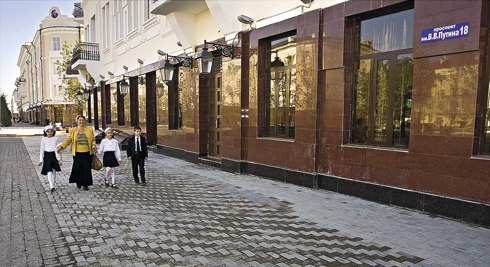
Putin Grozny Avenue all with a needle: there is an elite housing of pre -revolutionary construction (though restored after two wars that happened much later than the revolution), Japanese restaurants and jewelry stores. The elegant, although a huge mosque dominates the center, which was lying in ruins seven or eight years ago. If you pass several quarters from the mosque, past the Drama Theater named after the Chechen sniper Hero of the Great Patriotic War Hanpashi Nuradilov, you will go to Putin Avenue, which was previously called Victory Avenue.
Ramzan Kadyrov renamed it, and few of those who walk along the avenue think that he will always be called this way: someday they will be renamed again-when Ramzan Kadyrov himself becomes history. Everyone remembers that this street is restored from the ruins, and such streets rarely wear the names of those who sent planes and artillery divisions to battle.
But everyone remembers where the money came from for the restoration of houses, both the theater, and the mosque, and the Japanese restaurant with a jewelry store. They do not remember the ideas of independence - and they will not remember while the federal center gives the Caucasus money. And the Kremlin will not stop giving the Caucasus money until the Caucasian elites are ready to express loyalty. Judging by the results of March 4, few in Russia can express loyalty better than Caucasian elites.
Migration shift “Money that is allocated to the Caucasus is not so huge compared to other subsidized regions, which are most in Russia. The problem, as in many other regions, is that in the end, these funds are invested not so much in the development of the republics as in the purchase of real estate outside them: in Kislovodsk, in Stavropol, Rostov, in Moscow, ”says Denis Sokolov, director of the Center for Socio-Economic Research, specializing in the economy of the North Caucasus. According to him, many problems would be solved if the land and municipal reforms were brought to the end, the results of which were protected by an impeccably working legal mechanism. In most republics, a moratorium on the privatization of the land is still in effect: local authorities fear that redistribution against the background of a huge ethnic diversity will cause conflicts. In fact, there is a de facto property-it is simply in the hands of people associated with republican administrations, who are not at all on the desire to start a transparent cadastral registration.
About the same thing happens with municipalities: complex and, as a rule, archaic economic schemes created a number of incredibly complex and confusing situations in which economic and administrative issues completely intertwined with ethnic policy. If the Balkarian villages in the mountainous part of Kabardino-Balkaria receive everything that they relied on Russian law on municipalities, this will immediately cause the wrath of the Kabardinists. And the Kabardinites in Kabardino-Balkaria are the majority, and its president of the Kabardian. And the Kabardians are Circassians, and now, it seems, only the lazy does not try to “comb” the Circassian theme in the west of the North Caucasus, so that the preparation of the 2014 Olympics in Sochi does not seem to Moscow too careless.
If the new Avar villages on the Dagestan Plain that arose over the past 20 years from sheep wintering will become municipalities, where then to go to the Kumyki, Nogais or the Russians who lived on this land long before the dashing of the 1990s? And if the Avar villages will not become municipalities, what will the Avars who make up the majority in Dagestan say?
Sokolov believes that these and many other conflict situations can be resolved if you give people the opportunity to become real owners of the land that the law would protect. Without this, no investment and no attempts to create additional jobs, even such ambitious ones as an undertaking with a ski cluster, will not change the existing picture: against the background of the unique, according to the Russian birth standards, a massive outcome of youth from the mountains to the plain occurs. In the cities of the plains, they do not have enough places to study and work, social elevators do not work there, but only corruption mechanisms and violence mechanisms work. And it remains only to leave, and where they go, they are not very happy to see them.
"
If you pass several quarters from the mosque, past the Drama Theater named after the Chechen sniper Hero of the Great Patriotic War Hanpashi Nuradilov, you will go out to Putin Avenue, which was previously called Victory Avenue
"
The religion of the world sociological surveys give an answer to the question of where this discontent comes from the visitors from the Caucasus: they have other rules of conduct, which they try to reproduce where they come to live. A person in the highland village lives in the strict framework of customs. When he leaves the village to the city on the plain, he loses these frames. When he leaves further to Moscow or Surgut, he completely loses its usual ethical guidelines. The transition from the village to the city and further to the large country is like modernization. But in the context of the destroyed education system, which adapted visitors to the city at least in the second generation, in the conditions of absent social elevators and non -working rights, this modernization is the other way around: the only moral landmark becomes Islam, and often radical Islam. Researchers working with Dagestan villages have already noticed that young people who are going to work in Surgut have nothing to do with the radicals. Young people who come from Surgut back are grouped into radical communities. In such a paradoxical way, internal Russia, which, in theory, should be the main window for the external world for the Caucasus, becomes a source of radicalization.
The shadow of Abdul-Hamida many experts agree that Putin after re-election for the third term received a unique window of opportunities in order to seriously reform the Caucasian policy. This is exactly what those who consciously contribute to his Caucasian electoral results are expected from him. The Caucasus still needs land and municipal reforms, the Caucasus needs transparent accounting, clarity in the management of power operations and civil control over security forces, a new personnel policy is needed.
The chances of such changes, unfortunately, are small: Vladimir Putin too values the loyalty of the Caucasian elites and security forces to decide on serious transformations, without which the creeping alienation of the North Caucasus can no longer be stopped - as well as the growth of Russian ethnic nationalism. “Putin risks being in the position of the Ottoman Sultan Abdul-Hamid the Second (1876–1909),” says Andrei Ryabov, an expert at the Moscow Center of Carnegie, “who in the Ottoman Empire relied on everyone except the Turks, and as a result led the state to final weakening and decay.”