
Translated material
"Touch the Cosmos ourselves"
The Cosmonautics Day marks the apotheosis of technical thought - it is precisely the engineers and designers who managed to create those machines that have been automatically displayed apparatuses and even people into space for more than half a century. The famous designers, however, began their work not at all in brand new design bureaus, but most often in the field, experiencing rockets and engines that they made themselves. From this hobby, a completely new branch of science and technology was born. What is the situation with rocket modeling today? We are talking about this with Alexander Ilyin, the organizer of the Rocketfest festival ( http://raketojf.ru ).
- How did the idea of Rocketfest appear?
- To begin with, a few words about rocket modeling. There are two types of it - sports and amateur. The first has been preserved since Soviet times. Proceedings-sportsmen hold their competitions several times a year. Participants in such competitions are mainly kids, pupils of technical creativity circles. For them, a missile model is a sports shell from which it is required to fly higher, longer or spectacular.
The dimensions of the models of athletes, their appearance and engine power are usually limited by the framework of the rules, so they do not fly very highly, and, with rare exceptions, their dimensions are about half a meter. Although not at competitions, but at demonstrations, athletes fly more interesting designs.
Amateur missile modeling, independent of sports sections and circles, arose relatively recently. The surge of home rocket science in the 90s was caused by the appearance of model missile engines (MRDs) on the open sale of the old Soviet reserves from closing houses of technical creativity.
Fans launched models on wastelands and in forest parks, enjoying the very process of manufacturing a small one, but rockets. Unlike athletes, they did not chase records, but simply rejoiced at every successful launch.
But at the beginning of the "zero", the stocks of engines came to an end. Amateur missile modelism could cease to exist, because not everyone is ready to turn their kitchen into a chemical laboratory and establish artisanal production of MRDs.
Fortunately, the production of solid fuel engines for missile models was deployed in Kirov. People began to return to their hobby.
In the spring of 2009, I had the idea of combining amateur missile modelists-the transition from separate scattered launches to joint events.
An example was the Astronomer festival - astrophone. For ten years, he went from a short meeting (a couple of dozen people) to a grandiose multi -day event for several thousand guests.
Only five people came to the trial missilefest No. 0 (June 27, 2009) in South Butovo, but the beginning was laid. I did not give up and conducted additional preparation, as a result, there were already more than 30 guests and 6 launching, including guests from St. Petersburg on missile fluke (July 12).
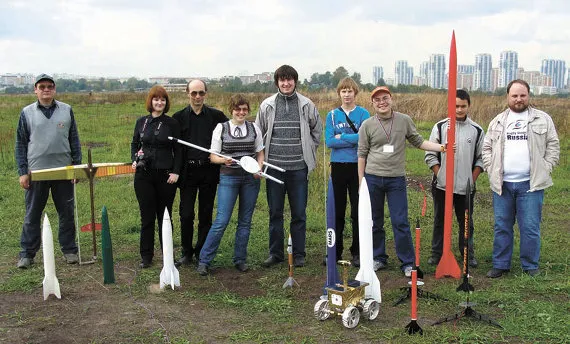
In the organization of the festival, Nikolai Dzis-Vovarovsky (founder of the Russian space startup "Selelenok") helped me (and continues to help).
In addition, many regular participants in the festival can rightfully be considered its organizers - without their contribution, there would be no event.
- What difficulties appeared immediately during the first festival?
-The main difficulty is the almost complete absence of amateur missile modelists. Ten people for Moscow and, perhaps, about 20-30 throughout the country.
Many simply did not know that rockets can be made not only in circles for schoolchildren.
Therefore, the main goal of rocketfest is the propaganda of rocket modeling, an increase in the community of enthusiastic people.
It’s relatively easy to convene for the spectators: our event has always been and will be free and open (long and tedious preliminary registration of spectators is not required), but it is very difficult to find people who will make a show. Those very missile modelists.
And yet - people need to be surprised. Something new should appear at each festival, otherwise interest will begin to disappear. So, the technical level must be constantly improved. So far, it is possible, although with difficulty.
The second difficulty is the excessive attention of the authorities. No, not in terms of help, on the contrary.
During Rocketfest No. 2, representatives of law enforcement agencies were waiting for us on the field. They said that any flights in Moscow and the Moscow Region require special approvals. Even the launch of a paper aircraft from the sixteen -story window!
Why did such attention arose, although - despite the rigidity of the laws - the police are not interested in people who let paper aircraft? The answer is simple: there was an ill -wisher who wrote the complaint “where should”. He wanted to organize an event similar to our missile fluore, only paid - accordingly he saw competitors in us.
As a result, we had to go to the semi -underground position - to refuse the announcements and leave South Butovo.
But the work on the "legalization" of the festival continued. As a result, at the end of 2011, we enlisted the support of the administration of the rural settlement of Goretovskoye (Mozhaisky district of the Moscow region) and in January 2012 we conducted a completely open missile facultiness No. 12. All the necessary permits from the Federal Air Transport Agency (an organization regulating the air movement) were received - the sky above the village was open only for us.
-The next festival will be held for the 13th time. What has changed in it over the past time?
-The technical level has changed-powerful engines, large models, and copies of really existing missiles have appeared. There was a community of people close in spirit-amateur missile modelists.
Of course, a lot of experience was gained: to organize a show that will be safe and at the same time spectacular is not easy. Everyone strives to come closer to missile models, take a picture with them - constant work with the audience is required.
- How is the Rocketfest going? Is it possible to describe the "average" participant?
- Rocketfest is a one -day event. However, in the summer we are going to go to two -day festivals.
After all “launching” are pulled up (and usually “rocket launchers” are collected quite slowly), the installation of starting tables begins, and missile models are placed.
A peculiar tradition: to arrange a “missile garden” - a place where all models and spectators can take beautiful photos.
Then the starts begin. Usually, before each start, the host tells what he actually will fly now. After the launch of the rocket parachute, the “search party” is sent for it - it usually includes children. The gaps between the flights are filled with stories about rocket modelism, astronautics, astronomy. And of course, communication.
The "average" participant is a young man, carried away by astronautics, astronomy, science fiction. By the way, among the launching there are people working in the space industry. Unlike sports missile-like competitions, missile flows-after all, the event is mainly for adults. But we are also happy with small guests, however, we ask them to come with their parents.
- What has changed for the organizers and participants with the advent of a new status?
- For the organizers, there were undoubtedly new problems, but additional opportunities appeared. For example, now it is necessary to collect a whole package of documents, go to various instances and certify them. Also, the mass event needs to be insured, which means that it is not only in missiles and engines, but also in various papers (I remind you: the event for spectators and participants is completely free - we will organize it at our own expense).
In addition, the delivery of participants to the Mozhaisk region requires some effort: it is necessary to distribute pedestrians over car enthusiasts or organize (again at your own expense) a minibus taxi.
On the other hand, legal status allows you to give announcements and invite special guests (for example, astronauts).
I want to note support from the administration of the rural settlement of Goretovskoye and personally its leader Alexei Andreyevich Kuzmin. At the venue of the festival, snow was cleared, hot nutrition was organized. In addition, the audience were invited, and missile facilities No. 12 became a record for the number of missile models observing the flights (about a hundred people were present).
We hope that further cooperation will continue - which means that we will launch missiles not just in the field, but on a specially equipped site with stands for spectators, sun tents and tables for convenient preparation of models to start.
Do not forget about such domestic amenities as nutrition and toilets.
- Let's get back to the beginning of the conversation. The hobby of missile technology during the time of Korolev was the development of a completely new area of technology and space. Today, real missiles have long been withdrawing devices to Mars and Jupiter, and even to the boundaries of the solar system. What drives missile modelists?
- As I said above, there is a sports and amateur rocket modeling.
Many amateur missile models dream of moving from models to real private missiles flying to heights of tens of kilometers. More recently, the Rocketch team Anton Fastenkova tested a missile with a hybrid missile engine.
The launches of rockets with GRD were held in the USSR in the 30s: on August 17, 1933, the famous GIRD-09 started, and on May 23, 1934-a cruise missile 06.1. Since then, these engines have not left the stands in our country (for example, at the M.V. Keldysh research center). But the famous American private suborbital spaceshipone cosmoplane flies precisely on GRD.
A test of a domestic amateur rocket with a hybrid engine (rocket weight-4.25 kg, motor thrust-20-23 kg)-a truly new era. Now reaching a height of 10 km becomes a task for the next couple of years. And 100-150 km-for a five-year plan.
Then, perhaps, the team will approach the creation of a tourist shuttle on the GRD. Amateur missile modeling is not only a hobby, but also an environment in which a private space business is growing. That is what happens in the USA, this is how it happens in us, though on a much smaller scale, since the movement only began to develop. Another couple of examples from America - the founder of SpaceX Elon Musk found the engine for his company at the Rocket Modelist festival. Some members of the CSXT team, which in May 2004. I built the world's first amateur missile that overcome the cosmos border (100 km), after the completion of the project, founded UP Aerospace, which makes and launches probing missiles and works on universities, large aerospace corporations and the US Ministry of Defense. Therefore, without the development of amateur missile modeling in Russia, there will be no developed private sector in the astronautics.
Amateur astronomers, despite the presence of excellent photographs made by space telescopes, continue to study the sky on their own. So the “rocket launchers” - they want to touch the space themselves.
In addition, rocket -modeling is just an interesting activity - it is not necessary to build large missiles to enjoy the launches. Transcits to nature, communication - all this is also an integral part of amateur rocket -modeling.
- What missiles are launched more often - made independently or “designers”? And in this regard, the question: how much is “technical”, that is, how much participants exchange technical knowledge and skills?
- Yes, recently missile “designers” and even completely ready to launch missile models appeared on sale. This is good - after all, not everyone can spend a dozen evenings on making their own rocket. The proportion of 50/50 is observed on missile flows: half of the “products” are completely homemade, half on the basis of ready -made missile sets.
Communication, training, exchange of experience in the community of amateur missile modelists is constantly going on. Often, joint projects arise, rockets are “wandered” from one person to another for refinement. And of course, we are always happy to convey our experience to beginners.
-Once, in LiveJournal there was an interesting story about photography from a balloon, when the participants managed to photograph a meteor. In this regard, the question is: do the missiles that are launched by the participants of the Russian Federation have other goals or “payload”?
- Yes, the element base, available to us, is far superior to everything that missile modelists of the 20th century possessed. An interesting example: one of my friends created a telemetric block that drops information from the rocket model more often than from real ballistic missiles at his work.
Two main devices that lovers install on their missiles are a height and video camera. Although we do not chase records, it is always pleasant to find out the flight height. And to see yourself and friends somewhere below, behind a missile exhaust, is doubly pleasant.
The next stage is GPS trackers and various control boards that throw the parachute, start the engine of the second stage or turn on the beaks.
With an increase in the height of the flight and the mass of the “useful load”, one can think about the installation of real scientific devices.
By the way, we are working on a joint project with the guys who captured the meteor from the balloon. The goal is to launch a rocket model in the black sky of the stratosphere.
-Do you cooperate with someone, for example, already with such a famous event as astrophoretes?
- We are open for cooperation and are ready to consider any proposals.
At the concerts of the bright “cosmic” rock cosmofest, our missiles flew, we launched them as part of the festival of youth and science of Kaluga. Several times I traveled to the village of Orion’s foster families, where I told the kids about space, and then carried out launches with the subsequent distribution of missile sets.
Rocketfest No. 11 took place in the ethnographic park of Ethnomir in the Kaluga region: we were invited to the festival of all flying Skyphest. We would love to participate in astrophast.
Questions were asked by Olga Black