
Translated material
Stanford prison experiment
School friends
There are coincidence in life. In 1933, two people were born in New York who were destined to enter very important chapters in the history of psychology. It is curious that they not only were born in one year, but also went to the same school and were, as they say, school friends. One of these friends died at the age of 51 A, the second is still alive. The main achievement of the first-Stanley Milgram-an experiment staged in 1964-we already wrote (TRV-FUNNE No. 86, http://trv-science.ru/86n.pdf ).
The other friend, Philip Zimbardo, is successfully engaged in the study of shyness, in 2002 he managed to visit the president of the American Psychological Association, but his most famous work was completed more than forty years ago within just one week. He was called the then (and current) place of work of Zimbardo - Stanford University.
Navy order
Zimbardo received an order for a study from the US Navy. The naval were concerned about conflicts, riots and cases of frank sadism in sea prisons. It seemed to the military that all this happened because people with the corresponding psychological organization were recruited (or come) into the ranks of the jailers. The explanation of psychologists was required
They allocated money, and soon the newspapers appeared that volunteers are required to “simulate the prison”. The term is from a week to two, payment-15 dollars per day (this is in 1971, by current standards-somewhere under $ 90/day).
70 volunteers came to the experiment, after an interview and survey, 24 were selected 24. The most stable psychologically related to the middle class, white, and students.
Not familiar with each other. After that, tossing the coins distributed these two dozen into two groups - future "jailers" and future "prisoners". The “prisoners” said that they would receive $ 15 per day, that they are guaranteed medical care and normal nutrition, but some rights, for example, for personal life, may be limited. About what to expect from the experiment and how to behave, they were not told to them. And they sent them home, asking to be at home on Sunday.
The day before the experiment, the “jailers” were collected, they gave them uniform in a military manner, whistles and batons - a symbol of power and dark glasses - to exclude visual contact. So outwardly they became as depersonalized as possible.
Among the "jailers" they conducted a briefing in which they conveyed the only specific wish - no physical violence. And so: do what you want, we have all the power (Zimbardo acted as the head of the prison), and they have no.
In August, the seventy -first
The "prisoners" acted very harshly. On Sunday, a real police came for them. They burst into the houses, accused them of theft, searched and put on handcuffs (all - in the presence of neighbors), and then took them to the station. They were photographed, they were captiloscopered, after which they brought them to the experimental “prison” with blindfolded eyes. Moreover, the police did not make it clear that the experiment began (by the way, this is the beginning of experience - the most difficult accusation of Zimbardo of the inequality of a prison experiment).
Prison was equipped at the university. Three tiny cameras - 6 by 9 feet (~ 2.5 × 3.5 m) with three bunks. "Loner" - even less. Camera for walking. Security room room. All rooms are equipped with video cameras.
The "prisoners" were also depersonalized. The shapeless short robe without underwear made me move unusually, the chain on an ankle symbolized lack of freedom. On the head is a hat made of a nylon stocking: to hide all the differences in the length and color of the hair. They began to call prisoners only by numbers. Of course, the "prisoners" were in prison all the time. “Security” is only eight -hour shifts. However, the experiment very quickly got out of control. The “guards” often began to go out overtime, the rollings of the “prisoners” - conceived in order to help the “prisoners” get used to their numbers - became a long execution.
The “guards” quickly began to show sadistic inclinations and more and more often mock “prisoners”. Especially at night, when they thought that camcorders did not work.

The experiment is addictive
It turned out to be surprising how everything, including the experimenters, turned out to be drawn into a dangerous game. So, the “director” of Zimbardo himself, having learned that on the fourth day in prison “ripens the conspiracy” in order to escape, demanded that the police transfer the experiment to a real prison and, after the refusal, was terribly annoyed.
The “prisoners” also believed in their fate, and when they were offered to abandon their fee (recall, this is decent money - they should have received more than $ 1,000. In terms of a modern course), to go out “under honest word,” the majority agreed. True, in the end they were refused.
And when the experiment was interrupted only after six days according to the official wording-“due to the pathological reactions of the participants,” the guards were upset. They wanted to continue.
That it is impossible to continue the experiment further, Zimbardo pointed to his student and Gerldfrand, and later his second wife, Christina Maslac. Of the fifty people who observed and worked in the experiment, only she, who met his course in the process, wondered about his ethics. Everyone else got involved and were ready to continue the game further.
So this experiment helped to put not only some ethical framework in experimental psychology (as well as an experiment of Millgram). It turned out that many horrors of mankind are laid in us - it is enough to only deprive a person of individuality and give him full power.
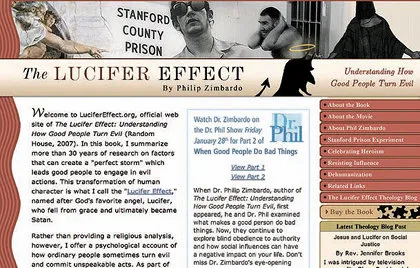
It is curious that thirty years later Zimbardo became one of the experts who studied the famous scandal in the Abu Graib prison. Then he put all his strength to counteract the efforts of the US military and governments, who tried to show that the whole problem is in a particular overseer, and with the system - everything is fine. A little later, Stanford’s experience and Abu Graib Zimbardo united in the monograph “Lucifer effect: understanding how good people turn to evil”. By the way, the latest events in Kazan could also become a good material for Philip Zimbardo.
Alexey Paevsky,
Snezhana Shabanova