
Translated material
Ossetians are prohibited
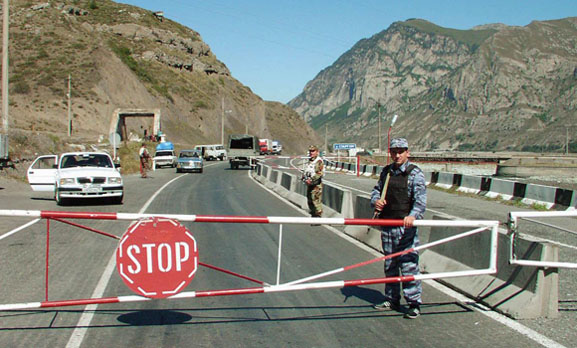
In February of this year, Georgia unilaterally abolished the visa regime with Russia - the corresponding document was signed by President Mikhail Saakashvili. According to his decree, the citizens of the Russian Federation for entering Georgia and staying on its territory within 90 days are not required.
With the initiative to cancel the visa regime with Russia, Saakashvili spoke on February 28, presenting the annual report in the Georgian parliament. Relations between countries were torn in September 2008 on the initiative of Tbilisi. The Georgian authorities then explained their decision to the “hostile actions and military aggression of Russia, as well as the recognition of the independence of Abkhazia and South Ossetia.”
It is impossible to say that this decree was perceived with enthusiasm in Russia. In response to the actions of Tbilisi, Moscow said that she was ready to introduce a visa -free regime with Georgia, and, moreover, proposes to restore bilateral diplomatic relations. To establish a visa -free regime, “it is necessary that the Georgian side ensures reliable legal conditions that would guarantee the safety of Russians visiting Georgia,” said Alexander Lukashevich, official representative of the Russian Foreign Ministry.
The special activity among citizens who want to use the visa-free regime is not yet observed, given the cold winter and not in spring snowy weather in March. The exception, perhaps, is the Russian Armenians, for whom the Georgian Military Road is the only highway connecting them with the Fatherland. The main flow of passenger and freight vehicles is transit.
The movement of vehicles along the military road connecting Russia with the countries of the Transcaucasia is now difficult. All winter, the motorway operates with interruptions. Often, the press service of the Ministry of Emergencies in North Ossetia disseminates the following information: “In connection with heavy snowfalls, as agreed with the Georgian side, by order of the Emergency Situations Commission of the Government of North Ossetia, the movement of transit vehicles is prohibited in the area of Vladikavkaz-the Lars settlement in both directions before the special order”.
The abolition of the visa regime for all Russians has not yet influenced an increase in the passenger flow at the Upper Lars checkpoint. According to the border control of North Ossetia, after the cancellation of the visa regime by Georgia, the route along the Military Georgian road through the Verkhny Lars checkpoint and the Dariali checkpoint is not very popular among Russians. Basically, Georgians living in North Ossetia began to go to Georgia; A few citizens from Chechnya, Ingushetia, Dagestan. The basis of the flow of passengers is still made up of citizens of Armenia and Azerbaijan, who are following from Russia to Transcaucasia and vice versa.
Of course, the Georgians living in the North Caucasus were the first to welcome the abolition of the visa regime. For travel from Vladikavkaz to Tbilisi, taxi drivers, mainly, Mohevites from the Kazbek district, who, in addition to Russian, also Georgian citizenship, take from 1000 to 1500 rubles per person. Frequent passengers: small entrepreneurs, public figures, scientists from the North Caucasus Federal District, trying to restore lost contacts with Georgian colleagues after August 2008.
The most popular Georgia, which announced its Caucasian policy, is used by ethnic groups, territorially bordering Georgia: Chechens, Ingush, the peoples of Dagestan, Circassians. For Chechens, the cancellation of the visa regime is a good reason to visit relatives living in the Akhmed district of Georgia, where the Chistine Chechens have historically live. In addition, numerous refugees from Chechnya, who fled during the two Chechen warrior, settled there. For Ingush, it is important to restore cultural and historical contacts, for example, through the Jayrakh district bordering Georgia, where the famous medieval monuments of culture and archeology are located.
Perhaps with Ossetians-the people with whom the Georgian is associated with long-standing national-cultural and religious bonds-it is still difficult to restore relations. The war of August 2008 is an event remaining the most tragic in the recent history of Ossetian-Georgian relations, which for a long time spread both household and related contacts that existed centuries between two Orthodox peoples. From North Ossetia to Georgia, mostly, Georgians living here leave - to visit relatives; And a few groups of skills of ski resorts are businessmen who can allow rest in the elite resort of Gudauri.
Touchstone
However, the residents of the region could have used to go to Georgia without visas. Indeed, on October 15, 2010, Tbilisi abolished visas for residents of the North Caucasus Federal District.
As the Deputy Minister of Foreign Affairs, Nino Kalandadze: “The indicated decision is introduced as part of the liberalization policy of the Georgian government, and based on the continuation of traditional relations with the peoples of the North Caucasus.” Residents of Dagestan, Chechnya, Ingushetia, North Ossetia-Alania, Kabardino-Balkaria, Karachay-Cherkessia and Adygea have been given the possibility of a visa-free crossing of the Russian-Georgian border through the Upper Lars checkpoint.
The official Tbilisi explained his decision, in particular, by concern for the rights of the North Caucasian residents who want to cross the Kazbegi-Verkhny Lars checkpoint in the land area of the Georgian-Russian border. To do this, they had to receive a visa to enter Georgia in Moscow, in the Georgian interests section at the Switzerland embassy. The Russian Foreign Ministry regarded the decision of the Georgian authorities as a provocation to announce unilaterally the introduction of a visa -free regime for citizens of the Russian Federation living in the North Caucasus.
The decision to simplify the transition through the Kazbegi -Verkhny Lars checkpoint caused an ambiguous reaction among part of politicians and experts and in Georgia itself, who expressed various opinions: from supporting the initiative of Saakashvili to statements about the possible beginning of “creeping aggression” by North Ossetia. So, according to the Georgian political scientist Paata Zakareishvili, the decision of the Georgian government to cancel the visa for residents of the republics of the North Caucasus is a political rather than a socio-economic decision.
According to the member of the Public Chamber of the Russian Federation, the President of the Russian Assembly of the peoples of Georgia Gochi Dzasokhov, such a cancellation of the Georgian visa regime for residents of the North Caucasus republics "bears a provocative nature aimed at destabilizing the situation in Russia."
"Slave" Ossetians
However, the abolition of visa passage is still not valid for everyone: some residents of the Kazbeg region (Georgia) living in the territory of North Ossetia cannot get there.
For the vast majority of natives of the Ossetian villages of the Kobinsky basin and Trusovsky gorge remaining in the Kazbeg district of Georgia, entry into the territory of Georgia is prohibited. In Stepandzmind, previously called the Kazbeg district, bordering on the North Ossetian section of the Russian-Georgian border, there are about 30 Ossetian villages. This land at the source of the Terek and Aragva rivers extends south and north of the main Caucasian ridge, making up the eastern part of historical Ossetia: Daryal, Tirsygom, Kudskoye gorges and Kobskaya Valley.
Ossetians living here were economically integrated into North Ossetia. With the collapse of the USSR, Ossetians were on different sides of the borders. Communication is difficult after 2006, when the Russian Federation closed the border with Georgia at the Upper Lars checkpoint. Ossetians and Georgians-Mohevites from the Kazbeg region in the North Ossetia were cut off from their houses.
The situation was especially deteriorating after 2008: the Ossetian villages located in this area were practically destroyed. The population died out or went to North Ossetia, and the false houses are destroyed under the onslaught of bad weather and looters. Today, the Ossetian population of the Kazbegsy district has only a few. The situation has not changed for this category of citizens and after canceling visas by Georgia in 2010, and now, after the February solution of the cancellation of visas for all Russians.
Chairman of the Public Organization "Daryal", uniting immigrants from the Kazbek district of Georgia, the founder of the site www.cobag.ru , Gairbek Salbiev characterizes the situation:
“Not one or two people who came from there warned that I would never go there in any case. The Georgian special services at the Dariali checkpoint have lists of undesirable elements. In the Georgian press, I often meet the term “our Ossetians” and “not our Ossetians”. That is, I am not their Ossetians. Some of our guys: Kobins, Trussians tried to go there, but they were not missed by the Georgian special services. They do not want their names to be called, because they are afraid for their homes, which are located in the Kazbeg region. Border guards motivate their refusal by the fact that for the former residents of the Ossetian villages, lists of persons who are prohibited from passing to the Kazbeg district have been compiled in the Central Administration of the Georgian Ministry of Internal Affairs. The surname of the Haybrek Salbiev among them. About 20 facts are known when the Ossetians, after passing passport control at the Dariali checkpoint, are not allowed further into the territory of Georgia. ”
As Sababiev explained, periodically, Georgian intelligence services are interested in passengers from North Ossetia passing through the Dariali gearbox about the activities of Gairbek Salbiev and the Daryal organization. In Georgia, their activities are considered separatist: they are accused of attempts to separate the Kazbeg region from Georgia. The public figure himself categorically refutes such accusations.
According to Salbiev, we are talking about the economic integration of the Kazbeg region in North Ossetia. “Economically, the Kazbeg district cannot be imagined without Ossetia,” Salbiev believes. Here in Vladikavkaz, natives of the Kazbeg district: both Ossetians and the Georgians-Mohevites are often going to discuss problems. They want to understand each other, find at least some solution. Haybrek Salbiev believes that the problem would have been solved if the Georgian authorities allowed the Ossetians to return to their native lands, visit their villages and gradually destroying houses and farms. “There is no question of returning to permanent residence due to economic backwardness and low living standards in the region,” Sababiev explains.
Agricultural activity and trade in residents of the district not only Ossetians, but also the Georgian-Mohevites were inextricably linked with Northern Ossetia. Cheese, vegetables, meat were brought here for sale. Cattle was distilled to North Ossetia for the winter. After the closure of the Russian-Georgian border in 2006, the traditional way of the rural population was violated. Many residents of the Ossetian villages of the Kobinsky basin of the Trusovsky gorge, driving their herds to pastures in North Ossetia for the winter, could not return home to Georgia. Many peasants went bankrupt. For the sixth year, these people cannot return home. According to a strange coincidence, neither the abolition of visas for the North Caucasians, and even a recent decision to cancel visas to all Russians, do not apply to Ossetians, which have recently inhabited almost the entire territory of the Kazbeg region.
The statement of visa -free travel is stated, the head of the public organization noted for what purposes this was done: to reunite the fraternal peoples of the Caucasus and for border trade. However, Salbiev considers it ridiculous because the President of Georgia took this step unilaterally. The appeals of immigrants from the Kazbeg district to international human rights structures have not yet brought any result. At the beginning of the year about violations of their rights, immigrants from the Ossetian villages of the Kazbeg district informed the Supreme Commissioner for National Minorities, the Supreme Commissar of the UN Human Rights, the European Commission for Democracy through Law, and the Commissar of the Council of Europe on Human Rights.
The other day, among the Ossetians, immigrants from the Trusovsky Gorge, the news spread. At the entrance to Georgia at the Georgian checkpoint "Dariali", 80-year-old Shamil Dzantiev was denied. Shamil Dzantiev is the father of the mayor of Vladikavkaz Sergei Dzantiev. Shamil’s father’s father Dzantiev is located in the village of Sosolt of the Trusovsky Gorge. The entrance to the gorge, where dozens of Ossetian villages are located, is prohibited by the Ossetians themselves. Historically, only Ossetians lived in this gorge - the Georgian population has never been here. Now, at the entrance to the Trusovsky Gorge in the village of four, the checkpoint of Georgian border guards is established, prohibiting the entry into the depths of the gorge to other Ossetian villages. About five kilometers from the village of four is located the village of Dzantiev - Sosolt. But they will hardly be able to return to their homeland to Shamil Dzantiev. To him, an elderly old man who survives his life away from his native hearth, entering Georgia, as well as hundreds of Ossetians living before 2006 in the Kazbeg district, is prohibited.
Dangerous law
Ossetian’s indignation is also expressed by the clause of the Decree, which states that people who come to Georgia should not cross South Ossetia. Despite the cancellation of the visa regime for Russians, Georgia does not intend to cancel the law on visiting the so -called. "Occupied territories" of South Ossetia and Abkhazia. Often, citizens of the Russian Federation who visited Abkhazia and South Ossetia are delayed in Georgia, and they, according to the specified law, provide for an arrest for up to 4 years or the payment of a large monetary fine. The law on visiting the “occupied territories”, which, incidentally, was called to cancel Russian diplomats as a compromise decision, scares away many people who wanted to visit Georgia.
Last summer, Russian President Dmitry Medvedev said that Russia is ready to consider proposals for facilitating the visa regime from the leadership of Georgia, but not from Saakashvili, whom he considers a “non -commissioned” figure.
In turn, the Russian Foreign Minister Sergei Lavrov said that the visa regime with Georgia will not be canceled, but Russia will maintain civilized relations with Tbilisi regarding the order of entry and exit of citizens.