
Translated material
: Ruriki leaped

The projects of the Norwegian architectural bureau Snojett , exhibited in the pharmaceutical order of the Schusev Museum of Architecture, force them to regret that our completely northern country has headed not the Nordic, but Asian. The architecture and interior design from us acquire some features of the eastern bazaar. Spatial chaos, in which everyone tries to shout the rest, forty love for everything brilliant. When you see the buildings built according to the projects of Sneyhta, I really want to call for the help of the Varangians again.
The first success of the bureau was the Alexandrian library in Egypt. The idea of this building was born among the country's authorities under curious circumstances - during his visit to Egypt in 1974, US President Richard Nixon expressed a desire to visit the famous library of the city of Alexandria, founded in 332 BC. Nixon was not aware that the library is considered an irrevocably lost for the last 2000 years, and local officials also do not know where it is. Nixon's visits to other states have always greatly influenced the architecture of the cities that he visited - to take at least his visit to the USSR, for which the churches were demolished along the route along which he followed in Moscow.
Egypt authorities did not demolish anything, on the contrary, they decided to build. Once the library has a demand, it is necessary that it be. In the international competition, at which 500 projects were presented, Snecytta won. The building in the form of a cylinder, the stone surface of which is covered with carved letters in ancient languages-in a modern way minimalist, and at the same time seems incredibly ancient. The cylinder is placed with a slope, and one side of the end goes into the ground, the other is directed into the sky - on the one hand, it seems to be brought by sand of time, on the other - it starts into the future, into space and new knowledge.
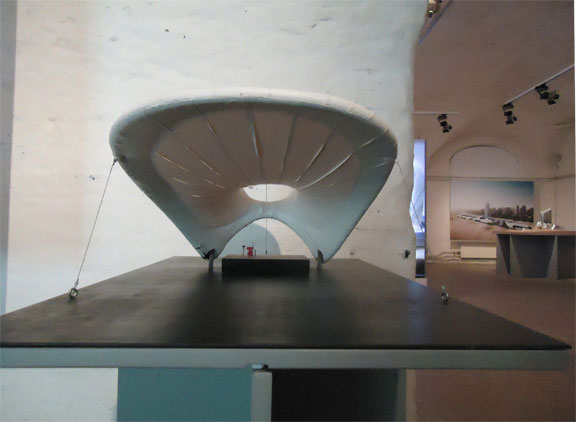 Bureau "Snojetta". Concert venue for a jazz festival in Consberg
Not only large state orders, such as Alexandria or opera in Oslo, a walking area on the roof of which, by the way, resembles in nature, our Central House of Artists is the same simple geometry, the same cladding with white marble, but it looks much more positive, probably because in Oslo they wash the marble was succeeded. Norwegians work perfectly with chamber spaces. The Museum of Peter Dass, the legendary priest and poet of the XVII century, who sang the nature of Norway and faith in God, was decided to build next to his house and the medieval church of Alstachyug. Architects were able to honor the poet’s memory and at the same time preserve the wild beauty of the landscape in a very original way. They cut part of the soil from the hill near the church, and in this artificial ravine they placed the museum building, through the glass base of which the surrounding landscape is visible, and the roof of the second floor, concrete volume, is at a level of land. No less interesting is the fishing museum in karma, the concrete walls of which are annually watered with fertilizers and bended milk, which is why they are increasingly growing in lichen, gradually merging with the landscape.
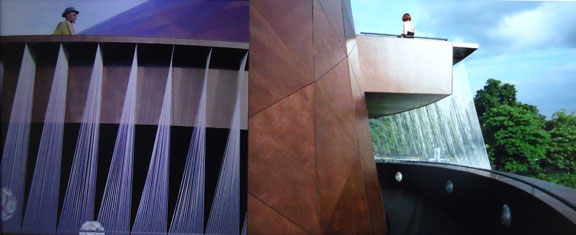 Bureau "Snojetta". Pavilion of the Gallery "Serpentine" in London
Norwegians know how to not only hide the building in the landscape, but also create a very bright and memorable image - the Pavilion of the London Gallery "Serpentine" with cables stretched from the floor to the floor that create the impression of waterfalls, or a concert venue for the jazz festival in consberg - a white structure of organic shape. Steel structures with stretched fabric resemble the work of the Significant Contemporary Artist Anish Kapoor “Marsius”, exhibited in the Turbine Hall of the London Gallery Tate. This work is also connected with music - a Greek legend about how Martians, a satire, which reached skill in the flute ownership, called Apollo himself to the competition, and Apollo punished him, tearing off his skin, which hangs in a church in a Phrygia at the source of the Meander River and begins to tremble at the sounds of a flute. Kapoor made a certain hybrid of a flute and skin of huge sizes from metal hoops and a red fabric stretched between them. Snecytta has a similar design, but she not only portrays a musical instrument, but in fact they are a funnel under which the musicians perform, works as a huge natural sound power.
This and other projects are the Museum of Arts in Lillehammer, the architectural complex at the entrance to the Memorial Museum September 11 at the zero level, the Center for Science and Culture of King Abdul Aziz in Saudi Arabia and the gates of Ras-al-Khaim in Dubai, can be seen until April 22.
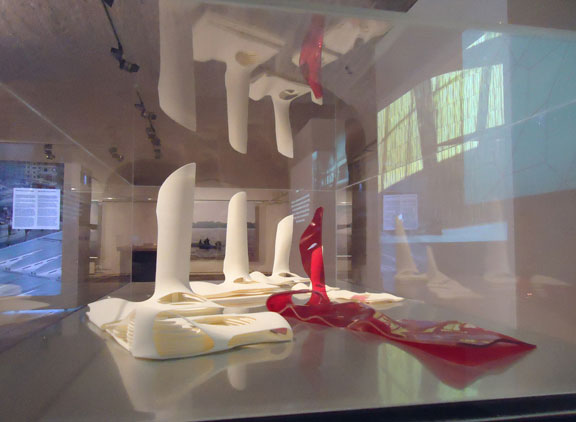 Bureau "Snojetta". Volumetric sketches for the project "Gate of Ras-al-Haim in Dubai"
On the day of museums on April 18, this and other expositions can be viewed for free, and after, at 20:00 in the Ruin building, the concert of Sandra Kolstad , the Queen of the Norwegian Electronic Plaam will be held. Severe and heroic, but very rhythmic and “dance” music is excellent for the voice acting of Snojetta architecture. However, dancing in the ruin is still not recommended, as follows from the name, this is a very fragile, specially stopped halfway to destruction and a mothballed architectural monument in this state. So you should not destroy it.