
Translated material
Schengen cracks at the seams
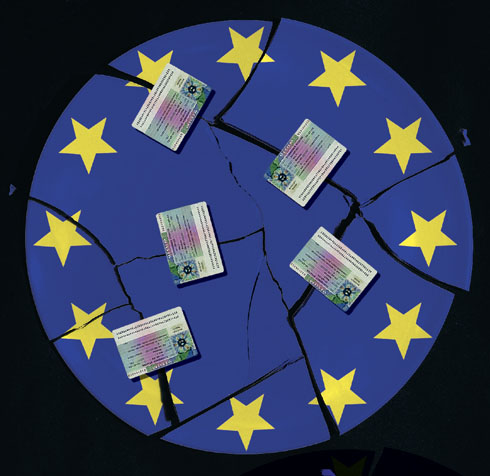
Unlimited dead end. The Schengen agreement is cracking at the seams. Germany has already decided and is waiting for France: in the event of the victory of Nicolas Sarkozy in the presidential election, Paris and Berlin, as it became known to The New Times, will make a joint statement about the need to restore border control within the EU. Why Europe wants to scream again - the New Times sorted out
In early April in the office of the head of the Ministry of Internal Affairs of France, Claude Gean was a phone call. “Claude, I made a statement that literally repeats your words and your boss: of course, it’s time for us to put our borders in order again.” German Minister of Internal Affairs Hans-Peter Friedrich was glad to inform the like-minded person that the ideas of the French president Nicolas Sarkozy supports the wider front of the Eurorealists-this is the name of supporters of the immediate restoration of border and customs control within the European Union.
Gean and Frederick are almost repeated in chorus: in Europe it is necessary to introduce constant border control. It is impossible to limit yourself only to football tournaments and other major events, as prescribed in the Schengen agreement - the security of citizens is primarily threatened by anti -globalists and the rest of the subversive element, but illegal migrants. And they threaten constantly, and not just in the days of championships or G8 summits.
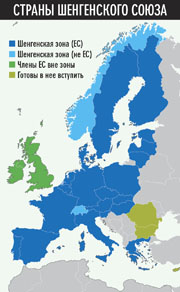 |
| Click to increase |

New trends
Back in March, starting this campaign, President Nicolas Sarkozy as part of the election race decisively stated: if the external borders of the EU are not strongly strengthened, France will leave Schengen in a year. “Our immigration system works worse, because there are too many foreigners on our territory, and we can no longer find housing, jobs and schools,” said the head of the French republic.
EU officials cannot yet take the side of the Franco-German "realists." In Brussels, a draft amendments to migration legislation is now being discussed, which can return the internal borders to united Europe. New rules will allow European countries to unilaterally introduce passport control with neighbors in the Schengen zone for up to six months. To establish this regime, approval from the European Commission may be required - Brussels officials insist. France requires complete freedom for national governments in this matter. According to experts, Germany, Austria, the Netherlands and Denmark are ready to support this position. It is expected that amendments in Schengen legislation in one form or another will be adopted until mid -autumn.
A number of experts, for example, Tilo Herz from the University of Vienna, believe that the adoption of amendments in the future paralyzes the functioning of the Schengen zone and will return to Europe full -scale control at the internal borders. “The national policy aimed at the unilateral deterrence of migrants diverges with the very idea of Schengen, which is built on mutual trust,” says Elizabeth Colllet, a researcher at the New Times in a conversation with The New Times. - Governments must trust colleagues in other countries. If they stop trusting each other, the system stops working. ” But she doesn't work anyway.
Greece again ...
In early March, at a meeting in Brussels, dedicated to the problem of illegal migrants, the heads of governments of Germany, the Netherlands and Austria, they also accused the pre -end of Greece of creating a migration “hole” in the most important areas of the Schengen space. “The Athens were hard to understand that the patience of the European Union burst, and not only on the issue of debts,” the expert of the Center for European Political Studies in Brussels Michael Emerson explained to The New Times. For more than ten years, the Greece authorities are not able to ensure control over illegal migrants on the border with Turkey - about 130 thousand illegal immigrants from Muslim countries are transferred to Europe every year. “We will have to get out of the Schengen agreement if we do not take adequate measures to combat illegal migration,” said Greek Minister of Civil Protection Mikhalis Chrysochidis.
The European Union has already allocated Greece in the amount of € 250 million for the implementation of the border protection program. Where this money will really go is unclear. After all, Greek authorities are now more busy with domestic policy than solving the problem of external borders. Nevertheless, Mikhalis Chrysochidis said that by 2013 30 centers for the content of illegal migrants will be created in Greece.
There is no unity
Last year, Denmark, having decided to again introduce a selective border and customs control * * * see the New Times No. 18 of May 30, 2011, caused displeasure of the champions of Eurocles, especially the left wing and new EU members- Romania and Bulgaria. But now that the control is already canceled, and moods in Europe are changing before our eyes, the demarche of Copenhagen no longer causes such irritation.
In general, in Europe, a clear split is now about this. All the same head of the German Ministry of Internal Affairs Hans-Peter Friedrich believes that each country itself is responsible for issues of its own security. The Danish Minister of Integration of Sön Pind advocates permanent customs control in order to prevent the penetration of drugs and weapons into the country: the case with the Norwegian terrorist Anders Brayvik, who bought explosives throughout Europe, is a striking example. On the other hand, the Poles simply opened almost unlimited access to Europe to Ukrainians. Only according to the approximate estimates, more than 300 thousand citizens of Ukraine now have current multiple Schengen visas issued in Poland.
"
It is expected that amendments in Schengen legislation in one form or another will be adopted until mid -autumn
” Slogans and life
The problem of borders is one of the most difficult in modern international relations. Schengen's founding fathers could still ensure the stability of imaginary boundaries while buffer states existed. When they were gone, Europe was one on one with an uncontrolled resettlement of peoples. “Then the system crisis that we observe has come,” German political scientist German Glenz from the organization Politic Watch noted The New Times.
The Brussels Euroboron came into contradiction, which became, in fact, a special socio-political education with its ideological base, and political, economic and, one might say, life foundations of EU members. One of the pillars of Brussels ideology is the freedom of movement, proclaimed an enduring value. This is exactly what the European Commissioner for the internal affairs of Cecilia Malstra said. For example, refugee stream could be sharply reduced by starting confiscates from vessels transporting illegal immigrants, and planting captains who turned it into business. But - "values" interfere. By the way, the selective passport control at the border sometimes takes much less time than the expectation in lines to the cash desks on paid autobahns of France, Italy or Spain.
The slogans and life in the EU exist as if in parallel, as under socialism. “Brussels bureaucracy, like any other, cannot abandon those huge privileges and levers of influence that it already has. To do this, it is just that you need to fight for the “values”, in fact, not responsible for anything, ”says Herman Glenz.
In Europaganda, especially on the Euronuis channel, the phrase “European Family” is constantly present. As you know, in any large family there can be no equal rights, otherwise it decays sooner or later. The EU systemic crisis is precisely caused by the “idea of equality”, which leads to inflating of the bureaucracy (there are already 27 commissars with its own apparatus in the EU; each country - according to the minister), slowness in making decisions, departmentality, prevailing slogans over common sense ...
Meanwhile, the voices of the "Eurorealists" sound more distinct. Thus, the president of the Czech Republic, Vaclav Klaus, at one of the meetings with his Italian colleague, Georgio Napolitano directly stated: in the current situation, while the Schengen zone exists, it is impossible to solve the problems with migrants. According to Klaus, with the introduction of Schengen, the EU did not think about possible “long -term consequences”: “The Schengen system is very pleasant for our citizens, but in the long run it will create even more serious complications.”
In the Schengen information system, there are almost 35 million personal data and 4.7 million data per cars. Now in Databank there are 692 thousand foreigners who are prohibited from entering the Schengen space. With the help of SIS, 85 thousand people are wanted. Among them, respectively, 23 thousand missing adults and 29 thousand children.