
Translated material
The economy of happiness
Gross inner happiness. An international conference with an unusual name was held at the UN headquarters in New York: “Happiness as a new economic paradigm.” Politics, diplomats, financiers, religious figures from 70 countries, led by the UN Secretary General, calculated the economic effect of the non -economic and seemingly ephemeral concept. The New Times found out about the results
Material well -being cannot be the only measure of human well -being, said the UN General Pan Gi Moon from the rostrum of the forum: “The internal gross product has long been the main indicator of the development of the economy and the activities of politicians. However, he does not take into account the social and environmental costs of the so -called progress. ” The world needs a new economic paradigm that would reflect the relationship of three pillars of sustainable development: social, economic and environmental, says pan Gi Moon. Together they make up “gross happiness”. 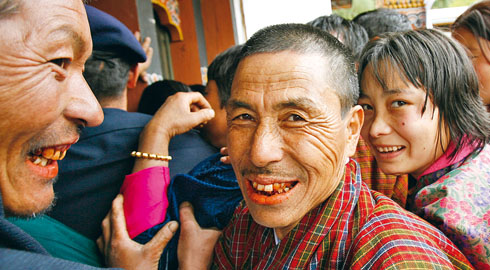
Himalayan approach
One of the main organizers of the conference was a small state in the Himalayas with a population of 700 thousand people - the Kingdom of Butan. It was it that became the world pioneer in a completely new field of research - the "economy of happiness." Explaining this concept, Prime Minister Butan Jigma Tinley said: “Economic growth is mistakenly considered as an indicator of an increase in welfare. The more we cut down the forests and exhaust the population of fish, the more GDP grows. Sometimes even crimes and wars make him grow, since a large amount of money is spent on them. ” Meanwhile, the main thing is what a family needs for happiness is a good house, a sufficient amount of land (if the family is engaged in farming) and technical means that allow you to spend less physical energy on agriculture, explained the simple needs of the tinla Butans.
His point of view was close to an authoritative Western scientist. The growth of monetary well -being since the middle of the last century has not led to an increase in life in life in the United States, according to a “report on world happiness”, a group of economists, led by Jeffrey Saxi from Colombian University, issued to the forum. The growth of welfare was blocked by damage to the environment, inequality, and a decrease in confidence in the government, the authors say. The governments of Sax strongly recommend that you refuse to increase economic growth at all costs. It's time to think about the factors that make people happy, that is, about the quality of the natural and social environment.
The Himalayan kingdom has already done this in practice - four years ago, Butan officially transferred to the “gross domestic (national) happiness” (VNS) instead of the usual indicator of GDP. And this allowed, according to government reports, to develop a new system of counting of welfare, based on "honest trade, natural and social capital." In fact, the small Butane is recognized as one of the advanced countries in the world in terms of combating corruption and publication on the Internet of electronic declarations on officials of officials. In addition, Butane is one of the most “environmentally friendly” countries of the planet, even smoking is completely prohibited here.
If we talk about the economy, then the replacement of GDP on the ANS was affected, for example, on taxation: with average income of the local population at the level of $ 110 per month ($ 1300 per year), only those whose income exceed $ 2000 per year. Back in 2006, the social psychologist Adrian White from the University in Leicester (Great Britain), who built the first global Ranking of Happiness, called Budan the happiest country in Asia and the eighth in the "index of happiness" in the world. Well, the Danes were then the happiest in the world in the world. 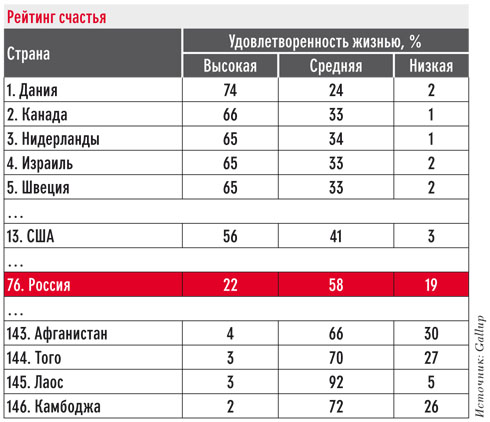
Denmark leads the rating of the happiest countries and after 2011. This list-the annual Well-Being Index-is Gallup. 146 countries are ranked in it - by the degree of how much their population is satisfied with life. The methodology of this study was developed by a psychologist and sociologist, Nobel laureate Daniel Kaneman (Princeton University). In each country, Gallup interviewed 1 thousand people over 15 years old. People evaluated their satisfaction with the current and expected (five years later) situation on a 10-point scale. In accordance with the results, Gallup divided the respondents into “successful” (satisfied with life) “fighting” (average level of satisfaction) and “suffering” (dissatisfied).
In Denmark, representatives of the first group - “successful” - 74%: this is a world record. It is also good in Canada, the Netherlands, Israel, Sweden. However, only in 17 countries of the world happily the majority of the population. The most unhappy country in the world is Cambodia: there are only 2%“successful”, but “suffering” - 26%. Also at the far pole of misfortune - Laos, Afghanistan, Nepal, Tajikistan: no more than 5%are happy there. In Russia, the share of “successful” levels is just below the average ID -level - 22%. In 87 countries (most of them African), as in Russia, are satisfied with their lives less than a quarter of the population. And in 28 countries, no more than 10%are satisfied.
"
Economist Jeffrey Sax strongly recommends that the governments abandon the increase in economic growth at all costs. It's time to think about the factors that make people happy
" Barometer of revolutions
Satisfaction with life is a very bizarre indicator. Especially if you compare it with traditional ideas about the material well -being of certain countries. So, the Irish, despite the economic crisis, are included in the twenty happiest states. And the Spaniards, despite the gigantic unemployment, are satisfied with their lives no less than the inhabitants of the prosperous Germany, oil Kuwait, and sunny Malta. In poor Moldova, there are not much less happy than in the same Germany. But the inhabitants of Italy, where the government holds unpopular reforms, and the economic prospect is in question, are much less happy than in countries with its level of development. Greece, in terms of happiness, rolled into the level of Indonesia and Uganda.
The Arab Spring did not lead to an increase in life satisfaction in the Middle East and North Africa. In Egypt, Tunisia, Yemen - countries surviving the revolution, there were no more happy.
By the way, the barometer of happiness from Gallup has a good prognostic force. So, in 2008-2010, the share of “successful” in Egypt decreased from 29% to 11%, and in Tunisia - from 24% to 14%. The situation was a little better in Algeria. These indicators literally “trumpet the alarm”: if the Egyptian and Tunisian authorities were worried about their future, they had to take extraordinary measures at that moment. But the rulers traditionally pay less attention to life satisfaction than the growth of GDP. And with the economy, everything was good: Egypt GDP in 2009-2010 grew by an average of 5%, tunisia - by 3-3.5%. But the misfortune of the Egyptians and the Tunisians was so great and so quickly grew that the sociologists who saw these figures were not at all surprised that the revolution happened in both countries.
All these comparisons, sociologists from Gallup write, show: happiness is a local phenomenon, and political leaders should keep this in mind, developing their plans for actions. But in general, the level of happiness, according to Gallup studies, depends on all aspects of life with which a person is in contact: satisfaction of basic needs (food and housing), the availability of work and its quality, the protection of people with a system of law and law and order, the development of institutions and infrastructure (from the honesty of elections to the availability and quality of roads, education, environment, medicine). Of course, economic growth is important. But only as one factor out of ten, and nothing more.