
Translated material
Corruption foam
Why is our milk so expensive
Corruption foam. Russian milk is one of the most expensive in Europe. In search of the reasons for this, Transparency International experts have found that the product of the corruption component is great in the price of the product. Experts beat the alarm: bribes and “rollbacks” will lead to the fact that real milk will disappear from domestic shelves, and all kinds of surrogates will take its place. The New Times plunged into the dairy rivers
“We are faced with the phenomenon of corruption extortion. For example, to bring the gas pipeline branch and put a distribution station for 500 houses by us in five sections of 20 acres of land - they simply had to give them an organization responsible for gasification, ”said Transparency International, in the economy of 200 cows (all interviews in the report are anonymous). Transparency experts interviewed farmers, agricultural holdings, industry associations and processing companies. All participants in the dairy production chain unanimously stated that they are constantly faced with corruption situations - both when interacting with state bodies and when working with other enterprises.
"Milking" in a circle
Corruption payments, as a result, turned out to be 15-30%in the final price of milk. “If we take into account that on average per capita, 262 kg of milk is consumed per year, then the payment for corruption when buying milk can be from 1572 to 3144 rubles a year,” said the author of the study, Lyubov Konstantinova.
With the help of an interview, she and colleagues traced all the way of dairy products - from cow to counter. Already at the very first stage - when the farm is just beginning to be created - the future manufacturer has to overcome barriers that are very far from those prescribed in laws and rules.
“Corruption can be discussed when starting a particular production at the construction level, land car, connecting electricity, and coordination of various conditions with civil service. You just can’t do anything, ”the words of the representative of the Western Milk processing company are given in the study.
“We cannot launch a dairy farm for two years,” the director of the Lenin state farm near Moscow, Pavel Grudinin, shared with The New Times. -District services are “pulling” with the documentation for connecting to the mains and in the end are strongly advised to contact some kind of commercial structure that does the entire procedure quickly and with a guarantee. But, of course, not for nothing. And we do not want to overpay, and we do not have such an opportunity. ”
Manufacturers who have their own processing capacities are faced with even greater problems. Their activities in Russia are regulated by the most “cannot”: only the collection of certificates and permits can take about two years. In addition, the state itself organizes an excessive and confusing control system in which corruption flourishes. A striking example is double control by federal state bodies of all dairy products at the stages of both production and processing, the surveyed farmers say. So, milk processing companies need to obtain permission to import dry baby food both that of Rosselkhoznadzor (which, in theory, should be engaged only in raw milk), and Rospotrebnadzor. Each dairy company is controlled by an average of 30–40 supervisory services, the requirements of which often contradict each other or are obviously impossible. How to overcome their manufacturers? The answer is clear: with the help of "kickbacks" and bribes. 
"
Each dairy company is controlled by an average of 30–40 supervisory services, the requirements of which often contradict each other or are obviously impossible
"
Milk with rollback
As follows from the report, in this vicious system all or almost all subjects of the dairy business are involved. For example, the milk manufacturer agrees to deal with the supplier of equipment only if the “rollback”, that is, part of the non -cash money paid by him under the contract should return back already in the form of cash. “When selling any equipment, as a rule, 80% of farms are being rolling in a rollback ... It happens that they ask for 10-15% ago,” the representative of the company for the sale of equipment for dairy farms as saying.
Alexander Tyupin, director of the Krasnodar Milk Choice LLC (certified dealer of the Swedish company Dlaval, producing equipment for dairy production), admitted in a conversation with The New Times, which periodically encounters similar facts. Although even more acute, he claims, the problem of “kickbacks” is for those who provide the livestock workers with regular technical assistance or any services, for example, for veterinarians.
For those who do not have their own processing, it would seem, the easiest and most direct path to the consumer is to sell milk in the market or in a street stall. But there are also barriers: after all, to open a stall, permission is needed, and you have to pay for a place in the market. Naturally, you won’t get permission just like that, and the real price of renting a place in the shopping rows is not at all the same as indicated in the price list. And again the corruption meter ticks, adding rubles and a penny to the final price of a package of milk.
Does not sour, but rot
The milk that we buy in the store does not slip out for weeks. It does not acidify at all, but simply spoils (“rot”, as Pavel Grudinin put it). In any case, it does not behave at all like ordinary natural milk. Just because it is not a natural product at all. Sometimes it is generally difficult to call it milk.
“For me, corruption is primarily when plants use not valuable and healthy milk fats as raw materials, and fatty fats - palm, coconut oil * * these vegetable fats differ from high -milk - 39 ° temperature of melting. They are absorbed worse by the body, because they do not melt, remain in a solid state and are deposited on the walls of the vessels. , far from always of good quality, without informing the consumer, ”says Andrei Danilenko, chairman of the board of the National Union of Milk (Soyuzmoloko). According to him, the falsifications are mainly sinning regional dairy. Sometimes, in the “milk” they produce, natural milk is not contained at all. But palm and coconut oil are two to three times cheaper than Russian raw milk. It is no coincidence that a third of the Palm oil was bought by the dairy industry. According to Soyuzmolok, more than 50% of the butter sold in retail networks, more than 30% of sour cream and cottage cheese, more than 70% of melted cheese today are a falsification.
Dairy giants, such as Wimm-Bill-Dann, Danone, Ermann, of course, do not fall to such frank falsification. But more and more often they prefer to purchase raw materials from local, but from foreign suppliers - mainly from European countries. The processor refuses Russian raw materials, because it is unprofitable for him: for example, the wholesale price of dry whole Belarusian milk is lower than the cost of a similar Russian product (130 rubles per kg versus 160 rubles per kg - on average for 2011). It turns out that it is more profitable to buy powder milk in Belarus, Kazakhstan, in the countries of eurozone than in Russia.
Under these conditions, the domestic producer of raw milk remains either to agree to the terms of the buyer and sell his products with a loss for himself, or to turn the business, letting the dairy herd under the knife. “If it was beneficial to produce milk in Russia, then we would observe expanded reproduction. Natural milk would have been produced more and more, the number of the herd has constantly increased, ”says Pavel Grudinin. “We see the opposite picture: people from the village leave, there are fewer cows.”
According to the Russian Geographical Society, the country in the country is about half as much as it was 22 years ago, respectively, milk is produced less. If you do not delve into history, then over the past year, milk production has decreased by 0.3% (from 31.9 million to 31.75 million tons). The number of cows - by 0.2% (from 3.72 million to 3.70 million heads). It would seem great trouble: a percentage of a percent! But this is a decline, not an increase. The industry continues to die quietly. 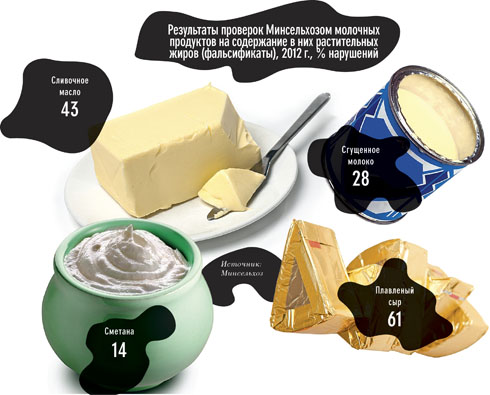
"
According to Soyuzmolok, more than 50% of the butter sold in retail networks, more than 30% of sour cream and cottage cheese, more than 70% of the melted cheeses today are a falsification
"
Less of the state
In Russia, the dairy industry enjoys the support of the state - this year, for example, it will amount to about 30 billion rubles. That's just this help in recent years was carried out mainly in the form of preferential lending. All this, according to Andrei Danilenko, resulted in a significant “reinterruption” of the industry. And loans, even preferential, must be given, with interest. As a result, according to Soyuzmolok, in the price of each kilogram of dairy products, four to five rubles are paid on loans.
The other day, the delegates of the III Congress of the National Union of Milk producers turned to the government with an open letter. The tone of the document is almost panic: the industry is written in it, does not withstand competition either with the state dairy industry of Belarus, or with importers from other countries, or with domestic falsifiers. Naturally, “in a dry remnant” - a request to the state to join, will be happy, help with new subsidies and benefits.
If the congress delegates carefully studied the report of Transparency International, perhaps they would ask the state completely different: not to interfere in their business. Indeed, this intervention has still brought producers only forty inspectors and insatiable bribes of state officials at all levels. And consumers are a third more expensive than should be, and Erzatz-Moloco instead of a natural product on the shelves.