
Translated material
The currency failed
Profit and losses of private investors
The currency failed. Private investors, concerned about saving their savings from inflation, and if you are lucky, also earn, traditionally await the financial results of the first quarter with special impatience: they, as a rule, largely determine the trends for the whole year. What investments provided profits and what losses - found the New Times found out
The key factor that influenced the “well -being” of all Russian markets in the first quarter was, of course, the growth of oil quotes in the world - primarily in connection with the aggravation of the political situation around Iran and sanctions, which they decided to introduce European countries, the USA and Canada * * * see more than the New Times No. 3 of January 30, 2012. As a result, the average in three months the price of the Russian Urals oil variety exceeded $ 117 per barrel, and in March it even went off for $ 122-almost at the level of May 2008, when an absolute record of the cost of oil quotes was set ($ 127.5).
Ruble, dollar and euro
The pattern of iron is triggered for Russia: the more expensive oil (and, accordingly, there is more flow of petrodollars to the country), the stronger the ruble. Therefore, our national currency in the first quarter was simply “sentenced” to growth. From January to March, inclusive, the dollar rolled from 32.2 rubles to 29.43 rubles, losing about 8%. The same can be said about a single European currency - its course decreased over the same period from 41.5 to 39 rubles, or by 6%. Accordingly, those who at the beginning of the year changed their rubles for dollars or euros in the hope of a short -term win, counted. The minus was those who opened foreign exchange bills in banks: the losses per quarter on dollar deposits amounted to 7.2%, in the euro - 4.7%.
But ruble deposits were a good solution for those who are not ready to risk too much. Moreover, domestic banks, trying to attract more customers, have actively increased deposits from the beginning of the year. In the first quarter, the average deposit rate in the leading ten banks of the country reached 9.5% per annum. Smaper and even offer up to 12%. This significantly exceeds the official rate of inflation (according to the results of 2011 - 6.1%), so the savings on ruble deposits are growing - an average of 3% over the past three months. 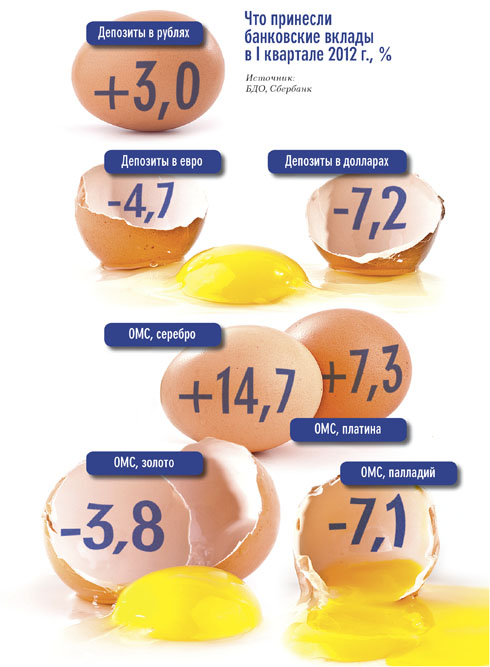
Another beneficiary from high oil prices was the Russian stock market, whose “blue chips” are almost completely shares of the oil and gas sector companies. Is it too surprised that the shares of 60% of Russian companies traded on the Moscow Interbank currency exchange have grown in price. The leading domestic stock index of the MMEVB per quarter increased by 8%, reaching 1519 points. In terms of annual profitability, a result is three times higher than the best deposit rates in banks. The Bloomberg Russia -us index, tracking 14 Russian “blue chips”, has grown at all over the past three months by 18%. The growth leader for this period (by 38%) has become Surgutneftegaz papers, which showed the best quarterly growth dynamics since 2000. The second result (+36%) was demonstrated by the most popular Russian Internet search engine "Yandex". In third place - Sberbank (+35%).
Formation funds focused on shares also showed positive dynamics - especially the Pyths specializing in the investments in the paper of oil and gas sectors (+11–27%). Electric power facilities brought their shareholders per quarter an income of 8-13%. Even the papers of energy companies have grown up, which sagged after the December Plos, arranged by Prime Minister Putin to their leaders, and subsequent mass inspections of corruption schemes in the industry.
However, shareholders do not believe in the further growth of the Russian stock market and actively withdraw funds from Pyths: for the 1st quarter, the outflow of funds amounted to 4.9 billion rubles. The indicators were worse only in the midst of the crisis of 2008-2009.
"
Those who at the beginning of the year changed their rubles for dollars or euros in the hope of a short -term winning, counted
" Gold
For a long time it was the main guarantor of profitability for the investments of small investors * * * See more The New Times No. 44–45 of December 24, 2011. But by the end of last year, Dragmetal began to lose price (since the cost of oil grew rapidly), rummaging from the September maximum of $ 1920 for a triple ounce to the level of $ 1520. For the 1st quarter of 2012, Troika ounces added about 7%in price. True, gold is quoted in dollars, which means that ruble yield on it turned out to be negative. If the depositor opened anonymous metal account (compulsory medical insurance) in the bank nominated in gold, then in the quarter he lost 3.8%. If we talk about other compulsory medical insurance, then more than 7% were lost by the owners of palladium accounts. But it was possible to earn money in silver accounts in silver (14%) and platinum (7.3%) that grew up in price during this time.
True, in recent weeks, the excitement in the gold market has caused a CITIBANK forecast: they say that this year the cost of trox ounce will reach $ 2400, and in the following - even $ 3400. Goldman Sachs analysts also put on growth, although more careful: “We confirm our 3-, 6- and 12-month gold forecasts at $ 1785, $ 1840 and $ 1940 per ounce.” At the same time, long -term investments in precious metals Goldman Sachs experts do not seem attractive.
A curious look at gold investments is offered by an authoritative international investor, editor of Gloom Boom & Doom Report Mark Faber: “I do not sell my gold, because I do not believe the governments, the federal reserve system, the European Central Bank and generally anyone who prints the money. But I never recommend investing all the money in gold, because you become very dependent on the growth of prices for raw materials. ” This approach is also shared by Maxim Osadchiy, the head of the analytical department of the BKF Bank: those depositors who have free funds, he advises at least 10% of them in gold (ingots or compulsory medical insurance). For what? Yes, just in case: if suddenly it is cheaper to cheaply become cheap or currencies, the gold will again begin to increase in price again. 
Experts surveyed by The New Times warn: there are not so many hopes for the fact that all the positive trends of the first quarter will remain. As for the stock market, April-May is the season of mass closure of the registers of joint-stock companies. Those who own shares on the day of closing the registry are entitled to receive dividends, and this, as a rule, pushes quotes up. However, after closing the registry, many get rid of the shares (sometimes to buy other papers for this money and get dividends from several companies). Therefore, in May-June, the market in Russia usually sags, and there is no reason to believe that 2012 will be an exception to the rule.
Everything is far from unambiguous with the ruble. High oil prices are recognized in developed countries the main threat to economic growth, and leading importing states, led by the United States, are already preparing to print strategic reserves. Be that as it may, by mid -April, oil quotes slowly began to decline. The fall of a barrel will inevitably entail a weakening of the ruble, and the dollar by summer is quite capable of returning to a level above 30 rubles, and the euro above 40.
According to the estimates of the chief economist Alfa-Bank Natalia Orlova, by the end of 2012, the dollar will cost 33 rubles, and the euro-43 rubles (with the cost of oil $ 100 per barrel). Orlova recommends that private depositors play by the summer to strengthen the ruble, and then think about a partial transfer of assets to dollars. Maxim Osadchiy, for his part, also advises in the second half of the year to reduce the share of ruble investments to 35–40% of the total amount, placing another 30–40% of the funds on deposits in dollars, and divide the rest between investments in gold and euro.