
Translated material
All -Russian "swamp" strike
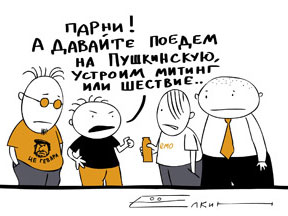
Experts record the growth of the strike movement in Russia. Rosstat will not help here, but there is data on the Internet. It seems that this is not just a fixation method or a self -organization mechanism, but also a new type of strike. From the network to offline: Pure "Swamp". “Swamp” in general - naturally, a strike is not only in this sense.
You all rally in your Moscow, but in Russia, you see, the peak of popular discontent! No, not a "bloody regime", but because of money. That is the peak of strike and other labor activity. At least, as specialists from the Center for Social and Labor Rights, who counted for the first quarter of 2012, believe as much as 60 protests in the field of labor relations. Which is 8 more than last year, and even compared to 2008, the growth is completely multiple, then the number of protest shares, according to the same Central Bank, amounted to 11 pieces. And by the summer, as the author of the analysis, Peter Bizyukov “Kommersant” said, and the peak of protest moods can be recorded at all - there can already be 50 promotions per month.
Is the strike movement wide?
Protest moods in general last year showed stably high levels and demonstrated a clear growth trend. FOM completely recorded a year ago that the number of those who are able to reach the protest campaign exceeded (for the first time during the years of “stability”) the number of those who are not ready. The indicator is serious, but is unlikely to say that the Russians are ready to massively strike, protecting their rights in a dispute with the employer. At the same time, according to VTsIOM, Russians stably believe that labor rights in the country have not been protected - so the overwhelming number of Russians (80 percent of respondents) considered the overflows for the past one and a half years, about half of the respondents stably say that no one has protected their rights at all.
“A wave of folk anger” or is there a “club of folk war”? On the eve of the holiday of “Peace, Labor and May”, I just want to plunge something from the category of Soviet anti-capitalist propaganda.
The Center for Social and Labor Rights has recorded the dynamics of activity since 2008-that is, it has a crisis dynamics and everything is logical there: in 2008, everything is calm, but already in 2009-immediately a surge. Reductions, dismissal, decrease in salaries, growth in discontent and, as a result, an increase in conflictogenicity between employees and employers.
In 2009, 272 labor conflicts at the enterprises were immediately recorded in the Central Bank, while in 2008-only 59. Further, however, the growth of activity was not fixed-approximately at this level (plus or minus) the number of conflicts was the following for 2009 two years. But maybe this year everything will change? The second wave of crisis and an increase in dissatisfaction with the tax burden in the entrepreneurial environment scared us, and who will suffer if the entrepreneur falls a profit? An employee with a high degree of probability will suffer.
However, it must be remembered that the employee is not able to strike “by law”.
The Labor Code establishes de facto prohibition conditions for the legal strike. Not every enterprise will go to the illegal strike, and the employer is highly likely to protest in court. And it will most likely be the winner. The Rosstat has been fixing the number of strikes at the status level for the past few years: several pieces per year. So for the “record” on the Central Department of Sciences, the first quarter of 2012 is recorded ... 2. In the annual dimension, as much as in 2006 - 8 pieces.
Once-before the adoption of the current TC and its subsequent editions-everything was not so. Control figure: In October 2005, Rosstat recorded 2565 strikes in Russia. That is, in one month (!) An order of magnitude more than in the crisis in 2009 was recorded by the Central Department Store. True, there was an all -Russian strike of state employees, but also against the backdrop of other, more calm years, the current unofficial statistics look not too impressive. 67 “official” strikes in 2003, 80 - in 202 and many thousands - again “officially” - in “peaks” 1997, 1999, 2004 and so on.
De Jure or de facto in Russia is forbidden to strike several million people. This includes civil servants, including municipal, security officials, state employees, transporters. That is, a significant and most structured (in the sense of a network organization) part of the working population from participating in strikes is simply excluded. It is difficult to strike in single -industry towns and workers of industrial enterprises - the law and the court will not be on their side, try to get a little.
And even without Rosstat it can be assumed that the number of strikes is at the level of status. This is despite the fact that the number of dissatisfied in general and labor conflicts, although it fell in the "years of Putin's stability" of the era of the second term, but clearly not up to zero. And with the crisis, their number was to increase sharply, but the number of strikes, if it has grown (according to the Central Construction Center - has grown and significantly), then it is clearly not up to the previous values. Where did the previous discontent go?
"Internet-business"
Without relying on Rosstat, the Central Department of Sciences records reports of strikes and other labor conflicts on the Internet. With this approach, background noises can take place from the overall growth in the Internet, rejuvenation of labor collectives (older people are unlikely to run to expose their complaints against the employer to the social network), the emergence of new methods of searching on the network, finally.
For example, the search for social networks and blogs of Yandex is only a few years old, the company is periodically improving it and far from always striving to convey this to the consumer. And such an improvement (say, due to the inclusion of a popular social network in the search for Yandex Blogs) can significantly affect the results of monitoring. And this is only one factor. And dozens of factors can affect the results.
In general, the Central Department Station fixes the following cases: organizing online people go out after offline, really howl. And somewhere, after all, they just talked, but did not go far.
And somewhere they protested, but in other means and such cases in recent years there have been more than one or two dozen. The mechanism “from online - in offline” was also used during various thousands of rallies throughout the country for various occasions.
Do you know what it is called in the capital now? This is called the "Riot of the Emerged Citizens", "Protest of Fat Cats" or "Swamp": And the mechanism is the same, and, we can assume, the grounds for protest. "Facebook-VKontakte-classmates-revolution" of a local scale. Only the protest form is different.
"Strike" of a new type
There is a nuance: in recent years, two things are characterized by such a protest that distinguish it from standard strikes. Firstly, it is increasingly structured not on the principle of a single group, but problematic, even when the problem in the narrow understanding is quite “strike”. Protests in Kaliningrad and Primorye against the restriction of the import of foreign cars or rallies of amateur fishermen “for free fishing”-this is a natural strike protest.
People are infringed financially, invade the sphere of the private, passing the line where they should not invade, and they go out into the streets.
Moreover, not only the victims themselves join such a protest, for many and for various reasons. They became people (previously understood, but in the conditions of “stability”, awareness intensifies) clearly: the more protest, the less the risks of a separate protester, and the potential effect can be larger.
However, in the event of a protest of employees of a single enterprise, massness can be achieved mainly in any monogrod. When families are connected to the striking and a mass protest rally is obtained, it is more difficult to please the instigators of the strike, and intimidate the rest, using the court decision. This was demonstrated in the Mezhdurechensk of the Kemerovo region after the accident at the Department of Generation or during protests in Pikalevo.
Second: such a “economic” protest is doomed to “politicization”. The “political opposition” of one or another inevitably connects to it, the authorities are forced to react to it. If only because angry citizens appeal to them - they are either directly or indirectly to blame.
Moreover, the standard reaction of the authorities relates the protests that miners, that “foreigners”, that “swamp audience”. They are standardly accused of selfish intent, and the protest is not called natural, but inspired from the outside. The governor of Kemerova Tuleyev saw in the Mezhdurechensk “drunk and not miners”, Deputy Prime Minister Sechin in Primorye - “Crooks”, Gospropagand of different levels in Kaliningrad and Moscow - “an unsystematic opposition trying to seize power”. It is likely that in each particular case there were some external interests (the Pikalevsky conflict with the overlap of the highway, it seems, was primarily a conflict of owners of different assets), but there was a protest.
So, returning to the “ordinary strikes”: displacing them from the legal sphere - including by virtue of the ban on the way to strike doctors and teachers, transport workers and government officers - the authorities themselves provoked the growth of deaf discontent.
And as a result of the impossibility of solving a purely labor conflict directly on the spot and without much risk, the non -working mechanism of mediation, the sympathy of the law and the court to the interests of the owners, and not the employees who are useless legal trade unions, sooner or later the conflict becomes political, and not labor.
The enemy is not the owner or the employer, but the mayor, the governor or even the “acting prime minister”. And due to many circumstances, primarily the policy of the state and its agents, this is not so unfair.
The state building may well be perceived for both the owner and the employer and certainly works with them in the same bunch.
It is in this sense that the “swamp” is the same “strike” as the “ordinary” strike of employees of Benteller Automotive LLC (its Central Bank calls the March “strike of the month”). Moscow is the city of officials and the headquarters of large corporations, a sort of service and management service of the whole country. Here is the main “owner” and “employer” of all Rus' (it is possible without quotes, if you understand not Putin, but an expanded state). However, here, as elsewhere, it is impossible to achieve a legal solution to the issue. Here, the growth of salaries with the growth of the corruption rent of bureaucracy also stagnates. Here, as elsewhere, many are unhappy with this.
When the propagandists in their manner reproduce the thesis about the “two Russia”, they are cunning. Both the striking worker, and protesting with the “swamp” moved by the same feeling - the inability to solve the problem differently, in some legal way. And before comparing the metropolitan rallies with the Arab spring, it was not worth comparing them with Mezhdurechensky or Kaliningrad?