
Translated material
Grigory Gritsenko: Relic

Grigory Gritsenko 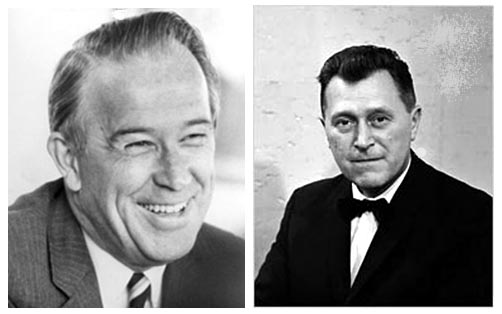 Henry Jackson and Charles Vanik. Photo from the site "Notes on Jewish History" "
 Henry Jackson and Charles Vanik. Photo from the site "Notes on Jewish History" "
In recent days, the prospects for canceling the amendment of Jackson-Vannik have been discussing again. This time - in the package with the adoption of the "Magnitsky Law", which limits the possibility of receiving an American visa for Russian officials included in the list of those involved in the persecution of the deceased lawyer. Magnitsky’s case is a separate difficult story, and we will focus on the legendary amendment and its role.
The conditions under which the so -called The amendment of Jackson-Vanik to the US trade law, in the current situation, it seems a little phantomagoric. However, 38 years ago, all interested parties were not laughing. The fact is that this amendment was one of the levers of impact on the political leadership of the USSR and other social stands in order to mitigate the restrictions on emigration from them. It was primarily about Jews, but far from only about them.
These conditions, for a number of reasons, were indeed very stringent. After all, the mass departure from the USSR struck a strong blow to the image of the socialist system, which by Soviet ideologists has long been declared the best in the world. But then the question arose: why do people go away from this best system in the world? Moreover, they leave for the worst system in terms of quality of life?
Another reason why emigration was limited was economic, since the mass outcome of qualified specialists caused serious damage to the national economy of the countries of the socialist camp. Moreover, this damage was multifactorial.
The first factor - the production and research sector of the economy lost important specialists, and the social sphere (especially medicine) - highly qualified workers.
The second factor in economic damage was associated with the adopted procedure for financing education. Formally, under socialism, education was free, but it was really assumed that the specialist would work out the costs of his training after receiving a diploma. However, this order could effectively act only in a closed economy. After the beginning of the emigration of the certified specialists, the full reimbursement of the expenses incurred (and they were rather big) did not occur.
And the third factor (specifically Soviet) was that some of the potential emigrants worked in the sectors of the military-industrial complex, and the regime of secrecy was extended, then, in principle, they could not leave the territory of the USSR. Or they could, but only after leaving these industries and the long-term waiting period, as a result of which their information about Soviet military-technical developments became very obsolete (this argument was often used to refuse to leave for specific people even when there was no real access to Gostaine).
It is not difficult to guess that if the country that qualified specialists leave is of great economic damage, then the countries that these specialists accept, on the contrary, receive additional economic benefits. Prepared personnel immediately appear, on the training of which you do not need to spend money, or time, or teachers. In any case, with the readiness to use the existing competencies (many emigrants and then and later complained about displeasure).
Although the listed reasons would be enough to understand why emigration from the USSR was a very difficult task, however, this is far from a complete list. Still, it was still more internal causes, and besides them there were external ones.
The main external reason for the restriction of Jewish emigration was an extremely negative attitude to an increase in the population of the state of the Israeli of the Arab countries. It is rightly believing that the growth of the population leads to an increase in the country's economic and military potential and, thereby, makes it less vulnerable to future attacks, the Arab leaders actively pressed it on the USSR, achieving the restrictions (or complete prohibition) of Jewish emigration from it.
As a matter of fact, at this point the opinion of the Soviet leadership coincided with the opinions of the leaders of the Arab countries. And if there were no other opinions, emigration (in any case, mass) would hardly have happened. However, not only the Arab countries, but also the political leadership of Western countries, primarily the United States, pressed the Soviet political leadership. In all meetings and negotiations with Soviet leaders, American representatives insisted on taking away the existing departure barriers.
It should be noted that emigration freedom for the Americans was not an empty sound. Still, the American nation is just a product of immigration from other countries, so the right to leave has always been considered one of the basic civil rights, and its prohibition or restriction was perceived extremely painfully. Although the pressure of American Jewish structures played a role that did not allow “lowering on the brakes” this problem.
It is well clear that the Soviet political leadership could not but take advantage of the possibility of playing between different camps. If the American side crushed too persistently, someone from the USSR was released, but not just like that, but having received any bonuses from the United States. After that, the immediate reaction of the Arab countries followed, and the emigration stopped for a while. It stopped until any of the Arab regimes (progressive or conservative-it doesn’t matter) did not take any steps that the political leadership of the USSR did not approve. Then the gateways raised it again.
In addition to the above requirements for compliance with the secrecy regime, Soviet leaders established powerful financial barriers. In 1972, the provision was introduced according to which potential emigrants with higher education were required to compensate for the state’s costs to study at universities. For example, the amount of compensation for a graduate of Moscow State University was 12,200 rubles (with an average salary in the country, 130-150 rubles).
This measure caused a violent wave of protests in the West. One of the consequences of these protests was the amendment of the Jackson-Vannik. The content of this relatively small amendment to be reduced to the following: Congress gives the US President the right to exclude goods produced in countries with non -and -entry economies imported in the United States from non -scrimination regime. In addition, the president receives the right to exclude these countries from loans, credit guarantees and investment guarantees provided by the US government.
The list of countries with non -market economies and the time of the beginning and end of these sanctions is determined by the US Antrezenta on the basis of the presence or absence of emigration restrictions in these countries.
Here, in fact, are all the sanctions that the US administration can impose on countries that hold back emigration - increased customs duties and non -editing of state guarantees for loans and investments.
It is clear that it is impossible to assess the damage from these sanctions. The fact is that 1974 was the year of the Cold War. And during the Cold War, trade and economic relations between the USSR and the United States were practically rolled up. In order for these relations to become quite significant, it took time that the story did not provide us. In 1979, Soviet troops will be introduced into Afghanistan, which will cause a new wave of economic sanctions against the USSR, against which the amendment of the Jackson-Vannik would somehow fade. Therefore, we can say that its real meaning was close to zero, and its acceptance was mainly propaganda.
Moreover, this amendment is currently propaganda in nature. It is clearly evident that the Russian Federation does not fall under the validity of these two points of amendments: the market economy of Russia is recognized by the United States and the European Union back in 2002, and that the emigration restrictions are swinging, in Russia, as a newly educated state, they never existed.
Understanding this situation, the American presidents, starting with J. Bush-st., Imposed a moratorium on the action of this amendment against Russia, and now this moratorium is renewing automatically. That is, over the past 20 years, no sanctions in relation to Russia are applied, and thereby the real value of the amendment is negligible for us.
Attempts to cancel the amendments through the Congress come across this issue in a multi -component bargain with the president. And this is obviously not the hottest problem with which the American administration needs to bargain something. Although a number of Russian and international Jewish organizations that do not want to draw this issue into the context of relevant disagreements were connected to lobbying for the cancellation of the amendment.
Attempts by some Russian officials look a little strange to cancel this amendment. It is not clear why it is to demand this, if it does not actually apply to Russia for a long time. If there are still countries that fall under this amendment, then let them fight for its cancellation, if they need it.
Another question is that the presence of an amendment creates some difficulties for American business, working with Russia - it will be in a competitive loss after our country's full entry into the WTO. But again this is not a problem of Russia. Unless, of course, our officials do not assume that in the near future, Russia can still turn into a country with a non-market economy in which emigration will be limited (or even prohibited). And so, in order to avoid future damage from this, it is precisely necessary to urgently cancel the ill -fated correction. And then it will be too late.
The problems of the international activities of Russian business, its expansion to foreign markets can be discussed on April 23 at 19:00 in the public conversation of the “first -person” cycle in the Great Hall of the Polytechnic Museum - with the participation of scientists and businessmen.