
Translated material
"Party of Medvedev" instead of "Putin Party"
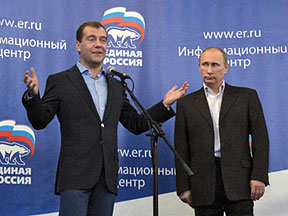
Putin's departure from United Russia and the delegation of Medvedev there is not a very good sign for the party-political system in Russia. Since it is clearly shown: the authorities do not want any parties that are able to become independent political players. Even if only partially independent.
The latest tradition of political castling, of course, began not with Russian tandemocrats. However, so that, repeatedly and at the highest level, it is impossible to recall this from Simeon Bekbulatovich in any way. And if Dmitry Medvedev “does not exclude” for himself the opportunity to run for a second term in six years, then the event is completely unprecedented.
The second series of castling, of course, came out not so dramatic. History has the ability to repeat in the form of a farce, and even the September scattering “Putin-Medvedev” seriously did not pull the tragedy. The decision to put Medvedev on “United Russia” is already simply ridiculous, as if the senior “tandemocrat” is sticking to the younger, disgusting structures after the acquisition of a fresh “Popular Front”.
Meanwhile, the question seems quite serious. For Putin, EP is a clear toxic asset that can only drag his rating of popularity (still very high) down. It got to the point that quite serious people discussed the liquidation of the “party in power” in general and building a new structure on the basis of the same ONF.
Now this option seems unlikely - nevertheless, a whole prime minister has been detained in the party.
However, for the fate of parties in Russia, in general, the decision seems to be disastrous. Sometimes frivolously, and sometimes seriously, officials from among political managers reasoned and still say that the role of parties should increase. So, due to what it is to increase if a person can easily integrate into the party who, throughout his presidency, was not a party unless mud did not mix and tried to distance himself from her all the time. No, the congresses had to make speech, but he also managed to enter something about “the need for greater openness of party structures” and other things that were unpleasant for the United Russia.
However, Medvedev’s arrival in the party does not guarantee any changes, rather the opposite.The bureaucratic structure, which specializes mainly in the approval of the decisions of the executive branch, having received as the leader of the prime minister (that is, the most senior appointed official in the country), is unlikely to become less bureaucratic.
Boris Gryzlov already promised Medvedev the support of all the delegates of the party congress without exception. That is, the person under whose leadership the party lost 15 percent in the Duma elections, party members are waiting with outstretched arms and are ready to abandon the leadership of the most popular politician in the country for his sake. Such a statement perfectly characterizes the degree of subjectivity of the United Russia party - it is zero (see also a dead end of optimism ). The party simply does not have their own interests, different from the interests of the Kremlin and Belodomic authorities.
And the words that the party will influence the composition of the government is nothing more than cunning.We have already seen the members of the EP in the government many times and from them only Vyacheslav Volodin could be called a party functionary with confidence (see the first party party ). Shoigu was the founder for the party for the party, but obviously more than just “United Russia in the Government”, the same applies to Alexander Zhukov. Yuri Trutnev is primarily a former governor, a businessman, and only then a unicorn. Probably beloved by Trutnev, and then for him will personally be more important than membership in the party. The party did not delegate the United Russia government, they were appointed for other reasons.
And the removal of Putin from the party does not guarantee an increase in its independence, in the sense of the ability to generate its own decisions.Rather, on the contrary: in an effort to increase his hardware weight, Medvedev can really engage in party leadership (which Putin almost did not do) and start breaking the party through the knee. In this case, there is a risk of turning the structure already built into the official machine into a completely frank appendage of the government.
In this regard, by the way, the well -known statement of Viktor Chernomyrdin about party construction seems not quite corresponding to reality. Well, it doesn’t work out the CPSU, it turns out some eternal “Our House Russia”. The CPSU was also largely part of the bureaucratic apparatus, but at the same time a duplicate power structure. United Russia, like its predecessors, cannot boast of anything like it.
However, the rest of the parties (with the exception, perhaps the Communist Party) are still not quite what is called political parties in the world. And in this sense, Putin’s statement that representatives of the opposition forces may also enter the government also does not add optimism about their fate. And as long as there are no parties in the country, it is difficult to hope that some multiple increase in their number will change something in the political culture of Russia.