
Translated material
Unrealized atomic project
On the 100th anniversary of Vladimir Semenovich Spinel
On June 24, 2011, a wonderful physicist, a professor of the Faculty of Physics, MSU, Honored Worker of Science and Technology of the RSFSR, chief researcher at NIIIIF Vladimir Semenovich Spinel died. He did not live up to his anniversary very little: on October 4, 2011, Vladimir Semenovich would have turned 100 years old.
V.S. The spinel was born in the city of Belaya Church of the Kyiv region. In 1931, he entered the Physical Committee of the Faculty of Kyiv State University. In 1935, he came to Kharkov, to the Ukrainian Physics and Technical Institute, where he completed the thesis and then went to graduate school. In the 30s, UFTI was one of the leading scientific centers, in which the whole constellation of outstanding physicists worked, whose names went down in the history of world science, D.D. Ivanenko, L.D. Landau, A.I. Ahizer, K.D. Sinelnikov, A.I. Leipansky, brothers E.M. and I.M. Lifshitsy, I.Ya. Pokanchuk, L.V. Shubnikov and others. Often scientists often came here-N. Bor, Frederick and Iren Zholio-Kuri, V. de Gaaz, P.L. Kapitsa, S.I. Vavilov, V.A. FOC, D.V. Skobeltsyn. For the first time in the USSR in the USSR, in the early 30s, the atomic nucleus was carried out in the USSR, liquid hydrogen and helium were obtained. The first steps in the science of V.S. The spinel took place in this seething atmosphere of free scientific creativity. At first, he works as a theorist, under the leadership of L.D. Landau, then conducts research in the field of experimental nuclear physics. He published his first scientific article “On the construction and work of the impulse generator and a tube of 4 million volts” in 1938 [1], and in 1940, under the leadership of Professor Fritz Lange, he defended his dissertation on this subject.
In the late 1930s, nuclear physics developed very actively, and immediately before the war, many nuclear physicists were well aware of the importance of research aimed at creating atomic weapons. Despite the fact that some well -known scientists were skeptical of the possibility of practical use of the energy breakdown of nuclei in the next 50100 years, in 1940 a commission on the problem of uranium was being created in the USSR and work on the atomic project begins. In the same 1940, very young scientists V.S. Spinel and V.A. Maslov, who worked under the leadership of F. Lange, managed to offer a solution to two most important problems related to the creation of an atomic bomb. The first was the problem of separating uranium isotopes to obtain an enriched mixture containing a sufficient amount of Uranus-235. The second task was to develop the design of the atomic bomb itself.
At the end of 1940 V.S. Spinel along with V.A. Maslov and F. Lange submitted two applications in the Bureau of inventions of the People’s Commissariat of Defense of the USSR. [2] The first of them described the possible design of the atomic bomb and the consequences of its application, and the second set forth the method of separating uranium isotopes using a multi -chamber centrifuge. Later in one of his interviews V.S. The spinel said that the technical concept they proposed could not work, but they described the basic principles of the design, including the most important moment - the need for an external explosion to create a warhead with a mass exceeding critical.
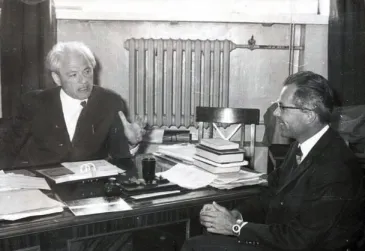
The authors have been waiting for an answer to their applications for a long time. In 1940, their proposals were called premature and even fantastic. Only six years later, after the tragedy of Hiroshima and Nagasaki, they paid attention to these applications, and it was decided to issue V.S. Spinel (V.A. Maslov died in the war) of copyright certificates for the inventions “On the use of uranium as an explosive and poisonous substance” and to enrich uranium centrifugation. As Vladimir Semenovich said much later, he imagined the omnipotence of the atomic bomb with its destructive strength and the danger of radiation irradiation, but did not realize the possible consequences of its appearance for the whole world. In 1940, the atomic bomb was considered as the most reliable weapon to protect the country on the threshold of the inevitable war with fascism, and scientists who worked on its creation believed that this weapon would be directed to military facilities. V.S. The spinel admitted that applications for the invention of an atomic bomb and centrifuge were submitted to him and his colleagues primarily in order to get the opportunity to work on their tasks: they dreamed of creating a laboratory and hoping that the applications would help to make such a decision. But life ordered otherwise ... If these applications received support, then, according to V.S. Spinel, the USSR could have an atomic bomb in 1945. And the centrifugal method of separating isotopes is now the basis of the industrial enrichment of uranium.
During the Great Patriotic War V.S. The spinel worked in Alma-Ata, where UFTI was evacuated. At the end of the war, at the request of I.V. Kurchatov, he was transferred to Moscow, then transferred to work at the Faculty of Faculty of Moscow State University and soon became an employee of NIFI-2 (later NIIIIF MSU). Together with L.V. Groshev, he created a laboratory of nuclear spectroscopy, which quickly turned into one of the leading nuclear -performance centers of the USSR. In the 1960s, Vladimir Semenovich managed to produce large-scale modernization of the laboratory, combining within its framework the three latest research methods: the method of indignant angular correlation of nuclear radiation, the method of nuclear orientation in magnetic fields at ultra-low temperatures and Messbauer gamma spectroscopy. The implementation of such a project, even if there was good financing, was a very difficult task, because work in each of the three areas should have begun almost from scratch. It was required to create devices and installations of a new type, modern electronics; The implementation of the experiments assumed the development of a complex methodology for obtaining supernarial temperatures. Despite all the difficulties, as a result, a unique center of research of super -toned interactions of nuclear -specific methods was created, which worked at the junction of nuclear physics and solid physics. In 1963, research in the field of resonant gamma spectroscopy led by V.S. Spinels were awarded the Lomonosov Prize of Moscow State University.
All scientific activity V.S. The spinel until the last days of her life was held in the department of nuclear -specific methods of NIIIF MSU. It was closely connected with teaching and was not limited to Moscow State University: he gave lectures at other universities in the USSR and abroad, was part of several problematic scientific councils of the USSR Academy of Sciences. In 1985, V.S. The spinel organized the All -Union meeting on super -thin interactions, which has become international and regularly passes to this day. He wrote many scientific articles, released two monographs and is the author of 15 inventions. For his achievements V.S. The spinel was awarded state awards.
Vladimir Semenovich published his last article in 2010 in the journal Physica C, without co-authors, at the 99th year of his life [3]. Can I find another example of such a longevity in science? In the article, he proposed the design of a fundamentally new gamma radiation detector based on the separation of charge carriers in a rotating superconductor according to the principle of centrifuge. Its drawing in this work is amazingly similar to the 1940 application drawing for the invention of centrifuge for the separation of uranium isotopes.
Vladimir Semenovich was not only a wonderful scientist, but also an excellent teacher who, in his own example, was able to instill the most important thing - love for science and a conscientious attitude to work. He raised the galaxy of wonderful students. Perhaps the secret of his creative longevity lies in scientific intuition, inexhaustible interest in new research and in sincere love for his homeland, the desire to protect it and work for its good. The name of Vladimir Semenovich Spinel, an outstanding physicist and inventor, will forever remain in the history of science and Moscow State University.
V.A. Andrianov,
A.N. Grum-Grzhimaylo,
Niiiaf Moscow State University
1. G.F. Kon-Peters, F.F. Langa, V.S. Spinel. On the construction of a pulse generator and a 4 million volt tube. Izv. USSR Academy of Sciences, N5-6, 785 (1938).
2. Atomic project of the USSR. Documents and materials. (Under. General ed. L.D. Ryabev). T.1 (1938-1945), part 1. Moscow, science, physical matt, 1998. Application for the invention of V.A. Maslova and V.S. Spinel "On the use of uranium as an explosive and poisonous substance", p. 193; Application for the invention of F. Lange, V.A. Maslova and B.S. Spinels “Method of preparing a uranium mixture enriched with a uranium with a massive number 235. Multi -chamber centrifuge”, p. 196.
3. Vs shpinel. Inertial Currents in Rotating SupercondUctor and U-Quanta Detector with Rotating Supercondting Absorber. Physica c, v. 470, 120 (2010).