
Translated material
Two sunrises per day
Most of the stars in the galaxy are double. There may also be planets. In order for the orbit to be stable, the planet should either turn close to one of the stars (the orbit of the planet is much smaller in double), or the planet should rotate immediately around the pair so that the planetary orbit is much larger than the distance between the stars. It is the second case that is most interesting.
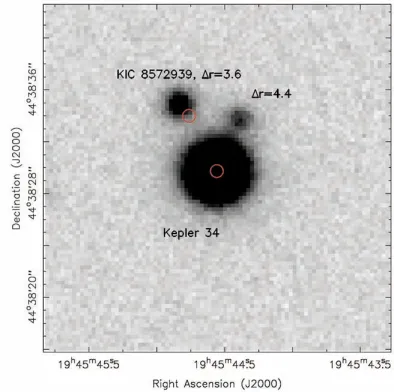
The first planet, rotating around double, was opened last year. This is Kepler-16. Of course, opening one object, it is difficult to say how common they are. Now the situation has changed: two more are open. This is Kepler-34 and Kepler-35, which are described in the fresh e-print of Arxiv: 1204.3955. Using detailed data on three planetary systems, William Velsh and his colleagues show that more than 1 % of not very wide double (with periods of 100-200 days) should have giant planets rotating around the entire system in the orbital plane of double.
S.P.