
Translated material
Fluff
The three main galleries of Moscow, “Aidan”, “Gelman” and XL are closed; "Dust" in Laboratoria Art & Science Space; “Fashion behind the Iron Curtain” in Tsaritsyno and the book “Soviet Style”; “Commissioner disappears” at the Gulag History Museum; Truthful Retusher Arkady Shayht and fashionable Chinese Ai Weiwei in Mamm; Soviet Mem Ushats in the Gallery “Vhutemas”.
The main event of Moscow’s exhibition life this week is a press conference given on April 23 by the gallerys about the cessation of the work of the three largest galleries of modern art, “Aidan”, “M & Yu Gelman” and “XL”. This is already known for some time, and everyone with a funeral mood is discussing the lack of art market in Russia. But the announced plans make it clear that this is not a gesture of powerlessness, but on the contrary - the beginning of a more complex and interesting work, in a new format.
Elena Selina explained that her gallery still remains, and will make a minimum of projects necessary according to international standards - 4 projects per year. But the director of the gallery will be Sergey Khripun - the permanent ally of Selina for 20 years. Selina herself revives the XL Projects, which will do the same as the gallery-large museum exhibitions-retrospects and new projects. The difference is that this organization will be non -profit. The meaning of these changes is that the content of the gallery costs 400 thousand cu In the year, which is excessive for a private person and a creative person, but when trying to find a sponsor for a large project, and state and private structures refuse, motivating the unwillingness to help culture by the fact that the gallery is a commercial institution and should cope itself.
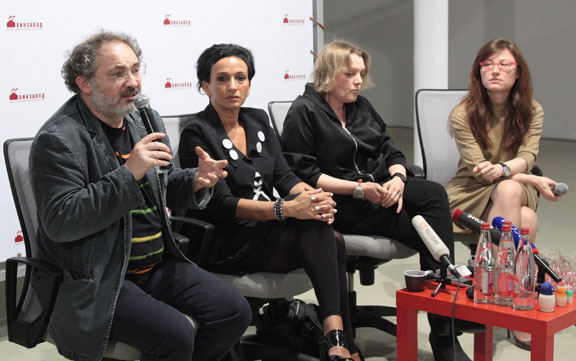 On April 23, three leading galleries announced their transition to a new format. Marat Gelman, Aidan Salakhova, Elena Selina and Elena Panteleeva. Photo: Valery Ledenev
Marat Gelman goes along the “party” line - he will devote himself to the “Cultural Alliance” program with state support - the development of the cultural sphere in the regions, and regional artists will be exhibited in its space - the circulation of events in two directions, centrifugal and centripetal. The art critic Milena Orlova ardently spoke about the fact that independent artists will now become state subordinates. What Helman, who is often reproached with collaboration, told about his position: “In bad weather, when ice, someone does not dare to leave the house and remains to wait out on the sofa, others say that I will sit behind the wheel and will go carefully, I know these risks. For three years I have been working at the State Museum in Perm, and no one will say that censorship or “advice” from the state was in relation to its activity. I'm starting a project in Krasnodar now. He talked with artists, officials, and everyone says-we have Cossacks here, you know, you can somehow without an art that affects religious topics. I told the governor - if everyone says so, you need to start with this. On May 15, the ICONS exhibition will open there. Milena is right when he warns us that the situation is dangerous and we must be careful. But who, if not people with authority and experience that can insist on their own, can work with the state. The country is slippery, the weather is bad, the atmosphere is bad, this is not a reason to leave. ”
Gelman clarifies who he sees as a promising partner - this is not a state in general, which, as a rule, wants to be glorified, and yet not a collector who, with rare exceptions, wants art to look like a fun party. These are municipal authorities. Their desire to glorify their territory coincides with the desire of curators and artists to make a loud event, which the audience will go and write the press.
Aidan Salakhova also reserves the space at the Winery - as his workshop. The highlight is that from Friday evening until Sunday evening, spectators can come and watch how the artist works. In addition, students of Salakhova from the Surikov Institute will work in the same workshop. She used to lead the first two courses, and then the children went to other workshops, where they gradually forgot how, and most importantly, why draw. Now she leads students from 3 to 6th year, which means that they are really released “her” by students, without injuries of a clash with an obsolete ideology.
It was Salakhova who spoke out loud that each of the pioneers of the gallery business in Russia became clear - “The Gallery format has become cramped”, to make dozens of personal exhibitions a year after year is boring. I must say, both the press and the audience also became boring. Exhibitions that go beyond the scope of contemporary art and convey some kind of knowledge about the chosen subject are most successful. In them, works of artists either appear as one of the types of transmission of this knowledge, or there is no art as such at all, but the texts and exhibits are shown as installation.
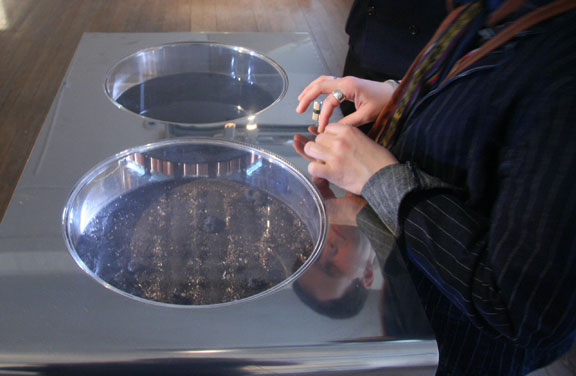 “Zdoghlocator” Hurvig Vaiser at the “Dust” exhibition is a DJ remote control, in which you can control two mixtures of dust, creating small strange landscapes from them
One of these exhibitions is “dust” in “Laboratoria Art & Science Space (until July 15) in the building of Nifhi named after Karpova, next to the brain institution. The curator of space Daria Parkhomenko works with Science-Art, projects on the verge of science and art. The exhibition about dust accidentally coincided with the events that the whole country is discussing, the dust from the apartment of the cardiac surgeon Yuri Shevchenko penetrated the unknown science into a neighboring apartment, which belongs to the Patriarch of All Rus', and the furniture and books, among which there are particularly valuable publications like the Robinson Crusoe Daniel Defoe Defo, were discussing. The cardiac surgeon had to pay 19 million rubles by decision of the court to compensate for invisible damage. The dust that has become the hero of the news in Russia is evidence of the moral decomposition of society. A completely different matter is the dust that artists and scientists are talking about, for them this is a way to understand the laws of the universe.
The exhibition begins with the old work of Anatoly Osmolovsky, which acquires a new reading here - along the walls near the floor itself, the slogan “genuine freedom is written in dust - in the most severe logic of development, everything else is arbitrariness”. As an epigraph for this exhibition, the work seems to indicate a reasonable structure of nature, but in relation to the dust of the patriarch, it will not be superfluous to recall the meaning that, apparently, initially meant the artist - the one who violates human laws will be punished by history.
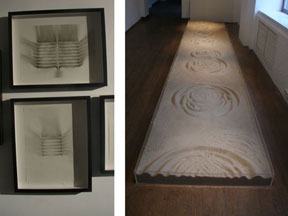
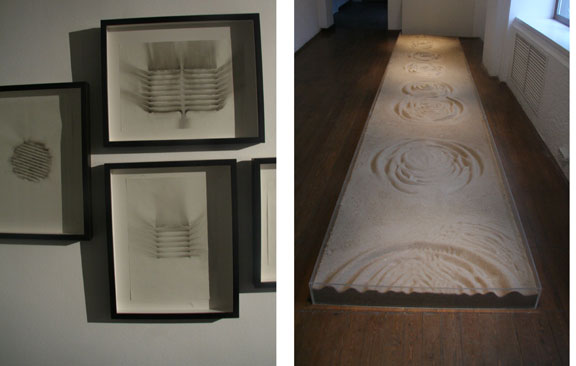 Mikhail Tolmachev “Ventilation Brows”, Natalya Egorova “Pseudomorphosis” - sand cast of circles on the water, which remain from the pebble launched along the waves
Dust makes the invisible - visible. When you let the pancakes by water, you never manage to consider circles that remain on the water, because you follow the flight of the stone. Natalia Egorova made a cast of “indignant water” from sand, a path with the “steps” of the stone, calling her work “pseudomorphosis” - a scientific term denoting cases when a mineral that is supposed to have a certain crystalline form, suddenly takes the pseudo -form inappropriate for its composition and properties. The graphics of Mikhail Tolmachev is made in cooperation with a soot - he applies the sheets of paper to the ventilation grilles and the movement of air is imprinted on them, dark particles settled with strange silhouettes, sometimes similar to the ribs of the chest, sometimes to architectural drawings. Stas Shuripa writes in the text about this work: “The artist’s function is in modern culture: to slow down meanings to show indistinguishable, traces of the movements of the spirit of time.”
Dust can be musical. Artists Marcus Dexker, Ditmar Offenhuber and Orkan Telkhan, impressed by the figures of Hlag, collected dust from Moscow streets and enclosed in a sealed glass tube - moving the piston inside it, the viewer can create a sound wave, which gives the particles various forms. Alexey Blinov and Fedor Sofronov take larger particles, who are still destined to become dust - urban garbage, namely - used metro tickets and ground transport. Each of them contains a unique digital code and is a certificate of the daily life of the townspeople, which on the scale of the universe are nothing more than the circulation of grains of sand. The viewer is offered to extract what has gone into the past. ” It is necessary to take a mop, to the handle of which cute headphones are connected on top with sentimentally pink, put on them, and turn the tape scattered on the floor with a mop. In bristles - a sensor that reads codes on tickets, and each of them corresponds to its sound or melody.
But this is not only the archive of the former. The work of Cyril Assa and Anna Ratafieva “Grisil” is similar to traces on the wall remaining from book shelves and books. But not too similar, because the authors seemed to be not talking about cultural memory. They chose the old technique, which builders use to mark the distances - the rope gets dirty in coal, then stretches greatly between two cloves, then you need to pull it, and it will slap on the surface, leaving a line from coal crumbs on it. Thus, they drawn the walls with the contours of shelves and books, and the technique suggests that something should be built. The cultural base that humanity has to create is a place for archives in the future.
Dust is often seen by artists not as a decay product, but as a material for creation.
Association "Up!" In its work, the "dust of the network" shows virtual dust dust. “Physical dust is a blood particle of a single body, a pixel is a single body turned into a particle. Physical dust is a trace of decomposition, and the pixel is the beginning of the creation. ” Artists take many online videos and each of them reduce to one pixel, making a mosaic screen from them. Virtual reality is endless scaling, the universe revealed from the pixel point to the world network. In the video work of Maxim Ksuta “Sower” - a ghostly figure, a person with his hands spread, guesses in a cloud of luminous particles on a black background. Some particles fall down, others rise and again join the figure. A person consists only of this circulation - what you sow, then you will reap.
As it turns out, the dust itself can be very interesting, but this will not change that the epithet “dusty” is often synonymous with the word “boring”. And when you learn about the exhibition of Soviet clothing, dusty mannequins and the atmosphere of boredom are immediately presented. This is the exhibition “Fashion for the Iron Curtain” in Tsaritsyno (until June 12) through the efforts of the curator Irina Korotkikh and collector Alexander Vasilieva really became what they wanted - a tour of the story that the USSR who made us remember and revise through “tapes, lace and boots”, and young, who are uninteresting in electrification and industrialization, emancipation and emancipation and emancipation and emancipation and emancipation and emancipation and emancipation and emancipation and emancipation and emancipation Likbez, dispossession and camps, may be interested in the past countries through the “outputs”, which are included in the sphere of their constant interests.
Contrary to announcements, often emphasizing the second part of the name “From the wardrobe of stars of the Soviet era” , the exhibition is not at all about what they write about in the yellow press - about the “dirty laundry of celebrities”. The exposition is built chronologically, one or two halls for every decade of the twentieth century.
The 10s-the daughter of a priest after the revolution sews clothes from dad's vestments. In general, it is interesting that just as in contemporary art, an important point for understanding the exhibit is to read the label: without the name, the year of creation, and you can’t really understand anything. Dress like a dress, but - "sewn from the fabric of the Chinese screen." And immediately you think about these years of the Civil War, a terrible hunger and at the same time an indestructible desire to remain beautiful. However, not devoid of practicality. From the apartment where the screen is standing is thrown out, you will remain in the middle of the street, which it was - it is better to look attractive to have more chances to survive. The "folk style" - canvas shirts with embroidery will be fashionable. In order, so to speak, "go for your own." The nobles and rich are disguised as despicable slaves, and do this not without grace.
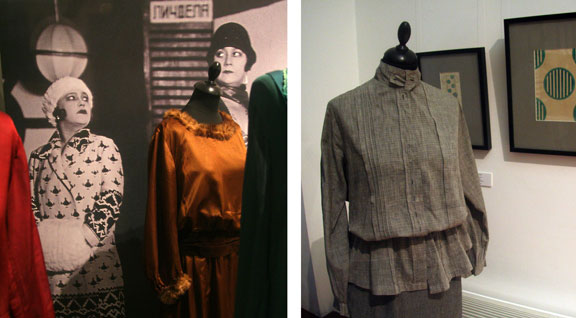 Girls of the NEPA and Rabfakovskaya blouse
The 20s are represented by both Nepov outfits and photos of fatal women, and the avant -garde - sketches of fabrics and suits of Lyubov Popova from their own collection of the Tsaritsyno Museum. The Rabfakovskaya blouse would become a hit with modern fans of modesty and an “environmental” style, and a jacket from the sketch of Popova - the dream of a raver. But we do not appreciate all these insights of our early Soviet “designers” - the Austrians bought the right to publish sketches of Popova and the reproduction of patterns on fabrics.
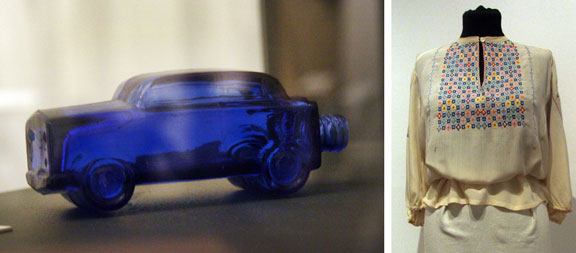 Bubble for cologne, factory "Freedom", Moscow, 1930s; Blouse in folk style, crepeles, embroidery, 1930s, gift of Tatyana Gasova, collection of Alexander Vasiliev
The 30s-constructivism is sequentially destroyed. Female dresses made of thin fabrics, floral ornaments. Again, the same canvas shirts-dresses with embroidery, but already as a harbinger of politics in which nationality will be important.
The 40s-the woman’s desire to look good and the desire of a man to see something seductive amazes. In the signatures to the photographs of women-frants, the explanations that “hair is curled on curlers” is adjacent to the instructions “on the tunic-the medal“ for courage ”. No matter how blasphemously it sounds, the heroines of the front are proud that they have such beautiful “brooches” - with jewelry as bourgeois remnants, the Soviet government fought until the 60s, so the orders and planks were the only jewelry that Soviet women could afford. In the same hall there are trophy fur coats and dresses, and among them is one of those very German night shirts that Russian women wore as evening dresses.
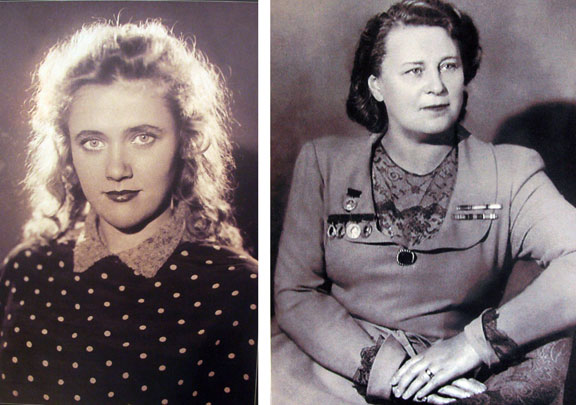 Actress Galina Suvorova in a dress in the "Andaluz" peas, fashion makeup, Moscow, 1945; People's Artist of the USSR Alla Tarasova in a woolen fitting dress with lining shoulders, a small neckline is closed with a lace shemizer. Photo of G. Vayl. Moscow. 1951
 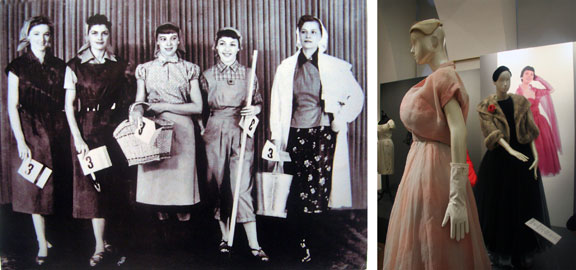 Soviet models in work clothes of cleaners and milkmaids shown at the international exhibition in Budapest, 1955; outfits of Soviet actresses in the style of New Look, 1950s
 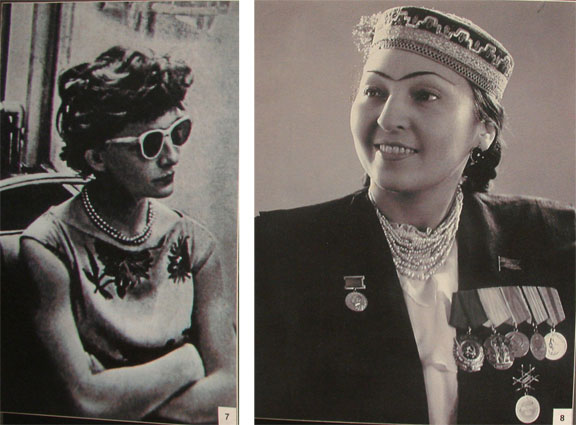 A stranger in a fashionable open dress in a large floral pattern, pearl necklace and sunglasses, photography by V. Kovrigin, 1958; Dancer and singer Tamara Hanum in a jacket with lining shoulders decorated with medals and orders, 1950
 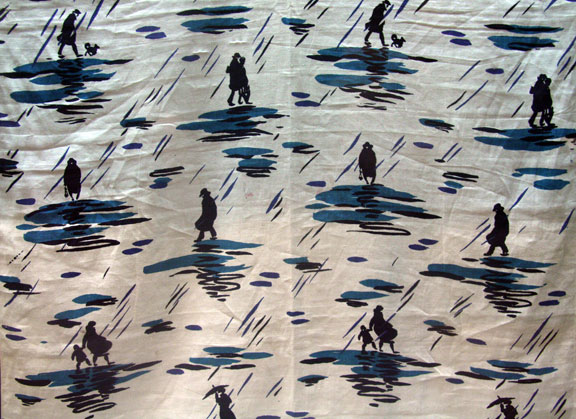 Decorative cotton fabric “rain”, author M. Zvyagin, Leningrad, 1960, clinging, mechanical to flow, collection of GMZ “Tsaritsyno”
 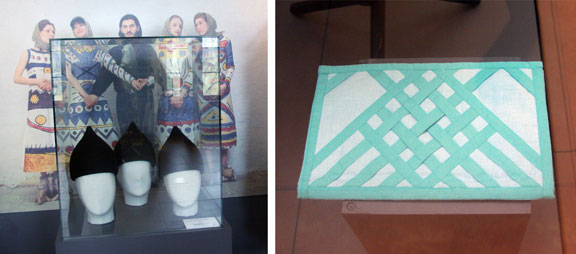 Lena Nartova, Katya Fillipova, Vera Oleinikova, Katya Baksha in painted work dresses George Ostretsova (in the center) from the collection “Russian Gentiles”, photography S. Borisov, Moscow, 1992; Three headdresses in the form of Old Russian helmets, USSR, 1980s, felt, Moscow House of models, gift of Kirill Gasilin; Soviet “clutch”, 1980s, designer Olga Astafyeva, gift of Lyudmila Chernovskaya-all from the collection of Alexander Vasiliev
50s - New Look and Diora models against Basil Blessed, a red dress from a new -fangle nylon, in which Clara Luchko made a furor at the Cannes Film Festival. Two halls with dresses, handbags and shoes of ballerina Galina Ulanova, from her museum-apartment in a high-rise-but there you can’t see them, they just hang in the covers in the closet.
60s - space sparkles, metallic. A costume of Golden Bricky Veronika Goryunova, the wife of the Soviet ambassador, in which she was photographed with Yuri Gagarin. And the harsh style, hard cotton fabrics with patterns suitable for kitchen towels.
70s-hippy home-made beads of bones and nuts, the famous "Rainbow Dress" (chiton and overalls) Maya Plisetskaya, sewn for her by Pierre Carden.
And the 80s is the era of bad taste, the king and the permanent ideologist of which is still Vyacheslav Zaitsev. The wildest specimens of “author’s fashion”, among which the projects of contemporary artist Georgy Ostretsov were clogged-the fact of the fact that as a performance for performances all this is fine, but as clothes are no good. These avant -garde structures do not interact with the body, they are self -sufficient as sculptures. Well, besides, these outfits are absolutely non -functional. The artist can afford to look like an astronaut or nesting doll, to be ridiculous, funny or ugly if the idea of his work requires that. But no idea can force women to wear “hats in the form of Old Russian helmet” made of felt by the Moscow House of models - because the head in them will look like an enema.
All the achievements and failures of the Soviet state are somehow visible in buttons and pockets, neckline and pro -deeds. Moreover, the raincoats and skirts are equipped with photo galleries of types, and it is clear when people behaved constrainedly, and when deliberately cheekily, when they smiled sincerely, and when it was done.
The exhibition is popular with a wide variety of people, and listen to how stylish ladies of retirement age recall cases from their lives associated with one or another detail of the wardrobe, and young “finished preparations”, or “Goths”, I don’t know how to do it themselves that their photos can be safely placed in the Tashen’s album, significantly nods each other: “everything returns”.
The exhibition was prepared for a very long time - a thoughtful and high -quality demonstration of exhibits requires a lot of money, and I had to look for sponsors. Previously, when our former mayor was not yet in disgrace, such problems did not happen - the disfigured Tsaritsyno was his favorite brainchild. Exhibitions of any quality were financed without any problems. The museum does not really understand what the difference between individual projects is - they are upset that under Luzhkov the exhibition of Andriyaki and his students took place with great success, there were a lot of advertising, people were falling, and after Luzhkov the next Andriyak did not go.
Now, a excellent project and history has to conduct a painful fund-racing project. What you sow, you will reap - where there is no corruption, everything solves the actual quality of the project, good ideas and important topics. There is no Luzhkov - however, a lot of people want to see “fashion behind an iron curtain”. It remains only to wish the museum to do excellent projects further.
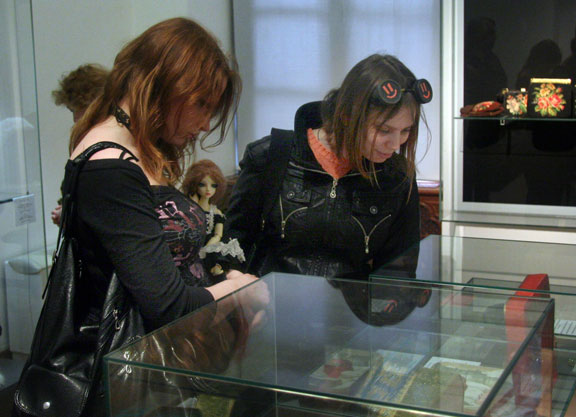 The post-Soviet youth fashion of the 2010s-Girls consider bubbles from Soviet spirits
 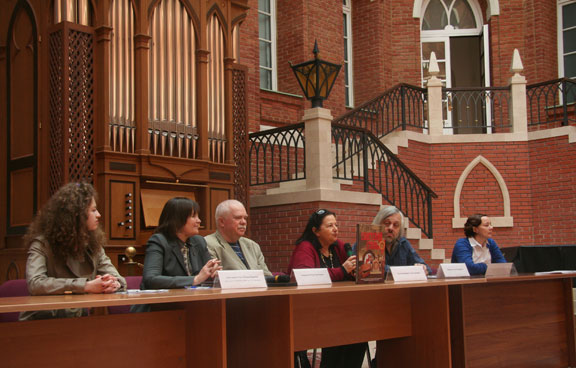 The presentation of the book “Soviet Style” was held in the interior of “Luzhkovsky” style, covered with a yard of a bread house. From left to right - Veronika Zuseva, the book editor, Olga Dokuchaeva, deputy leader GMZ “Tsaritsyno”, Igor Smirnoye, the author of the book, who wrote about the history of money and packaging, Marina Koleva, the author of the text of perfumery, Sergey Merzhanov, who wrote about Soviet dachas, and the curator of the exhibition “Fashion for the Iron Curtain” Irina Korotkiy.
Within the framework of this exhibition, the presentation of the book “Soviet style” was held - the first of its kind. Socialist life was considered before this in different publications, but never in this way. There were luxurious albums about Soviet porcelain and dictionaries of concepts without pictures, memoirs, in which the concepts of Soviet everyday life, deep studies in certain areas of life through the centuries in which the chapters about the Soviet period were the concepts. The book “Soviet Style” publisher “Avant+Astrel” - all aspects from jewelry to dishes are considered, it is illustrated by rare photographs from private archives, the texts are written by collectors and researchers of these things, and exciting, and “magazine” design with “cries” and quotes on the dresses corresponds to the requests of our time, makes it possible to quickly perceive inexpensive information. At the presentation, collectors spoke about the reasons for their interest in the subject of their collections or research.
Elena Sergeevna Yurova collects Soviet jewelry - not a jewelry, the value of which is understandable as the cost of precious metals and stones that make up it, but inexpensive jewelry as an inexplicable and inexperienced desire to decorate himself. Jewelry is the most unhappy theme of Soviet life. If furniture or clothes really need even a superman of the future communism, but he will not walk naked and store all things with a mountain on the floor, then there is no practical meaning of jewelry. Until the 60s, the desire to hang up the tracks was eradicated. In the visual material, jewelry on women is a rare case and usually only has negative characters, so in the pictures of the journal Crocodile, in the 40s, beads appear only once-on the neck of Hitler's secretary. Then the jewelry was no longer under such a strict ideological prohibition, but they were not in Favor-they were brought from abroad, or made themselves, from beads and natural materials like amber and plant bones.
Marina Koleva, who wrote about Soviet perfumes , emphasized the paradox - decoration was not welcomed, but the production of perfumes was a very important industry in the USSR. After the Great Patriotic War, one of the first to restore and expanded the perfume factory in Kaluga, large forces were thrown to develop the Research Institute of Synthetic and Natural Fragrant substances. After the war, more spirits were produced more than before the revolution. Of course, there were a lot of production products, in a large container, which was more suitable for satisfying alcohol needs, but there were “Red Moscow” and “Stone Flower”. In 1958, at an exhibition in Brussels, Soviet perfumes received the award of French perfumers - the highest of possible awards. Marina Koleva explains this by the fact that perfumes, smell are an impact on a subconscious level, and in this case they were a way to cause people a sense of happiness.
Architect Sergei Mirzhanov wrote about the phenomenon of the Soviet cottage - such, undoubtedly, existed, because it was not without reason that one of the few words of the Russian language that entered the international dictionary due to the inability to adequately translate them was the word Dacha. This place had a microclimate of security - official aesthetics did not work here, few people posted the flags on the facades of his houses, did not put the statues of leaders in the villages, was not afraid to tell seditious jokes in the country as in urban cuisines. The arrests in city apartments were commonplace, in the cottages - much less often, perhaps because partly departure to the dacha, the townspeople manifested their reluctance to fiercely fight the system.
A separate topic, in addition to the above, as well as dishes and food, toys and holidays, clothes and furniture, is Soviet underwear. He was dedicated to the magnificent exhibition “Memory of the Body” (2000-2001), which was supervised by Ekaterina Dego - real objects were exhibited, accompanied by the stories of those for whom this laundry played an important role in their life. The theater artist, the collector of Bellya Victoria Sevryukova, refused to participate in that project - the exhibition was sponsored by the German company Triumph, which produces beautiful modern linen and wanted to play in contrast, and she did not want "the Germans to defeat us under the skirt." For her, these things are a monument to the project of creating a superman. Victoria admires how "these freaks were supported by dumbbells, carefully pathetic." “We all were born in spite of this laundry” - it means that partly supernomers, who were reproduced not due to instinct and temptation, but for love, closing his eyes to external shortcomings.
She also has men's linen - a collection of things belonging to all members of the Politburo, with the exception of Stalin, and things of camp prisoners. These historical rags survive her from home and from work - many of them are woven from such severe depression that it is impossible to stay with them. She dreams of transferring them to some museum, along with her collection of ancient corsets-but, alas, the problem is that we have no fashion museum or costume.
That is, a few years ago, he was approved by Yudashkin's auspices. However, he really is not, and the fact is that he cannot exist fully under the leadership of his interests of a private person. Fashion, as you can see at least from the exhibition to Tsaritsyno and the book “Soviet style”, needs a serious scientific approach. Is it possible to imagine some exhibits from the collection of Victoria Sevryukova in the Yudashkina Museum? Such as the Calsons from the Gulag, with the comment that they are no different from the Army, except for one - for the soldiers - the seams were processed so that lice did not start in them, and for prisoners the guest took a step back, and specially processed the seams so that the lice of them would be a complete expanse. Let the enemies of the people suffer in full.
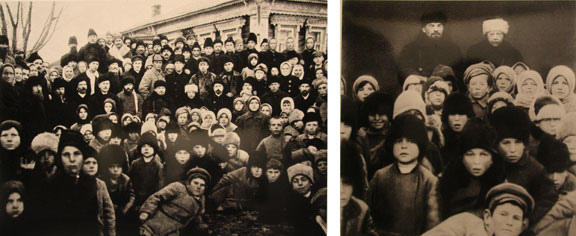 “Children from Kashino”: Lenin and Krupskaya among wealthy men at the opening of the power plant, the photograph was taken by F. Feofanov on November 14, 1920; A photograph published nineteen years later, in the midst of “purges”, the children in this photo were left alone with the leaders, without parents - they were shot by then
“Soviet style” and “fashion behind the iron curtain” are shown mainly by those fragments of the era that can be loved, or even respect. The exhibition “Commissar disappears” at the Museum of the History of the Gulag (until July 3), the collection of the Soviet shot retes - photographs and documents of the most terrible period of Soviet history, the actor Jonathan Litter, actually, said: “Not communism ruined Russia, but Russia ruined communism.” We are used to mourning about the “color of the Russian intelligentsia”, poets, scientists, artists, directors, executed under Stalin. And few are sad about the destroyed Bolsheviks who made a revolution and also shot. The English researcher of Soviet history David King, whose collection of archival photographs is presented at this exhibition, asks the question: how could the Soviet country look if Stalin had not appeared in it.
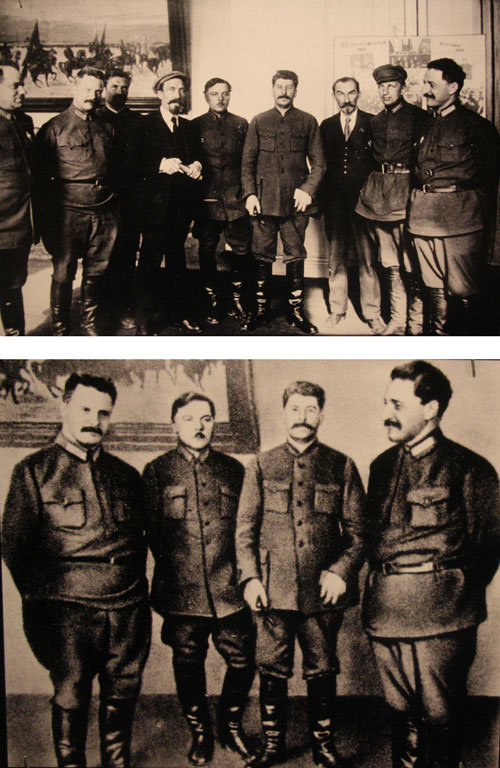 “Long friendship” - this group picture was taken in April 1925 at the HSC of the party conference. In the picture from left to right, Mikhail Lashevich, Mikhail Frunze, Ivan Smirnov, Alexei Rykov, Kliment Voroshilov, Stalin, Nikolai Skrypnik, Andrei Bubnov, Sergo Ordzhonikidze and Joseph Untleykht. Of Stalin’s associates appearing here, only one died his death.
Whole series of photographs with detailed explanations showing how those who made a revolution and could testify that Stalin was not the closest ally of Lenin disappear from the pictures. Red Commissars, about which it is not customary to regret (we also attribute Stalinist crimes to them as Stalin appropriated the achievements of the revolution) - it is they who become the main characters of this project.
They clean not only people, but also architecture, environment, as a witness. In the genuine picture of the first days of the February revolution, the sign “Clock is visible. Gold, silver ”, in the later versions of the photo on the sign of the jewelry store, it indicates:“ In the struggle you will find your right ”, and the black flag in the hands of revolutionaries was replaced by white with a black inscription -“ Down with the monarchy! ”
Two photos of Lenin in the spill - one of them, where Lenin was greeting - was constantly published and the other, with a “problem face”, pulling more on the hero of the social drama of the 2000s - printed only once. Imagemakers worked no worse than in Hollywood - you can see this by comparing the photo of Stalin with an uneven face and the result after retouching - fresh and brilliant.
The exhibition shows all aspects of the Soviet collage and retouching related to murders in the name of ideology and proof of successes that were not. Attempts to cross the crowd listening to Lenin or walking after Stalin, from other photos taken from other occasions, where there were more people were more, look stupid. It turns out in these collages that people look in the other direction, not listening to Lenin, and in the masses walking behind Stalin, it is clearly visible that the same fragment of standing people is replicated - contrary to the laws of prospects, their heads are reduced into the distance, then increase again.
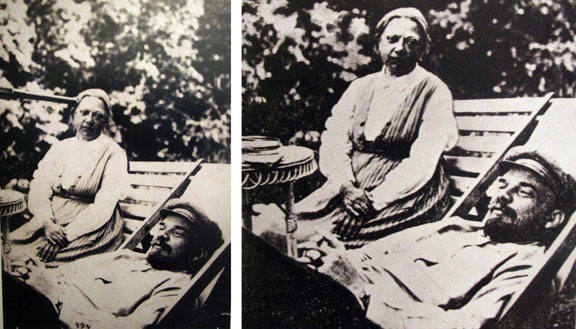 The basics of photography ”: a picture taken by Lenin’s sister, Maria Ulyanova, who was not alien to the ambitions of the photographer. She did not notice that a telescope pipe had fallen into the frame, which gives the impression that a rifle was directed in the head of Krupskaya.
It is not possible to list all the sets of destruction of archival memory and their evolution shown at the exhibition. But it is worth noting the moments interesting for our time. A special degree of shamelessness, when they have already stopped bothering with a thorough procedure for painting over the erased figure and simply covered the face and surname with ink, or just the whole field of the photo, turning it into a “black square” - yes, we do not hide it, but you cannot do anything about it.
The degree of subordination of creative people, not only during the time of Stalin, but then, and the confidence of the authorities is that you can cut history as you like - the picture of Valentin Serov “Lenin proclaims the Soviet government at the II Congress of Soviets” of 1947, was rewritten in 1962 at the insistence of Khrushchev, standing behind Lenin Stalin, Dzerzhinsky and Sverdlov were replaced by workers' figures. And the phenomenon of the “self -censorship”, designated in our years by the repressed artist and curator Andrei Erofeev - when people anticipate orders of the authorities and ahead of time clean up everything objectionable without any orders. Directors of cultural state institutions are now not allowed to exhibit works that can potentially cause a group of a group of citizens of the archaic worldview, and with the same manner of families in which relatives were shot, voluntarily cut out their faces from family shots and forbade pronouncing their names.
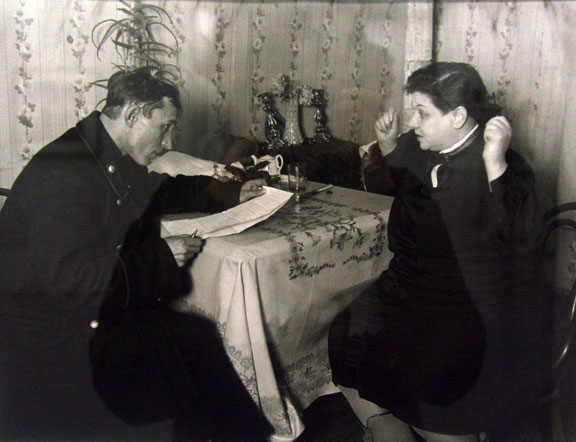 Arkady Shaiht, “Finin Inspector at Nepmanshi”, 1928, MDF collection
A good commentary on this exhibition, confirmation that the Soviet era was not consistent and holistic, will be the exhibition of Arkady Shaihet “Continuation. 1928-1931 ” (until May 27) in mamm. This is one of the most famous early -Soviet photographers, which we may not remember by name, but we know his picture “Ilyich's Lamp”. Some photographers ended with a shameful retouching, the shakht began from her - he worked as a work in the photo workshop, until one experienced journalist advised him to engage in a report. He did just that - and got to the advanced journalism, received prizes, a compliment from Bernard show, was the star of the “light” and “Soviet photo”. He was trusted with the most important reports, but he also did not escape his punishment - four months in Lubyanka. He took off Clara Zetkin so that the lower skirt was visible, he realized that it was seditious and tore, threw it away. But there was a responsible person who glued the scraps and said where it was necessary that Shaikht was taking off the leaders of the world proletariat in an inappropriate form. This is once again to the question of fashion and visual formalities - people should not know that “princesses are also pooping”, that the leader also has a lower skirt, and behind her also legs, probably.
Shayhet was invited to the “Soviet photo” because they considered that it was he who is able to fulfill the task - “we want to see a worker and a peasant as they are, without a susal embellish”. He tried to shoot without embellishment as he could, and that is why it is interesting to watch his photo now. Everything that he could, he tried to shoot honestly, but the names of the photo were ideological, memorable, like the paintings of the Wanderers - the contrast of the name and recorded reality creates a special effect, it is here that it becomes clear which game the Soviet press workers lead. At the exhibition there is no, so to speak, hits, like "peasants are resting in the royal palace. Livadia. 1929 ”, where absolutely criminal faces lay in white costumes on park sun loungers.
But there are “dispossessed at your former store. Ukraine. 1929 ”: Old women and children, (there are no men - they shot) with a Mazanka, covered with straw, such a hut is apparently a sign of prosperity. “Nepman at the Finin Inspector” and “Finin Inspector at Nepmanshi”, 1928, which seem to be staged caricatures, although they seemed to be filmed with documentary and the Nepmans even tried to fill the muzzle of Shayhet. “Red Dexhane goes to the construction of the Karakum Canal. 1930 ” - a gloomy crowd with pulls goes under the slogan written by Latin in the local language. The impossibility for us to read and understand this text is probably bewilderment about the essence of this slogan for people who carry it. “The first cars assembled at the Hook of October plant are sent to Moscow to open the 16th Congress of the CPSU (b)” - they are sent through the deaf villages.
And the most inexpressive - queues for trials, impenetrable persons of judges, documents in which nothing special is visible. Anything, Shayhet managed to remove beautifully. It must have been so scary that Shaikht preferred to move away from his devotion to realism, and removed everything impassively generally. And the submissiveness of the photographer of the reporting genre as a result is a photo of Maxim Gorky’s performance in front of the rabcores, then the individual shootings of the rabcores, in which they tried to portray the highest degree of admiration, then the combination in the photo and the picture of Isaac Brodsky, completed by the order of the magazine “Light”.
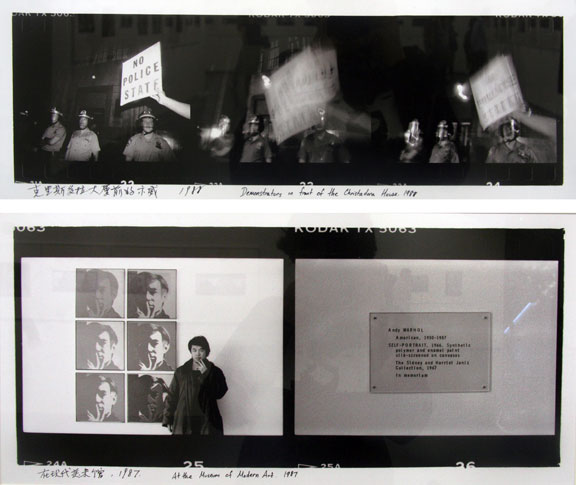 Ai Wevei from the series "New York. 1983-1993 "
And the three neighboring floors in the museum are the exhibition “New York. 1983-1993 ”of the Chinese artist Ai Wevei (until May 27), a man opposing the totalitarian regime, a very contradictory figure. In 2003, he was a special expert on the design of the National Olympic Stadium of the 2008 Olympic Games, in collaboration with Herzog & de Meuron. And in 2008 he undertook his investigation of the Sichuan earthquake, as a result of which many children died, published the names of dead children who did not fall into official statistics and information about corruption in the construction business. The Chinese government put him in jail, subjected all sorts of oppression for trying to tell the truth, Weivei regretted cooperation in creating the stadium.
The correctness of his struggle for the punishment of the guilty of earthquakes is undeniable, but his role in art is ambiguous. He defeated one ancient Chinese vase and painted the Coca -Cola logo another - as a sign of indicating that China has now become a servant of capitalism and all its craft art is used not for the benefit of man. Did he achieve his goals, did this idea bring this idea to the Chinese masses? It is unlikely. He simply destroyed two things that testified to the former greatness of this people. Зато стал модным автором на Западе.
Выставка его снимков на три этажа рассчитана на успех – ведь это громкое имя. Но все эти фото, увы, мог снять бы любой молодой человек прогрессивных интересов, попавший в Нью-Йорк, и болтающийся по модным местам вроде уличных протестов или музеев современного искусства. То, что мог бы снять сам Ай Вэйвэй и никто другой – его снимки с работами классиков современного искусства, близкими ему, и другие отсылки к ним. Он на фоне автопортретов Уорхола, копирующий его жест. Работа Вэйвэя – проволочные плечики для одежды, выгнутые как профиль Дюшана, они же, лежащие на полу, наполненные шелухой от подсолнечных семечек. Изящно сказать, что весь этот радикализм в искусстве так же прост, как семечки щелкать или как два пальца.
Однако Дюшан почти всю свою жизнь прожил как отшельник, а Вэйвэй делает карьеру. Дюшана в тюрьму никто не сажал, Вэйвэя преследовали власти – но не за искусство, а за документальное расследование, не являющееся произведением. Теперь незначительные фотодокументации жизни Вэйвэя являются произведением искусства – или не являются? Где проходит граница между политикой и искусством, и как ее пересечь – тема 7-ой Берлинской Биеннале, которой будет посвящен один из следующих обзоров. Могу сказать только, что Ай Вэйвэй в ней не участвует, так как не входит в круг друзей куратора биеннале – польского художника Артура Жмиевского.
Зазоры между широтой известности имени и реальным влиянием художника могут быть понятны только с течением времени. Много примеров бывает – от того, как Рембрандт был задвинут на задний план Герардом Доу, который писал аккуратней и точнее, чем Харменс ван Рейн, до молодого российского юноши Ильи Трушевского, авансом объявленного искусствоведами гением нашего искусства, но так как юноша не был заинтересован именно в искусстве, как гений он так и не состоялся. Критики то и дело обманываются на протяжении нескольких столетий.
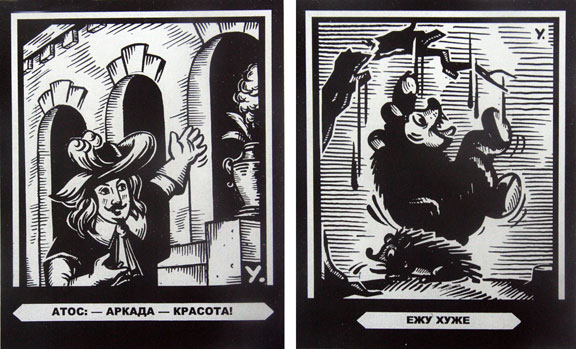 Изопаланидромы Михаила Ушаца: фразы, читающиеся одинаково с конца и с начала, сопровожденные картинками
Бывает, что кроме имени ничего и не нужно. Выставка «Ушац» в галерее «Вхутемас» (до 5 мая) посвящена раскрытию тайны личности, стоящей за словом, которое стало символом Московского Архитектурного Института. Учился в нем в свое время Михаил Лазаревич Ущац, вполне реальный человек, сделавший роспись парадных сеней Исторического музея, с родословным древом государей российских, которая мне намертво впечаталась в память как восхитительная, после того как стала контекстом для Марины Абрамович, «бабушки перформанса» сербского происхождения, которая в видеопроекции на 1-ой московской биеннале сидела на коне с белым трепещущим флагом в руках.
Тогда Россия не посчитала возможным вступиться за православных братьев, и Абрамович держала белую тряпку как знак того, что вся эта наша пресловутая история ничего не стоит, все сдались. Впрочем, сам автор родословной росписи не мог и подумать, что она станет контекстом. Как не мог и подумать, что сам станет символом. Был успешным театральным художником, автором журналов «Фитиль» и «Крокодил», изобретателем изопалиндромов, представленных на выставке. А стал одним из первых «мемов», понятия, изобретенного много позже, чем само явление.
Каким образом его фамилия стала символом выпускников МАРХИ – достоверно неизвестно. Я знаю две версии. Первая - на первом курсе он подписал свой планшет своей фамилией, и она показалась всем настолько привлекательной, что скоро все планшеты и кульманы были подписаны «Ушац» фамилией, которая уже стала «понятием». Вторая – абсолютно нереальна – работы молодых московских архитекторов посмотрел Владимир Ильич Ленин и вынес итог, со свойственным ему произношением: «Какой ушац!».
Как бы там ни было, помимо изопалиндомов и проектов Михаила Лазаревича, есть фотосвидетельства того, как он стал брендом – нацарапанное, кажется, еще в древности его имя на столе мюнхенской пивной, кадры из фильмов «Мимино» и «Афоня», где на фоне, на стенах маячит «Ушац». На Соловках, на Заяцком острове, на абсолютно плоской местности люди, жившие там несколько миллионов лет назад, выложили камнями лабиринты и узоры, которые могут увидеть только с неба. К этим каменным орнаментам в ХХ веке присоединилась надпись «Ушац», обращение МАРХИ к небу.
Пусть работы Михаила Лазаревича и не стали поворотными моментами в истории российской архитектуры, но имя его стало символом разумных решений, а сам он – героем мудрых анекдотов: «Один архитектор спрашивает другого: – Как думаешь, чем мне фасад облицевать? Коллега: – А давай паркетом! Тут приходит Ушац и говорит: - Этого делать не следует, так как впоследствии его будет трудно натирать».
Выставку Ушаца стоит посетить ради того, чтобы представить, что общественному разуму нужна персона, которая его будет представлять. Многие другие выставки представляют персонификацию общественного безумия, воплощенную в одном авторе или идее, эта – только о том, что мы сами и есть авторы наших лидеров.