
Translated material
The geodinomo moon is still hidden
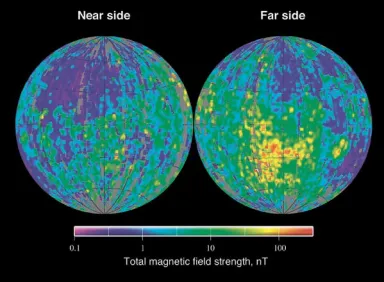
The newspaper TRV-NAUKA already wrote about the magnetic field of the Moon (No. 64), but the results obtained by a group of authors from the European Center for Research and Law Science (CereG) and published in the last issue of Earth and Planetary Science Letters [1], and are worthy of a separate mention. The fact is that the breeds of the moon are characterized by weak magnetization, which determines its own magnetic field of the moon, which is many times smaller in comparison with the ground. The reason for the occurrence of this magnetization remains a mystery. Two main hypotheses compete: (1) on the moon in the past acted their internally geodino, which requires a liquid iron core; (2) The magnetic field was external, associated with the solar wind or reinforced due to the plasma formed in the collision of meteorites with the surface. In the article [2], about which the TRV-hunger wrote, the second hypothesis was proved, but the first could also not be excluded. In a new study [1], the hypothesis of the external field is not rejected, but it is shown that the magnetism of the moon was also associated with the internal geodinago. Moreover, it was possible to determine that the magnetic field had the appearance of a dipole with a magnetic pole in the area of the modern pole of rotation of the moon. Given that the studied samples have the age of 3.3 to 4.4 billion years, and the conclusion about the dipole field dates back to this time.
Despite the certainly high quality of the study, you should add to this note and a spoonful of healthy skepticism. The fact is that the number of lunar samples studied is very small. So, in this study there are only 17 of them, of which only 5 were not previously studied from the point of view of their magnetism. At the same time, the conclusion about the dipole is generally built on data by 5 samples, for which the results are most reliable due to the natural feature - the presence of minerals that maintain magnetization. This difficulty is also added to this: the samples delivered by the Apollo missions were not oriented during the selection, and their real position in space is unknown. The top and bottom are reconstructed from the assumption that the linearity existing in them was formed during the course of the lava, the fragments of which are these samples. In general, the curtain over one of the lunar secrets was ajar, but a complete picture is hardly visible.
Alexey Ivanov
1. Cournede C., GattacCeca J., RochetTe P. Magnetic Study of Large Apollo Samples: Possible Evidence for Ancient Centered Dipolaar Field on the Mon. Earth and Planetary Science letters, 2012, v. 331-332, p. 31-42.
2. Gattacceca J., Boustie M., Hood L., Cuq-Landais J.-P., Fuller M., Bezaeva NS, De Resseguir T., Berthe L. Can the Lunar Crust Be Magnetized BY SHOCK: Experimental Groundtruth. Earth and Planetary Science Letters, 2010, v. 299, p. 4253.