
Translated material
Course for Jupiter
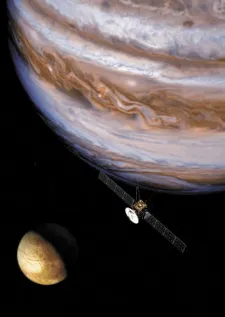
In early May, the European Space Agency (ESA) announced that the Mission of the Lun Jupiter (almost literal translation of the mission-Jupiter ICY MOONS Explorer) was selected as the LARGE mission (Large) for launching in 2022.
The Jupiterian project was chosen from three finalist projects proposed for implementation as part of the Cosmic Vision program. Two others are the X -ray observatory athena and the cosmic detector of gravitational waves NGO.
All three missions initially planned to be implemented in conjunction with the United States. However, last year NASA said that due to financial difficulties, it could not more support its participation; Thus, the developers of the missions had to urgently revise their scenarios in order to meet the more modest ESA budget.
The most recent version of the mission involves the study of three of the four Galileo satellites covered with ice and presumably containing water: Callisto, Europe (two flights) and Ganymede (work in the orbit of artificial satellite Ganyveda). The apparatus will also study the near -Soopiterian space.
Not everyone is satisfied with the choice of ESA: astrophysicists believe that the abandonment of the X -ray observatory athena will significantly brake the development of this branch of astronomy and, as a result, astrophysical studies as a whole. As the complexity of space missions increases, the problem of choice, apparently, will arise more and more often.
O.Z. ,
Based on materials from ESA