
Translated material
Why are the males the "female" plumage
As the readers of “thousands and one night” are well known, the easiest man is to get into someone else's harem, dressed up by a woman. Animals also use sexual mimicry. If the male looks like a female, he can avoid finding out relationships with other males and directed all the preserved forces to reproduction. Mimicry under the female is used by fish, reptiles and insects. It also has birds, but is usually limited by the early period of life. The plumage resembling female is worn by young males who have not yet reached puberty, and thus avoid aggression by senior comrades. But, having matured, the bird immediately changes the plumage to the appropriate floor. However, there are two species that have some of the males all adult life walks in a women's suit. This is Turukhtan (marsh bird from the Bekasov family) Phuomachus pugnax and swamp lun circus aeruginosus. Moreover, males are not worn from youth, but acquire in the second year of life, having reached puberty, so we are not talking about delayed development.
The adaptive advantages that the mimicry gives to the female, and the behavior of the masked males have been little studied. The French researcher Audrey Sternalski, now working at the Institute of Hunting Resources in Toledo (Instituto de Investigacion Cinegeticos) and her colleagues Francois Mougeot, became interested in this problem. Brittanyol (Vincent Bretagnolle), who at one time as the scientific director of Sternalski. Scientists investigated the mimicry of the swamp Luna.
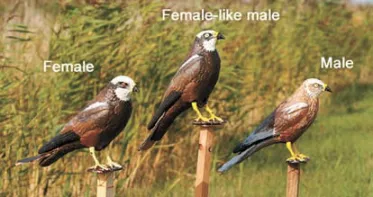
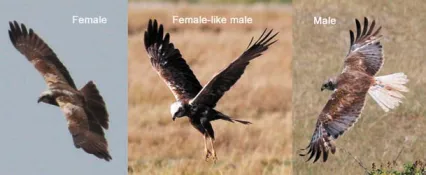
The colors of males and females of this species differ markedly. The main tone of the male feathers is gray, and the female is brown with white marks on the head and shoulders. In the population, which was investigated by Sternalsky with colleagues, about 40% of adult males had brown plumage with almost no gray spots. More thin and yellow legs and the color of the rainbow shell of the eyes distinguished them from females. In males, it is yellowish, in females-ocher-brown. In addition, males are about 30 % less and lighter than females.
In March-July, when marsh lines hatch the eggs and remove the chicks, the researchers installed high poles next to their nests with painted plastic figures of a male, female or male, disguised as a female. Each pair of birds was shown in turn all three figures. The owners of the nest perceived the appearance of a mannequin as an encroachment on their territory, and scientists observed their reaction. Thus, they tested 36 nests.
It turned out that typical males attack the figures of gray males, and attack brown 2.5 times less, with about the same frequency as the figures of females. Mashed males behave completely differently. They almost never rush to the figure of a typical male and only occasionally bother brown. The main object of their attack is the female mannequin.
Thus, males, painted as females, really almost do not suffer from female aggression. Brown plumage turned out to be useful adaptation, which allows its owner to avoid the struggle for the territory, nest and girlfriend. It is interesting that such birds imitate the females not only in color, but also by behavior: they do not show aggression towards males, but negatively react to the appearance of a female near their nest.
But do not represent typical males with victims of deception. They also benefit from this situation. The lack of aggression from a disguised neighbor creates a zone of calm around the nest. The distance between the nests of the two typical puddles is more than 700 m, and between the nests of a typical and disguised males - about 400 m. At the same time, the gray moon can even add an additional mate with the girlfriend of his non -conflict neighbor. In addition, “fake” females actively protect the territory from predators; This means that a typical male in this regard will be easier.
The easiest way would be to connect the difference in behavior of males with their coloring, which depends on the concentration of the pigments of Eumlanin and Feomlanin. But it would be a mistake to say that aggression is not characteristic of brown males, it is simply aimed at another object - not at the individuals of their gender, but on females. To understand this issue, researchers plan to study in detail the genetics of the color of the lunge and compare reproductive tactics that use gray and brown males.
Natalia Reznik
Audrey Sternalski, Frangois Mougeot, Vincent Bretagnolle "Adaptive Significance of Permanent Female Mimicry in a Bird of Prey". Biol. Lett. April 23, 2012, 8 (2) 167-170; DOI: 10.1098/ RSBL 2011.0914