
Translated material
Remember everyone
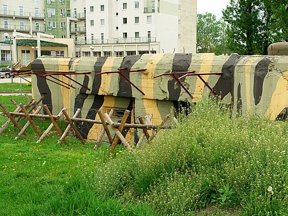
There is such a city in Poland near the Ukrainian border: Przemyshl. By Polish standards - a province. But even for Poland, in which there is Krakow, Gdansk and Star Maso in Warsaw, it is a surprisingly beautiful city. Very quiet, calm, friendly, cozy - a reserve of Austrian imperial architecture. For those who understand - such a small vein. Or Lviv, if you wash, restore and offend. Przemyshl is not just small, but very small. If you climb the Tatar Kopier hill, then the whole city is placed in sight at once. You can not turn your head.
This city has a glorious history. For example, through him, not without incident, the brave soldier Schweik rode to the front. As evidenced by the monument to him in the square and lane of his name. Here explain: can the city be bad if there is a monument to Schweik? But Schweik rode to war, and just the First World War made Przemyshl at one time known to every resident of the Russian Empire. Under the historical name Przemysl. The Russian Army Peremyshlya fortress stormed for several months and eventually took it. Almost one and a half million Russian soldiers remained on the fields of Western Galicia. But not for long, Przemysl was Russian, soon the city was lost, and according to the results of the wars-the First World War, the civilian-with us, and the Soviet-Polish Przemysl again became Przemyshl and became part of Poland.
In 1939, as a result of famous events, Parts of the Red Army were included in Pshemishl. Actually, at that time, for the Soviet Union, the city did not have a fundamental importance, but it was more convenient to draw a new border with Germany along the natural line - along the river San, which flowed just in the city. So the eastern part of Przemyshl became Przemysl and became part of the Ukrainian SSR, and the western became known as the premesel and became part of the Governor-General, but if it is easier, then the third Reich.
In 1940, intensive construction of the so -called “Molotov Line” began along the border. In application to Przemysl and surroundings - 8 fortified areas. The fortified area was supposed to consist of separate defense units, each of which consisted of strongholds. The supporting point was the most complicated complex of reinforced concrete structures called the general word of the bunker, which made any attempt to break through “in the forehead” crossing the brim and machine gun fire, and all this splendor was to be accompanied by other defensive structures with pricing wire, ditches, ranges, squadron, and minefields. If this whole complex would be ready, then ... But this “would” would not happen. The objective capabilities of the Soviet economy, the shortage of qualified personnel, the eternal domestic construction and organizational mess, excessively short specified terms - all this led to the fact that by the beginning of the war a significant part of the fortified is not yet begin to be built. But something was built: according to the flanks of the fortified area and in Przemysl itself-a gun-machine gun caponier and a machine-gun half-keboral stood up right on the banks of the dignity. They covered the approaches to the strategic railway bridge through a dignity.
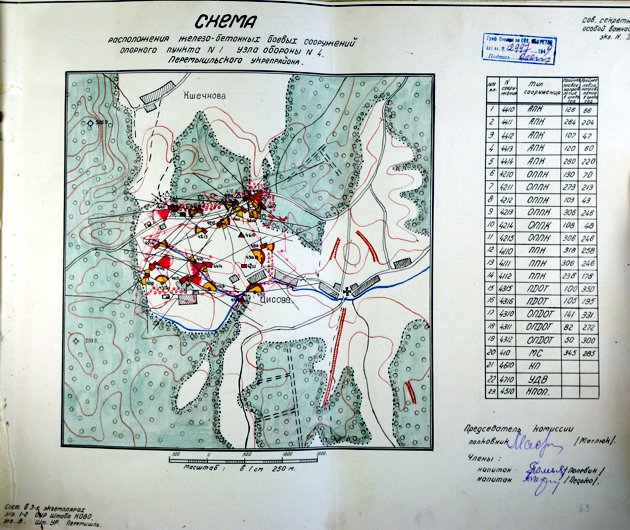 Project 1 of the supporting point 4 of the defense units 8 of the fortified area. Real fortress.
If it was built
By the beginning of the war in Przemysl there were practically no regular troops. The border was covered by the 92nd border guard, there were outposts in the city itself, the border guard headquarters was in Przemysl itself. The bridge and other objects guarded the garrison of 66 regiments of 10 divisions of the NKVD for the protection of railway and especially important industrial facilities. Even in the city there were the headquarters of the 99 rifle division, the commandant’s office and the garrisons of the bunks on the banks of the sanitary. Here, in general, that's all. True, the border guards were already in full combat readiness-a few days before the start of the war, they received the appropriate directive, and Dotov’s garrisons took their combat places, according to the directive from the district headquarters.
On the German side, units of two German divisions were concentrated.
On June 22, at three o’clock the last commodity from the USSR passed. In 3-30, shelling began in the city. Assault detachments of the Germans rushed to the bridge. On the other side, five border guards were waiting for them, led by Junior Lieutenant Nechaev, as well as the guide fighters-fire workers. As soon as the Germans crossed the white strip of the state border, fire was opened on them. After several attempts by a frontal assault, the Germans realized that they could not take the bridge. The first attempts by the Germans to force the rank also failed: they were covered with fire from the bunkers. In general, the war began.
The connection of the border detachment with a part of the outposts was lost immediately, the connection with Kyiv was unstable.
The situation was difficult because our soldiers fought in foreign territory. The Poles had reason not to love the "occupiers", the Ukrainian population was under the strongest influence of the OUN. There was no need to wait for help from the locals.
By the evening of June 22, the Germans managed to occupy almost the entire Przemysl. Junior Lieutenant Nechaev after his unit died, and the Germans were able to break through to his position, blew himself up and enemies with a grenade. Dota on the dignity continued to fight.
The resistance of the city garrison allowed the command to take out the values of the State Bank from the city, documents, and partially - the family of officers. The next day, the consolidated battalion of border guards and Red Army soldiers 99 divisions under the command of the senior lieutenant of the border of the NKVD of the USSR Grigory Polivods inflicted a counterattack. After a cruel battle, the Germans were knocked out of the Soviet part of the city and thrown back in a dignity. The fighting was already transferred to the territory of the Governor General. That is, on the territory of the Reich. Thus, Przemysl became the first Soviet city, repulsed from the Germans, and the city of Premesel on the western coast of San - the first enemy city captured by our troops.
On June 26, the military commandant and the head of the garrison of Perezhyshl, the Little Roatfront, Grigory Polivod, made the funeral of the fallen Soviet fighters on Mitskuevich Square (the market of the old city). In general, up to 40 Soviet soldiers and about three hundred - German were killed in the battles for Przemysl. The city was defended until June 27. Then I had to move away. The Germans have already broken through our defense north and south and were eager for Lviv. There was a threat of environment. In Kaponir, the garrison of Lieutenant Chaplin remained on the dignity. They fought until June 30. Then everyone died. It must be said, on the eve of the war, in June of the 41st in the units of the Red Army-in the 99th shooting division, and a large number of young officers-graduates of schools arrived in the 8th fortified area. Most of them did not live until the fall of 41. Those who managed to escape, was waiting for the Uman boiler ...
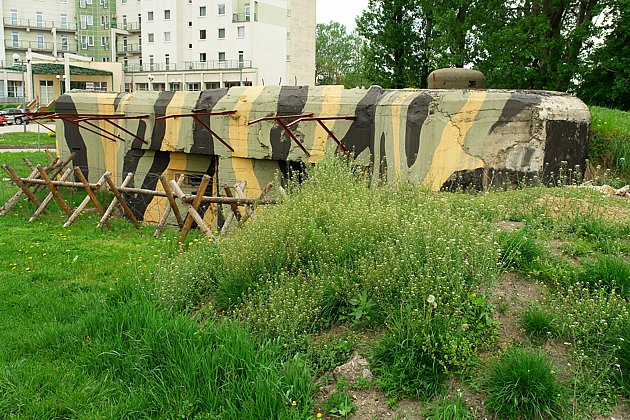 Kaponir Lieutenant Chaplin, fought until June 27, 1941
But there were also happy exceptions. Lieutenant Krivonogov, a few days before the war, who took under his command the garrison of the Dota in the Sanok region, and the dota unfriendly and unprotected, fought until July 3. July 4, he was captured. Then he will make a famous escape from German captivity on Hambel, as part of a group of Devyataev.
After the war, Przemysl was transferred to Poland. Nechaev and the soldiers who died during the liberation of the city were erected monuments. But about the graves of those who died in the 41st Polish authorities of Pzhemyshl miraculously forgot immediately after the return of the city of Poland. In 1965, no one knew about them.
In the early 90s, both monuments were destroyed by our soldiers. Well, everyone remembers what it was. But so far, on the banks of the dignity, there are caponier and semi -kaponir - real monuments to the courage and heroism of Soviet soldiers.
And here we are the time to think. Who are these people 41 years old for us? The "serf" soldiers, whom the "Bloody Stalinist regime" drove into the battle? Or heroes? Defenders of our country or invaders? Who were our fathers and grandfathers? It is necessary to ask not from the state, but from ourselves. You can be indignant a hundred times that annually our presidents promise each veteran for housing (and do not fulfill). You can be indignant a hundred times that the state recalls the heroes of war with shameful grocery sets. But ... let everyone answer: is it a memory is the prerogative of the state? Do your children know about the fighting path of their grandfathers-great-grandfathers? No? And then what do you want from the state? Here is every day, who does what and what does the memory of that war does not go away, does not disappear? Crazes the ribbon and passes veterans to the red light of the traffic light? This is not an accusation, these are just questions.
That's what I am all about. As you already understood, I just started from some time to engage in the history of the defense of Przemysl and 8 fortified areas. And I was just hooked that in the glorious city of Pshemysl there is not a single monument to ours. Poles are free will, how to relate to them. But we are not. Therefore, it somehow happened that several different and very good people began to promote the idea of installing on the caponier in the Przemyshlet of a memorial plaque in memory of our dead soldiers. But for this, the permission of the local authorities is necessary, and there is no way to do without the state. And the state responded. Both the Foreign Ministry and the Ministry of Defense.
In general, this issue is resolved and will be resolved. And I just suggest those who are important - it’s just important and necessary for myself - to take part in the perpetuating of our memory. A memorial plaque (more precisely two in Russian and Polish) costs money. In any situation, money will be. Just again: if someone personally wants to do something and somehow take part in the elimination of injustice in relation to people who just got up at their embrasures, lay down for their machine guns and began to just fight. Why do I need this? I am not a politician, not an intellectual, I didn’t make a liberal, I don’t need Peaar. But ... I just want a memorial plaque to be in Pzhemyshl. And I just want to know how these people died. That's all. However, help may not be limited to money. In the caponier, on which it is supposed to install the board, the young Poles opened a small museum of the history of Przemysl in the Second World War and restore the domestic equipment of the bunker. Here, too, help is needed. This is much more difficult than collecting money.
Vadim Gasanov, simple Russian layman
Dop. Office 9038/1683 of the Moscow Bank of OJSC Sberbank of Russia
Correspondent account No. 301018104000000225 in the opera of the MSTU Bank of Russia Bank-Recipient Bank of Sberbank Russia BIK 044525225 TIN 7707083893 KPP 775003035
Gasanov Vadim Kasimovich account No. 40817810538298732803
or card number 4276 3800 9267 0194 or card number 5469 3800 1677 3110