
Translated material
Moscow - Province: The signal was lost
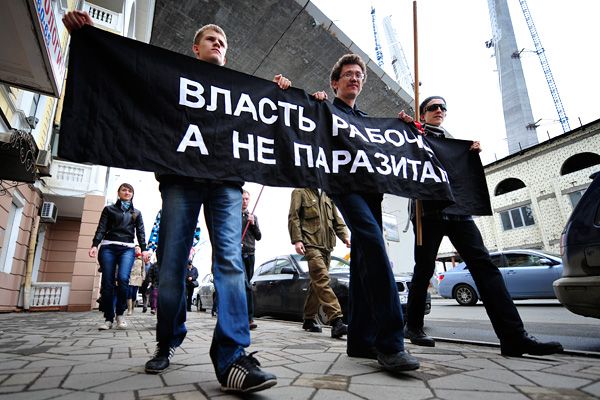 Photo: Promotion in support of the Moscow “Million Marsh” in Vladivostok. ITAR-TASS
 The province, which rally with Moscow for honest elections, this time on the "march of millions" responded sluggishly. Small groups entered the May holidays in the Square of Russian cities - from five to two hundred people. PublicPost found out who supported Moscow, and also asked the experts why the province no longer resonates with Moscow shares.
In St. Petersburg, about a hundred people went to the square of the Isaacievsky Cathedral. The police detained people with posters almost immediately. So in Avtosak was one of the leaders of the St. Petersburg "other Russia" Sergey Chekunov - he deployed a poster with a quote of Balmont and was immediately captured by the fighters of riot police. In total, 8 people were detained.
The Million March in Vladivostok gathered about 50 participants. The procession was attended by deputy of the City Duma Oleg Velgodsky and regional deputy Artem Samsonov. Six people were delivered to the police, they are accused of disobedience to the police and singing about obscene songs.
In Khabarovsk, instead of the declared 700, only five people came to the scene. Four of them, representatives of the Interregional Public Organization "Far Eastern Alternative", were detained. The Investigative Committee on the region opened a criminal case on the fact of calls for riots.
In Irkutsk, about 70 people came to the protest procession. “The fewer protesters in Irkutsk did not even come to the nauseous-predicted“ Russian March, ” said Babr.ru. The procession was attacked by provocateurs with American flags, chanting:“ McFol, reptile, where are my grants? ”
In Kemerovo , about 70 people came to the "march of millions". The police tried to detain the participants in the procession, but did this without much zeal. They did not detain the provocateurs who met along the road.
In Tomsk, the mayor's office agreed to hold stocks with the number of participants up to 1.2 thousand people. 150 people took part in the demonstration, about 100 Tomsk citizens in the rally.
Barnaul gathered about 200 people on a march, most students and graduates of local universities.
In Novosibirsk , instead of the declared 1700 people, only 70 people came to the action. The march participants protested against the "colonization of Siberia", the placement of NATO military base in Ulyanovsk, high prices for gasoline and housing and communal services.
In Samara, about 100 people gathered for a picket at the White House. People held posters: "Samara for honest elections."
Saratov gathered 100 people to the "march". The crown cut out of the cardboard with the inscription "I am also the king" were distributed to the square in front of the covered market. The rally was performed by the leader of the local "solidarity" Alexei Bityutsky, who was going to go to the "march" to the capital, but detained by the police on the night of May 5 to 6.
In Bryansk, a little more than 50 people went to the procession. On theatrical square, by their arrival, the police built a corral from the framework, but the protesters refused to enter it. Not without provocateurs - one of them protesters handed over to the police.
The opposition in Ulyanovsk supported only five people. The organizer of the action of Igor Toporkov was later summoned for conversation in the Center for Combating Extremism of the Ministry of Internal Affairs of Russia in the Ulyanovsk Region.
In the south of Russia, in Krasnodar , about a hundred people took part in the procession. The event was not agreed by the authorities, so it took place without posters, flags and slogans. Protesters walked along Krasnaya Street to Chistyakovskaya grove. The police accompanied the column, but did not interfere with its movement.
PublicPost talked with experts, learning why a protest impulse is quiet in the regions.
 Natalya Zubarevich, Director of Regional Programs of the Independent Institute of Social Policy
This is a fading reaction. Firstly, rallies cannot continue endlessly. Secondly, in the province of a layer of people, which we understand as a protest, quite narrow-due to the number of people and their much lower income. Since these groups are quantitatively much less, the fading reaction in them manifests itself faster.
- Is there a chance that the radicalization of protest in Moscow will somehow “shake” the regions?
Don't think. Any radicalization will narrow the number of people in Moscow, because most of those who went to stocks are people not at all configured for a power confrontation. They tried to show in peaceful ways that they did not agree. People are very rational, to beat their heads about a car zak or about the "astronaut" most of them will not be. Now they find alternative forms of peaceful protest, Moscow in this sense is very creative. But here the psychological moment is important: when the first time people went to Bolotnaya, they realized that there were a lot of them. This sensation does not arise in the province. The largest protest city was Novosibirsk (3-5 thousand people), everything else is hundreds. Therefore, the feeling of "many" there can not be physically there.
This is our trouble, because all the money, all the activity, all human capital flows into Moscow for decades. Even the millionaire cities are very much "dehydrated". People who feel that they are competitive, that they can realize themselves, move to Moscow. Super -centralization leads to the fact that the protest signal is spreading very slowly in Russia, this is the costs of supercontacked everything and everything in Moscow. And we will live with this, because in fact, increasing protest is possible in a completely different strategic - not in millionaires. If an economic crisis occurs, the protest will spread to industrial cities. I see this option possible, but not now, but when serious economic contradictions will accumulate. And we are moving there rapidly: all the last decisions made by the government are perpendicular to the economy. And then there will be what is called the cumulative effect. But this will already be another Russia, a completely different protest - "Give me money and work."
Why did Vladivostok "went"? The right -wingers were canceled. Why did Kaliningrad "went"? Because they introduced a stupid increased tax on cars and chopped down a couple of years before that the possibility of car second-hand, deprived people of work. Economic subtext was quite serious! And in other cities there is none of this.
 Boris Dubin, Head of the Department of Social and Political Studies of the Levada Center
The separation of the capital from the regions is associated, on the one hand, with the special role of Moscow and the concentration of all authorities in it, and on the other hand, with the group or fraction of people who enter rallies. These are people who concentrate several very important socio-demographic features, with a relatively good level of income, with higher education, and often even with two, these are people who cannot attribute themselves to the unsuccessful ... and, most importantly, these are people with high potential for integration, solidarity, associations that have managed to embody their potential. And with this in today's Russia, extraordinary deficiency. Those who go out in the square in Moscow can conditionally be called people of the 21st century. While the rest of Russia lives at times more distant. Someone, in large cities, in the twentieth, and someone in the nineteenth or even the eighteenth century.
The content of protest is changing now. This is no longer a protest against dishonest elections and not even against Putin, although there are residual slogans. But it seems that in Moscow a protest is already without slogans, it is rather a demonstration of its own significance, independence and rights to a normal normal urban existence. It is no coincidence that the slogan "This is our city" went - it is nominated by the industrialbanized part of the population of Moscow. I think that over time, these people will be supported in a wider context, but only when it becomes clear what they demand. For them, it will become clear as well. If the authorities behave stupidly and tough in relation to these people, then the radicalization of protest is possible. Then the province is responding.

After hard to overclock the march of millions on May 6, civil protests continue on the streets of Moscow. At the monument to Abai Kunanbaev on pure ponds, an opposition camp existed for almost a whole week, which was also dispersed by OMON employees. Protesters do not leave the streets of the city.