Translated material
Extreme measure
Is it worth starving if they don't notice it?
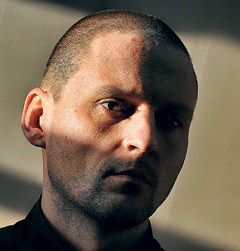
Cergea Udaltsov starved in protest against illegal arrest and court, and eventually listened to his friends' requests not to expose his life to mortal danger. “On Tuesday, May 15, at about 16 o’clock, when I was lying under a dropper, police officers entered the hospital ward and reported that they were taking me to a special receiver. Following the doctors appeared, they held an extract from the hospital in their hands, ”says Sergey Udaltsov, sitting on the prison skeleton of special -reception No. 1 on the Simferopol Boulevard. The opposition was hospitalized on the 6th day after the first hunger strike. He announced her immediately after his detention on the Patriarchal ponds on the night of May 8 to 9. After returning from hospital No. 68, where he spent less than a day-from the evening of May 14 to the middle of the day on the 15th,-protesting against the non-ordering of medical care, Udaltsov again declared a dry hunger strike.
Without help
He felt bad in the afternoon of May 12. The cellmates called the prison paramedic, he called an ambulance. According to lawyer Nikolai Polozov, Udaltsov asked him to be taken to the 64th city hospital, where he was taken out of the past, December hunger strike and where doctors already know him well. But the ambulance sent the opposition to the 52nd. “They were handcuffed,” says Udaltsov. -The ambulance was accompanied by buses of the 2nd operational regiment of riot police. I saw how people in civilian clothes talked with doctors. The attendant therapist, having learned that I was from a special receiver, called me a drug addict and a simulator and stated that there was no reason for my hospitalization. ” The same was repeated in the 55th city hospital. There, having examined it, the therapist’s duty officer said that “sugar is still normal,” and gave recommendations to follow a diet, told The New Times Udaltsov.
On Sunday evening, May 13, the starving again asked to call him an ambulance. He was taken to the 13th hospital. “The on -duty therapist, it seems, Ermolova, seeing me, said that I needed the help of another doctor,” Udaltsov says. “You consciously starve and do not need help.” As if mocking, she advised regular nutrition.
Perhaps Udaltsov is perplexed, such a reaction of doctors is associated with a negative attitude to his political activity? According to him, in the 68th city hospital, where he decided to hospitalize him in the end, the doctors first said that they would leave him in the hospital for several days, but then they quickly made tests, ECG, ultrasound, X-ray, “swept glucose” and discharged without holding the day. They issued a sick leave with an entry: "Start work on May 16, 2012." It looks like a mockery: the doctors knew very well that Udaltsova would be taken to a special receiver. “Probably, the task was set for doctors: preventing him from being treated normally and write out as soon as possible into the special receiver, as soon as it becomes a little better,” the opposition grinned.
The oath of Hippocrates
What determines such an attitude to Udaltsov and do doctors violate their professional duty, refusing him to hospitalize? “A dry hunger strike is very dangerous,” says Dr. Lisa Glinka, head of the Fair Help organization. - Hungry can die in 72 hours: dehydration occurs. Udaltsov has concomitant diseases, in which he is categorically impossible to starve. It is very bad if the doctors refuse to hospitalize it, listening to the advice of the security forces. Doctors should be absolutely apolitical. But I fully admit that he was not hospitalized if the tests showed that his blood sugar is still not low enough and the danger is not in danger. Another thing is if Udaltsov himself believes that he was not provided with high -quality medical care. Let him appeal the refusal in court. ”
One of the employees of the Moscow Department of Health on the terms of anonymity told The New Times that in the 68th City Board Udaltsov was put due to low blood sugar. As soon as he became better, they tried to write out quickly. The presence of Udaltsov in any hospital creates difficulties: in the lobby, in violation of the law, a police officer is constantly on duty, lawyers and human rights activists visit him in the ward. He allegedly behaves with doctors disrespectfully. The hospital is every now and then people in civilian clothes.
Lawyer Udaltsov Violett Volkov does not understand these arguments and is outraged by the attitude of doctors to her client. “On what basis is Sergey is prescribed from the hospital without ensuring a normal exit from the hunger strike? She asks. - They pump it with glucose, lifting blood indicators. And when they are so quickly removed from the hunger strike, then they leave it in a dangerous state. We will deal with this. ”
On Wednesday, May 16, Violetta Volkova handed Odaltsov a letter in which friends and sympathizers asked him to stop a hunger strike. “We do not need Udaltsov - a martyr! We need you alive! - The main pathos of the letter, which, according to Volkova, was signed by more than 600 people in pure ponds.
"
Vladimir Bukovsky: A hunger strike is a very radical form of protest. If you started it, you can't just leave it
"
Powerless protest
Sergei Udaltsov announces dry hunger strikes every time he - illegally, according to the opposition, awards the “day”. After 5-6 days, he becomes worse, he is taken to the hospital, taken out of the hunger strike and returned to a specialist, where he again continues to starve. But the hunger strike, in fact, does not achieve its goal - a higher court does not cancel the decision on the arrest, and Udaltsov lies his term to the end, undermining his health. Does it make sense in such hunger strikes?
“A hunger strike is a very radical form of protest,” says the famous dissident Vladimir Bukovsky, repeatedly starving in Soviet prisons and camps. “If you started it, you can’t just quit it.” This depreciates this form of protest. But you do not need to declare dry hunger strikes. A person without water cannot live for more than a week. Thus, those who starve dry simply undermine their health, and without having achieved anything. ”
Vladimir Bukovsky explained The New Times: the authorities to respond to the requirements of starving, need much more time than a week. In Soviet times, he says, the hunger strikes of political prisoners were learned from the programs of “hostile votes”, and the next day, messages about this lay on the table of members of the Politburo. “Then the authorities reacted rather nervously to our protests, it interfered with their foreign policy, we undermined the political situation. The prison administration was also not enthusiastic, they understood that the commission would necessarily come, they would be reprimanded to someone, someone would be removed from his post, ”recalls Bukovsky. -The most famous example of a successful hunger strike: hunger strike of two Perm camps, 35th and 36th zones, in 1973. It lasted a month and was associated with a lack of medical care. Before our eyes, the prisoner died of an ulcer. The person was starving 600-700. The Commission of the Central Committee arrived, and then they sent a military surgeon and the medical unit finally began to work. ” Bukovsky says that on the 16th day or earlier prison doctors began forced feeding starving through the hose and this was a real torture.
Forced feeding was secretly canceled in the late 80s, the leader of the Democratic Union Valery Novodvorskaya, who in those years had repeatedly starved in the special cost-minded person, where she served 15 days for participation in unanning rallies, told The New Times. “We announced dry hunger strikes for the right to get the status of a political prisoner,” she recalls. - We demanded that we be kept only with “political”, allowed us books, newspapers and did not force us to work. After 7-8 days, a dry hunger strike occurs agony. Therefore, our requirements quickly fulfilled: it was easier to give books than to bury one of us. They took to the hospital only if a person was losing consciousness. ”
One of the most famous Soviet dissidents Anatoly Marchenko died in Chistopol Prison on December 8, 1986. He was the last of the political prisoners of the Soviet era, which died behind bars. Marchenko held his last and most long hunger strike 117 days, demanding the liberation of political prisoners in the USSR. He stopped the hunger strike on November 28, 1986. And he died in the hospital after 12 days. A few days later, Mikhail Gorbachev called Academician Andrei Sakharov in Gorky and said that he might return. Sakharov asked Gorbachev to free the political prisoners.
In his book “From Tarusa to Chuna”, talking about one of the hunger strikes of 1975, Anatoly Marchenko wrote: “If someone asked me for advice whether to announce a hunger strike for him, I would say:“ No. ” [...] And yet I can’t condemn myself for the fact that, succumbing to emotions, I declared and held a hunger strike for a long time [54 days]. Moreover, I do not say that in some situation I won’t go to her again. The feeling of powerless protest, when you are held by the throat, can push to any extremes. The same can be the same as sympathy for another person, other people brought to despair ... "