
Translated material
With debts - to exit
Greece will leave the Eurozone
Grexit, or "With debts - to exit!" An attempt to form a capable government has failed in Greece - early parliamentary elections are waiting for the country. The population reacted to a political impasse by the massive seizure of their deposits from banks: in two days, May 16-17, € 1.2 billion was removed from the accounts. In the current situation, the exit of Athens from the eurozone seems to be practically inevitable. What will turn out for Europe - analyzed The New Times
The situation in which Greece is now is best is best described by a new, but rapidly becoming fashionable term Grexit, which the British invented. It consists of a combination of words Greece and Exit, that is, “Greece” and “output”. The first of the prominent European politicians about the inevitability of Greece left the eurozone was openly spoke by the Minister of Finance of Germany Wolfgang Shoible, who is considered the most persistent adherent of the currency union. In an interview with Rheinische Post, he directly stated: “We will cope with Greece's departure, protective mechanisms have already been developed that will help to do this without catastrophic losses.” And therefore, they say, there will be no “domino effect”. 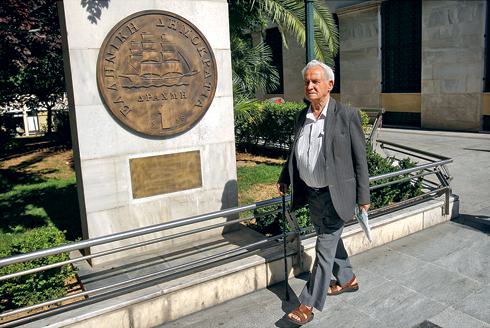
Lesser evil
Shoible was supported by the former head of the Ministry of Finance, an expert on world economic problems, Pen Steinbryuk, who said that "the Eurozone does not have to consist of 17 members." Around the same spirit, the head of the German Foreign Ministry Gvido Westerwell and the Luxembourg Minister of Finance Luke Frieden spoke: both believe that the departure of Greece is less evil than the continuation of her stay in the eurozone.
Member of the Board of Directors of the European Central Bank (ECB) Jean Asselborne threatened the Greeks that "the program of strict economy has no alternative if Greece wants to stay with the euro." However, the most Greeks do not want the reforms that are painfully hit on their wallets, as the elections showed.
The paradox, however, is that the real reforms, which are called from the EU, in fact, have never been, according to Hikas Harduvelis, the chief adviser to the transitional prime minister of Greece Lucas Papademos, who was just replaced by Panayotis Piracranos in this position. Those who led it to the collapse “save” the economy, ”said Harduvelis in a conversation with The New Times. The hint that, having become temporary prime minister, the technocrat of Papademos left the same politicians at the leading posts that made the Greek state with a “milking cow”.
Chaos as a norm
Translated from the Greek, the word "chaos" means "a gaping abyss filled with fog and darkness." It was in such an abyss that the Greece economy collapsed. Over the past five years, GDP has decreased by € 28 billion. The public debt increased by € 120 billion and amounts to 160% of GDP. This is the data of the Greek statistical department, which has repeatedly been convicted of the rough references. So no one knows real numbers - most likely, they are even worse than the released.
Over the past two years after the first package of assistance from the EU and the IMF, the privatization of state property, in fact, did not begin. As part of this program, by 2015, € 50 billion was supposed to enter the budget, while only € 1.6 billion was received.
The same hopeless situation with the sale of land. The word "cadastre" to the Greeks is unfamiliar, claims Harduvelis. Only 6% of land over the past ten years have been evaluated. What to sell? Mostly agricultural country is forced to import food. Import exceeds an export of € 16 billion (respectively € 67.7 billion and € 51.7 billion).
The Greece economy is completely regulated, which sharply reduces competition and kills economic incentives. The number of licenses for professions such as a pharmacist, lawyer, architect, forwarder or taxi driver is strictly limited. Many licenses were issued under the “black colonels” in the 60s, and then inherited or sold for a lot of money. To buy a taxi driver’s work license in Athens, you need to pay from € 100 thousand to € 150 thousand. It costs permission for long -distance freight transportation.
Last year, the government attempted to open the market. Apathelies rebelled. Interruptions with drugs began in the country. Cargoers and taxi drivers blocked the roads in the midst of the tourist season. The government backward, introducing various “special rules”, “transitional terms”, “temporary conditions”.
32 Law on the Deregulation of the Economics have been adopted. None of them acts.
In the corridors of the authorities in Athens there are jokes about how ministers advise each other to agree to all the conditions of the “three” (European Commission, ECB and IMF), but nothing to do.
The proclaimed reforms turned out to be a sharp fall in the standard of living for people. The salaries of state employees were reduced by 30%, pensions by 15% (though before the salaries and pensions in Greece were significantly higher than the average for the EU). VAT increased from 19% to 23%. The real estate tax has been introduced. Given the persistent reluctance of the Greeks to pay taxes, it automatically plused to the bills for electricity. Minimum salaries and unemployment benefits are cut. The latter is reduced by € 100, but it is still higher than, for example, in Portugal, not to mention Romania or Bulgaria.
Reducing jobs in the public sector (and there is practically no other in Greece now), the government was not able to create new ones. The unemployment rate is approaching 22% (from the entire working population). Among the youth, it is even higher - 53%. From March 2008 to March 2012, unemployment has almost doubled.
And the lumen is not visible. The recession ongoing fifth year (the level of production was reduced by 20%), the stabbed labor market and huge corruption (Fakelaki - money in the envelope - the main condition for business relations) scare investors, especially foreign ones. “In this sense, we are a country of increased risk,” admits Aris Singeros, who heads the investment office at the Ministry of Economics.
"
In the corridors of the authorities in Athens there are jokes about how ministers advise each other to agree to all the conditions of the “three” (European Commission, ECB and IMF), but at the same time nothing to do
"
Salvation in Drachm?
Greece today is absolutely uncompetitive, says Simon Tilford, a leading economist in the British Center for European Reforms. This is the reason for all her troubles. It seems that the only way for the country to get out of the pit is a return to Drahma. This is the opinion of Aris Singros. And not one. For this, Paul Germania would vote-a country that is the main donor of Athens, but whose inhabitants are tired that the problems of a neighboring state solve their taxes * * about 80% of the Greeks, according to the latest surveys, for preserving the country in the Euro zone. .
Drahma, a new old currency, the course of which, unlike the euro, the Greeks could dispose of their own discretion, will sharply reduce the export of local goods and services, reduce expensive imports, increase domestic demand for domestic products, an additional incentive for production will appear. The chief economist of the European branch of Citigroup, Jurgen Michels believes that in the case of default, it will be necessary to introduce the strictest control over the turnover of capital. Rich Greeks have already transferred abroad about € 250 billion. With a total currency, such an outflow cannot be prevented. It is another matter if Drahma returns. Then the euro transfers abroad can be frozen.
The operation to return the drachma should be carried out with jewelry accuracy. Mint - print the required number of new banknotes. Banks - closed for at least a week and taken under protection until the exchange of money is made. ATMs should issue no more than € 50 per day to cover the most pressing expenses.
There is a mandatory exchange of a solid course. Drachma will lose 50–70% of the value in relation to the euro. The country temporarily will not be able to fulfill its obligations within the EU. Salaries and pensions will immediately begin to be paid in the new currency. Firms and banks that have debts abroad in euros will not be able to serve them anymore and will have to declare bankruptcy. Many Greeks will lose their savings.
A recession will come more abruptly than the current one, which, as suggested in a conversation with The New Times, the president of the Munich Institute for Economic Research (IFO) Werner Zinn will last about two years. But then the inevitable rise will begin, German economists predict, referring to a similar development of events at the end of the last century in Argentina or South Korea.
"
If the Greeks declare themselves bankrupt, then Germany will irrevocably lose tens of billions of euros
"
Gricksets crept up
Of the total assistance of € 380 billion promised Greece, € 65.5 billion is in Germany. If the Greeks declare themselves bankrupt, then Germany will irrevocably lose tens of billions. The money is huge. “But Germany will survive. The weight of the Greek economy is too small in order to damage the German giant, ”Clemens Fouest concludes this conclusion.
The European Central Bank, which bought up Greek government bonds in the amount of € 35 billion, is unlikely to receive anything back. In the case of default, € 73 billion from the first package of assistance, and part of the payments from the second can be considered missing.
But as the chairman of the Bavarian Christian Social Union (CSS) and an ardent supporter of the exit of Greece from the currency union Khorst Zeehofer, “the introduction of drachma will not mean the end of the euro or the collapse of the EU. The preservation of Germany’s economic power is much more important than Greece in the eurozone. ”
Otherwise, the chairman of the coalition of the left -wing parties Syriza Alexis Tsipras thinks. He sharply opens against the measures of savings, considers the debts of Greece to be non -existent and does not intend to give them away. He wants to employ 100 thousand people in the public sector, return the cut pensions and salaries. He compares the situation of Greece after Brussels agreements with the situation of Germany after the Versailles Agreement. He constantly repeats in the public that there will be no bankruptcy, since European politicians are afraid of the Greek default in the same way that in the Middle Ages they were afraid of black plague.
According to recent surveys, the popularity of Tsipras increased to 28%, and he hopes to win the new parliamentary elections on June 17. If this happens, then the political correct Grexit will have to be translated into Russian as “Grixets”. With unpredictable consequences.