
Translated material
Provincial stripping
Provincial news. The Kremlin carries out mass cleaning of the heads of regions. The goal is to prevent the elections there in the next five years. Where, who and how they are cleaned - April 19 on April 19 on April 19, on April 19, on his microblog on Twitter, Smolensk Governor Sergei Antufiev wrote that rumors about his resignation were “ringing in my ears”. A few hours later, the news agency reported that the retirement was still submitted: the Smolensk chief left "of his own free will." Since the beginning of the year, two dozen regional leaders have “voluntarily” resigned. The Kremlin carries out the largest cleaning of the governor's corps from the moment of introduction of the appointment system. 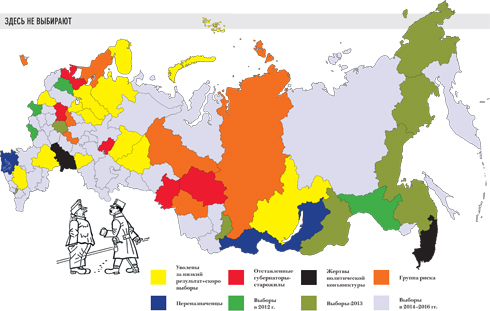
Causes and motives
Among the “cleared” there are different types, but the main motive of the radical personnel renewal is understandable - the supreme power is clearly in a hurry to get rid of the unpopular or crossed regional chiefs in order to delay the elections in the regions entrusted to them. A separate story with the “voluntary” departure of the Governor of Primorye Sergey Darkin: this gesture, implemented on the eve of the presidential election, was clearly aimed at adding to Putin the votes of local voters.
The Kremlin is clearly ahead of the focus. Having appointed new governors until June 1 - the deadline for the entry into force of the law on the elections of regional leaders, he actually transfers elections to the regions falling under the rotation until 2017. In 2012, the powers ended with 15 governors-it was they who were the maximum extent that they were “damaged”. The reassignment was received by those whose term of office expired before June 1 (i.e. they did not fall under the elections), who had a reputation as a leader holding political processes in the subordinate territory under control, and who demonstrated the convincing results of the “party of power” following the results of the Duma campaign. This is the head of Adygea Aslan Thakushinov, Kuban governor Alexander Tkachev, Tuvinsky leader Sholban Kara-ool, Buryat-Vyacheslav Nagovitsyn. Tkachev was even forgiven by Kushchevka, reasoning that the political and electoral manageability of the Krasnodar Territory on the eve of the Social Olympiad is more important.
Under the “voluntary” departure, the heads of territories fell, where the electoral results of the “party of power” in the elections on December 4 were failure. On this basis, the conclusion was concluded about the unpopularity of the governor (subtext - about the absence of “electoral handling” in the region) and, accordingly, about the presence of critical risks for candidates from the “party of power” in potential governor's elections. The Kremlin is clearly afraid that even cunning “filters” in this case will not help, and is insure of defeat.
Among the retired - both political heavyweights and the “new appointments” who came to the posts after the introduction of the system of “powers” the leaders of the constituent entities of the Federation, that is, the abolition of direct elections.
Dal - took
Among the “voluntarily” of the departed “heavyweights” is the Tomsk governor Victor Kors, Omsk - Leonid Polezhaev and Leningradsky - Valery Serdyukov. They also remembered the times of the “governor's freemen” and, as they say, did not show much enthusiasm for early care. But the fatigue of the subordinate population from them was obvious, and the Kremlin’s ability to find the necessary “arguments” to write a statement about care is clearly available today. Another group of regional leaders, whose powers ended this year, became the Kremlin appointed - Vladimir Artyakov (Samara region), Igor Slyunyev (Kostroma), Sergey Vakhrukov (Yaroslavskaya), already mentioned Sergey Antufiev (Smolenskaya). Evil languages say that some governors-“appointments” ahead of time wrote a statement about the “voluntary” resignation with an open date. It is not possible to verify this statement, but many of the retired candidates literally on the eve of the publication of information about the “voluntary” care fiercely refuted “dirty rumors”, which indirectly confirms suspicions. In addition, it is important to understand: psychologically, the “appointed” from the very beginning felt like “vertical screws”, such status clerks authorized by the Kremlin for regional administration. So - the Kremlin gave, the Kremlin took.
Finally, another group of retirees - the leaders of the regions where the United Russia failed loudly and where the “bad news” constantly came from the Kremlin about the low quality of management and conflicts with regional elites. True, the Vologda governor Vyacheslav Pozgalev, they say, left himself, taking on a political responsibility for the defeat of the "party in power." Sverdlovsk - Alexander Misharin - not only could not provide an acceptable result for United Russia, but also overgrown with a train of conflicts with regional elites, and to top it all into a scandalous accident. The Saratov Governor Pavel Ipatov, who received a reassignment in 2010, found an influential enemy in the Kremlin - Vyacheslav Volodin. Accused of the low results of the "party of power" in the Duma elections and numerous intra -elite conflicts, Ipatov was forced to write a statement "of his own free will." Similar motivation lay, as we might assume, in the case of “voluntary” resignations of the Murmansk governor Dmitry Dmitrenko (the result of “United Russia” on December 4 - 32%), Arkhangelsk - Ilya Mikhalchuk (31.9%), Irkutsk - Dmitry Mezentsev (34.9%) and Volgograd - Anatoly Brovko (36.2%).
"

Evil languages claim that some governors, “appointments”, ahead of time wrote a statement about the “voluntary” resignation with an open date
"
Weakness "Varangians"
The absolute predominance among the retirees of the Kremlin appointments is the best evidence of the complete failure of the system of “vesting powers” introduced in 2004. The main problem for the Kremlin was to find an alternative to canceled elections model of governor's recruitment. However, in the Russian personalist political system there was no dominant party capable of becoming a personnel source for appointments, nor a well -established mechanism for the formation of a personnel reserve of regional leaders. The concocted quasi -institutes of the “presidential thousand” type ”hastily did not fill this gap - the Volgograd head Anatoly Brovko, who had left with the“ own free will ”scandal, who had managed to quarrel with local elites and security forces, was precisely the presidential“ reserve ”. The appointments of regional chiefs were carried out according to opaque principles and, as a rule, became the result of a subcutional struggle of interested groups.
Initially, the candidates of future regional leaders were proposed by the Presidential Pollates in the federal districts, which, by the way, at least somehow justified the existence of this institution in the second half of the zero. Then, in the framework of the “Medvedev” policy, the right to call candidates passed to the majority in the regional parliament of the political party, read - “United Russia”. However, this episode of the “political form” was not much different from others - no real partization of the process of selection and appointment of governor personnel occurred. Having the status of the “drive belt” of the supreme power, the “United Russia” for the most part voiced the candidates who were selected in the presidential administration. Indirect confirmation of this: even after a change in the order of “endowing powers” in the framework of the political form in the regions, the “Varangians” were still appointed mainly. The vast majority of them could not fit into the local political landscape, were not accepted by either regional elites or the population. The main part of the “appointed” did not have experience in public positioning: these were mainly technocrats with bureaucratic thinking and the corresponding managerial style. Exceptions here, of course, were observed (mainly in the form of the mayors of regional capitals and former federal politicians), but they only diluted the general trend.
It is not surprising that the clash of “appointments” with a real competitive (even limited) political process in the form of December elections to the State Duma immediately revealed their political and managerial weakness. The vast majority of the “Varangians” poorly controlled the local elites and could not turn on the electoral controllability mechanism full power. Therefore, having evaluated the consequences of the elections on December 4, the supreme power on the eve of the forced return of the governor's “election with the filter” decided not to risk it. 
It is funny, however, the fact that, deleting the resignation of unpopular “Varangians” and “old -timers” in the “voluntary” resignation, the Kremlin mainly acts in the old personnel logic. Since there were no recruitment systems for the recruitment of governor personnel, the same “Varangians”-technocrats come to the places of retired majority. The appointment of Sergei Shoigu in the suburbs or Sergei Yastrebov in the Yaroslavl region (who won the primaries of United Russia in the mayor’s elections, but not allowed to the governor that became known throughout the country) also looks more likely with general logic. In these cases (as well as when the LDPR member Alexei Ostrovsky was appointed to the Smolensk region), the Kremlin was forced to put on public politicians. Partly, here also fits the appointment of the former Minister of Regional Development of Viktor Basargin on the Perm Territory, although it will not be called a widely promoted public figure. The latest purposes are also especially the influence of large federal economic players-so, the Tomsk and Omsk regions were actually “surrendered” to former Gazprom managers Sergey Zhvachkin and Viktor Nazarov, and the Murmansk region-the former top manager of the Kola GMK, a subsidiary of Norilsk Nickel OJSC Marina Kovtun.
To stake
It has already been announced that the elections in 2012 will be held in four regions - the Amur, Belgorod, Bryansk and Novgorod regions. The Belgorod Governor-“Old District” Evgeny Savchenko, who demonstrates the impressive economic successes of his area, who did not lose popularity over the 19 years of government and built a powerful administrative management system, will not meet any serious obstacles to re-election. Good chances to re -elect from the Amur leader Oleg Kozhemyako. The position of the Novgorod and Bryansk regional chiefs of Sergei Mitin and Nikolai Denin is not as strong as their Belgorod colleague, but the probability of re -election is quite large, especially taking into account the possibilities that the “municipal filter” gives, and the right to be assigned to the regions not to let self -extends to the elections.
In the candidates “for flight” today they call Kaliningrad, Vladimir, Oryol governors. They say that the Kremlin "shooting list" has not yet been exhausted. After all, until June 1, the Kremlin has time.